 Sudden Valley
 Exterior Work in the Geneva and Sudden Valley Area
Geneva sits in one of the greener, wetter pockets of Whatcom County, and homes here take on a different kind of weathering than you'd see further inland or east of the mountains. Between the tree cover, the humidity that never fully lets go, and long stretches of overcast, drizzly weather, exteriors in this part of the county are under near-constant low-grade stress. It's rarely one dramatic storm that does the damage. It's the accumulation — season after season of dampness, shade, and marine air working into whatever material is on the wall.
We work throughout Sudden Valley and the surrounding Lake Whatcom communities, and Geneva has its own particular mix of conditions worth understanding before you decide what to put on your home. This page covers what we see out here, how our siding, roofing, window, and deck work fits together as a system, and why James Hardie fiber cement is the only siding product we install.
What the Local Climate Does to a House
Whatcom County's marine-influenced climate means moisture is the constant variable. Homes in and around Geneva deal with a few specific stressors:
- Driving rain. Wind-driven rain off the water finds its way into laps, seams, and fastener penetrations that a calmer climate would never test. Weak flashing details or poorly sealed siding joints show their flaws here faster than in drier regions.
- Salt-tinged marine air. Air moving in off Puget Sound and the surrounding waterways carries fine salt content that accelerates corrosion on fasteners, hardware, and any metal trim that isn't properly rated for coastal exposure.
- A long moss and algae season. Shade from mature trees, combined with months of damp weather, gives moss and algae a long runway to establish on roofs, siding, and decking. Once established, it holds moisture against the surface underneath it, which compounds the problem.
- Slow drying cycles. Even after rain stops, dense tree canopy and cool temperatures mean surfaces stay damp longer than they would in full sun. Materials that absorb moisture, or that trap it behind their surface, don't get the drying window they'd need to hold up long term.
None of this is unique to any one street or neighborhood — it's the character of this part of the county. But it does mean the choice of exterior material matters more here than it would somewhere drier.
Why We Standardized on James Hardie Fiber Cement
We used to install a wider range of siding products. We don't anymore, and it's worth explaining why, because it's the whole reason this page exists.
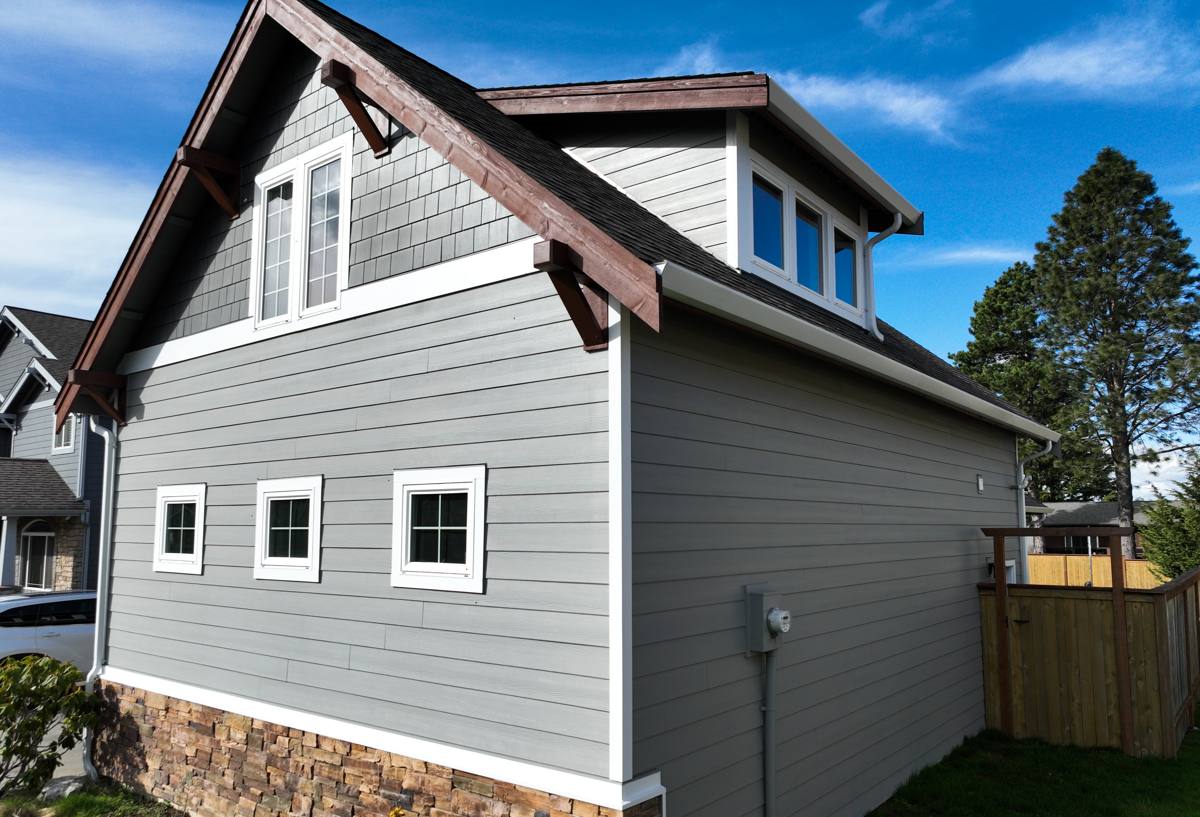
Fiber cement from James Hardie is engineered specifically to resist the kind of moisture cycling that Whatcom County throws at a house year after year. It doesn't absorb water the way wood-based products can, it doesn't require the same repainting cycle vinyl and some composite products eventually push you into, and it's non-combustible — a real consideration anywhere in the Pacific Northwest given how wildfire risk has crept west in recent years.
James Hardie also builds its siding in climate-specific formulations. For the Pacific Northwest, that's the HZ5 product line, engineered for regions with damp, temperate conditions and freeze-thaw cycling rather than the hot, humid HZ10 formulation used in the Gulf Coast and Southeast. That distinction isn't marketing — it affects how the product is manufactured to perform in exactly the conditions Geneva sees most of the year.
We're not going to tell you every other siding product is bad. Vinyl, engineered wood products like LP SmartSide, and other fiber cement brands all have a place in the market, and each has real strengths. But we've made a professional call to install one product because we believe it holds up best, longest, with the least maintenance burden, in this specific climate — and because standardizing lets our crews install it correctly every time instead of switching techniques and details from job to job.
What That Means in Practice
| Factor | What Matters Here |
|---|---|
| Moisture exposure | Fiber cement doesn't swell, rot, or delaminate the way wood-based sidings can when repeatedly wet |
| Finish durability | ColorPlus factory-baked finish resists fading and holds up to UV and moisture better than field-applied paint |
| Fire exposure | Non-combustible material, relevant given regional wildfire seasons |
| Long-term maintenance | No re-caulking or repainting on the cycle vinyl or wood siding typically requires |
| Warranty | Manufacturer-backed, transferable warranty on both the substrate and factory finish |
Siding, Roofing, Windows, and Decks — Why We Treat Them as One System
A house doesn't fail at the siding alone. Water gets in at transitions — where siding meets trim, where a deck ledger board attaches to the wall, where window flashing was cut short, where a roof edge dumps water straight down a wall instead of away from it. We handle siding, roofing, windows, and decks because those four systems have to work together to actually keep water out, and a crew that only touches one of them is guessing at how their work interacts with the rest.
On a Geneva-area project, that usually means:
- Siding: Full tear-off and Hardie install, or targeted replacement if only specific elevations are compromised.
- Roofing: Making sure roof edges, valleys, and any transitions above siding are shedding water away from the wall assembly, not into it.
- Windows: Correct flashing integration at every window opening — this is one of the most common failure points we find on older homes out here.
- Decks: Proper ledger flashing and separation from the house wall, since a poorly flashed deck attachment is a direct path for water into the structure.
You don't need all four done at once. Plenty of our work is a single-scope siding job. But when we're on a property, we're looking at the whole exterior envelope, not just the panels going up.
What a Siding Project Looks Like Here
Assessment
We start by looking at what's actually happening on your home — moisture damage, moss buildup, failing caulk lines, soft spots around windows and deck attachments. On older homes in shaded, damp lots, we're often finding problems that go deeper than the surface material, and it's better to know that before a bid gets written than after demo starts.
Removal and Sheathing Check
Once old siding comes off, we check the sheathing and weather barrier underneath. This is the point where hidden rot or moisture damage — common on homes that have carried failing siding for years in a wet climate — actually gets found and addressed, rather than covered back over.
Weather Barrier and Flashing
Given how much of the damage in this climate happens at seams and penetrations, correct house wrap, flashing tape, and window/door flashing integration matter as much as the siding itself. This is also where installer experience shows — Hardie siding installed to spec performs very differently than the same product installed with shortcuts at the details.
Installation
Hardie panels, lap siding, or shingle-style siding go up per manufacturer specification — correct fastening, clearances, and joint treatment. Given the moss and algae pressure in this area, we also pay attention to ground clearance and drainage planes so the new siding has a chance to dry out between wet stretches rather than staying saturated.
Finish Details
Trim, corners, and any transitions to roofing or window systems get finished so water sheds away from the wall at every junction, not just across the flat field of siding.
Maintenance in a Wet, Shaded Climate
Fiber cement is low-maintenance, not no-maintenance. In an area like Geneva with heavy tree cover and long damp seasons, a little seasonal attention goes a long way:
- Rinse siding periodically to keep moss, algae, and organic buildup from establishing, especially on shaded, north-facing walls
- Keep gutters clear so overflow isn't running down the siding face during heavy rain
- Trim back vegetation and tree limbs that keep siding sections shaded and slow to dry
- Check and refresh caulking at trim joints and penetrations every few years
- Have flashing at windows, deck ledgers, and roof-to-wall transitions inspected periodically, since these are the points most likely to fail first
Why a Local Crew Matters
Whatcom County's microclimates aren't uniform. A house tucked into the trees near Lake Whatcom dries differently than one on an open, wind-exposed lot. A crew that works this area regularly recognizes those differences and builds accordingly — correct clearances, correct flashing details, correct expectations about how long a wall assembly needs to dry before it's closed back up. That local knowledge is hard to substitute with a generic install approach.
Cost Factors to Expect
| Factor | How It Affects Scope |
|---|---|
| Home size and elevation count | More wall area and cut lines (dormers, bump-outs) increase labor |
| Existing siding condition | Hidden sheathing repair adds cost but is essential, not optional, once found |
| Siding profile chosen | Lap, panel, and shingle-style Hardie products carry different material and labor costs |
| Trim and detail work | Corner boards, window trim, and transitions add finish labor |
| Access and site conditions | Tree cover, slope, and staging access affect scheduling and labor time |
If your home in Geneva or the wider Sudden Valley area is due for new siding, or you're dealing with moss, moisture damage, or aging exterior materials, we're happy to come take a look. A free, no-pressure estimate gets you a straight assessment of what's actually going on and what it would take to fix it right — no obligation either way.