 Sudden Valley
 Exterior Work Built for Silver Beach's Climate
Silver Beach sits in the part of Whatcom County where Pacific weather systems roll in off the water and settle into the hills for days at a time. Homes here deal with a lot more than "it rains a lot in Washington." They deal with moisture-laden marine air that moves through the region, wind-driven rain that gets pushed sideways into wall assemblies, and a moss and algae season that can run nine months out of the year on north-facing walls and shaded siding. Add the tree cover common to this part of Whatcom County, and you get exterior surfaces that rarely get a chance to fully dry out between storms.
That combination is hard on a house. It's especially hard on the exterior cladding, since siding is the first line of defense against every one of those conditions, year after year, for decades. We work on homes throughout Sudden Valley and the surrounding Silver Beach area, and the siding failures we get called out for follow a pattern: moisture that got behind the material, finishes that couldn't keep up with the humidity, or products that were never really engineered for a climate like this one.
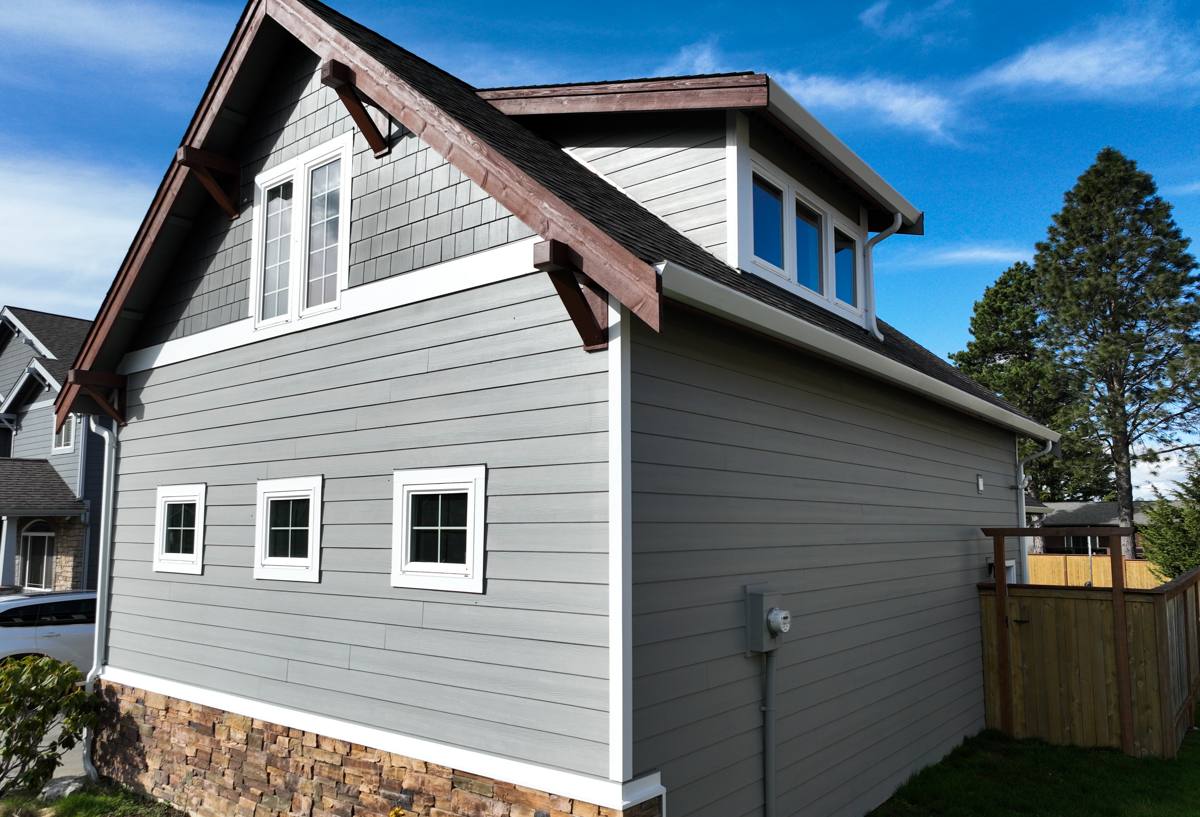
What the Local Climate Does to Siding Over Time
Persistent Moisture
Whatcom County doesn't get the heaviest rainfall totals in the state, but it gets a lot of low-intensity, long-duration rain and fog, plus damp marine air moving through even on days without rain. Siding here spends more of the year wet than dry. Any material that absorbs water, swells, or delaminates when saturated is going to struggle in that environment.
Wind-Driven Rain
Storms coming through this part of the county often carry enough wind to push rain into seams, laps, and butt joints rather than letting it run straight down the wall. Siding systems and installation details that aren't built to shed water under those conditions are more likely to let moisture behind the cladding, where it can sit against sheathing and framing unseen.
Moss, Algae, and Shade
Silver Beach's tree cover and lake-adjacent humidity create ideal conditions for moss and algae growth on siding, especially on north- and east-facing walls that don't get much direct sun. Some siding materials and finishes resist this better than others. Porous or unfinished surfaces give moss more to grab onto, and repeated cleaning to remove growth can wear down a weak factory finish faster than it should.
Comparing Siding Materials for This Climate
Homeowners in the Silver Beach and Sudden Valley area typically compare a handful of materials when it's time to re-side. Here's an honest breakdown of how they hold up against the conditions described above.
| Material | Moisture Behavior | Moss/Algae Resistance | Maintenance | Typical Lifespan |
|---|---|---|---|---|
| Vinyl | Doesn't absorb water itself, but seams and gaps can let moisture behind it; can warp in sustained damp-cold cycles | Moderate; smooth surface but seams collect grime | Low, but color fades and can't be repainted easily | 20-30 years, shorter with impact damage or fading |
| Primed Spruce/Cedar | Absorbs water readily if finish fails; prone to rot in shaded, damp areas | Poor without frequent treatment | High — repainting and caulking every few years | 10-20 years depending on upkeep |
| LP SmartSide (engineered wood) | Resin-treated but still wood-based; edges vulnerable if cuts/joints aren't sealed correctly | Moderate | Moderate — finish and caulking need monitoring | 20-30 years with strict install/maintenance compliance |
| James Hardie Fiber Cement | Cement-based, dimensionally stable, doesn't rot or swell from moisture | Strong, especially with ColorPlus factory finish | Low — occasional wash, no repainting for years | 30-50+ years with proper installation |
This is why our company made a deliberate decision: we install James Hardie fiber cement exclusively. Not because every other product is worthless, but because after years of exterior work in this climate, Hardie is the one system that consistently holds up to Whatcom County conditions with the least amount of long-term risk to the homeowner.
Why We Don't Install Vinyl, LP SmartSide, or Wood Siding
Vinyl siding is affordable and low-maintenance in the sense that it doesn't need painting, but it's a thin material that relies heavily on correct installation to keep water out at seams and penetrations. In a climate with this much wind-driven rain, any installation shortcuts show up years later as trapped moisture behind the panels — and by the time it's visible, there's often sheathing damage underneath.
Engineered wood products like LP SmartSide perform reasonably well when installed exactly to spec and maintained diligently, but they're still wood-based at their core. Cut edges, fastener penetrations, and butt joints all need to stay sealed for the life of the product, and in a climate where siding rarely fully dries out, that margin for error is thinner than we're willing to build a reputation on.
Primed spruce and unfinished cedar are the most demanding of all. They look good going up, but they depend entirely on paint and caulk staying intact, and repainting on a schedule that most homeowners don't keep up with. In a shaded, moss-prone area like Silver Beach, that maintenance gap turns into rot faster than most people expect.
We'd rather stand behind one product system we trust completely than install several and hope each one gets maintained the way it needs to be.
Why James Hardie Fits This Region
James Hardie fiber cement siding is engineered specifically to handle the kind of climate Whatcom County has — the company even makes a version of its product, the HZ5 line, formulated for cold, wet, freeze-thaw regions like the Pacific Northwest. A few reasons it holds up where other materials struggle:
- Fiber cement is non-combustible and dimensionally stable — it doesn't swell, warp, or rot from repeated wetting the way wood-based products can
- The ColorPlus factory finish is baked on under controlled conditions, so it resists fading, chipping, and moss adhesion far better than field-applied paint
- Hardie's warranty is a strong, transferable manufacturer warranty, which matters if you sell the home before the siding's functional life is up
- Proven long-term performance in coastal and marine-influenced climates similar to this one
None of that replaces good installation. Even the best siding product fails early if it's hung wrong — and that's the other half of what we control.
What Correct Installation Actually Involves
Water Management Behind the Siding
Proper installation starts with a correctly detailed weather-resistive barrier, flashing at every window, door, and penetration, and rainscreen or drainage gap where conditions call for it. In a climate that gets this much sustained moisture, the assembly behind the siding matters as much as the siding itself.
Fastening and Gapping to Spec
James Hardie publishes specific fastener patterns, gapping requirements, and clearances from grade, decks, and roof lines. Skipping these details is one of the most common causes of premature siding failure we see when we're called to look at other contractors' work — problems that are entirely avoidable with a crew that installs Hardie to spec every time, not occasionally.
Caulking and Joint Treatment
Butt joints and trim intersections need to be treated correctly to shed water rather than trap it. This is a small detail that has an outsized effect on how the siding performs ten and twenty years down the road, especially on shaded walls where moisture lingers longer.
Full Exterior Protection: Roofing, Windows, and Decks
Siding doesn't work in isolation. A home's exterior is a system, and in a climate like Silver Beach's, the roof, windows, and any exterior decking all interact with how well the walls stay dry.
- Roofing: A roof that's aging, poorly flashed, or losing granules sends more water down the walls and into places siding can't compensate for
- Windows: Failing window flashing or old, leaky window units are one of the most common sources of hidden water intrusion behind otherwise sound siding
- Decks: Ledger board connections and deck-to-wall transitions are frequent trouble spots for water intrusion if not properly flashed
We handle all four — siding, roofing, windows, and decks — because addressing them together, rather than in isolation, is how you actually protect a home in this climate long-term.
Signs Your Siding May Need Attention
A lot of siding problems in the Silver Beach and Sudden Valley area develop slowly and aren't obvious until they're serious. Worth checking for:
- Persistent moss or algae growth that comes back quickly after cleaning
- Soft spots, especially near the bottom of walls or below windows
- Visible warping, cupping, or separation at seams and joints
- Peeling or bubbling paint, particularly on wood or engineered wood siding
- Water stains or discoloration on interior walls near exterior corners
- Gaps opening up around trim, window frames, or corner boards
Any one of these is worth a look before it turns into a sheathing or framing repair.
Why a Local Crew Matters
Silver Beach and Sudden Valley have their own microclimate quirks within Whatcom County — tree cover, shaded lots, and proximity to the water all affect how a given house dries out after a storm. A crew that works this area regularly knows which walls tend to hold moisture, which details fail first on local homes, and how to sequence a project around the region's weather windows rather than fighting them. That local knowledge shows up in fewer callbacks and siding that performs the way it's supposed to for decades, not just the first few years.
If you're weighing your options for siding, roofing, windows, or decks on a home in Silver Beach, we're happy to take a look and talk through what we see — no pressure, no obligation. Reach out for a free estimate using the form below.