 Sudden Valley
 One Product, One Standard
Homeowners sometimes ask why we don't offer a menu of siding options the way some contractors do. The honest answer is that we made a decision years ago to install one siding system — James Hardie fiber cement — and we've stuck with it because it's the product that holds up best against what Whatcom County weather actually does to a house. That's not a marketing angle. It's a standard we apply to every job, whether it's a small repair section or a full re-side.
Fiber cement isn't the cheapest siding material on the market, and it isn't the lightest or the easiest to install. But when you're the crew responsible for what's on the wall in ten or twenty years, those trade-offs stop being abstract. We'd rather install fewer products correctly than install several products and hope they all age well.
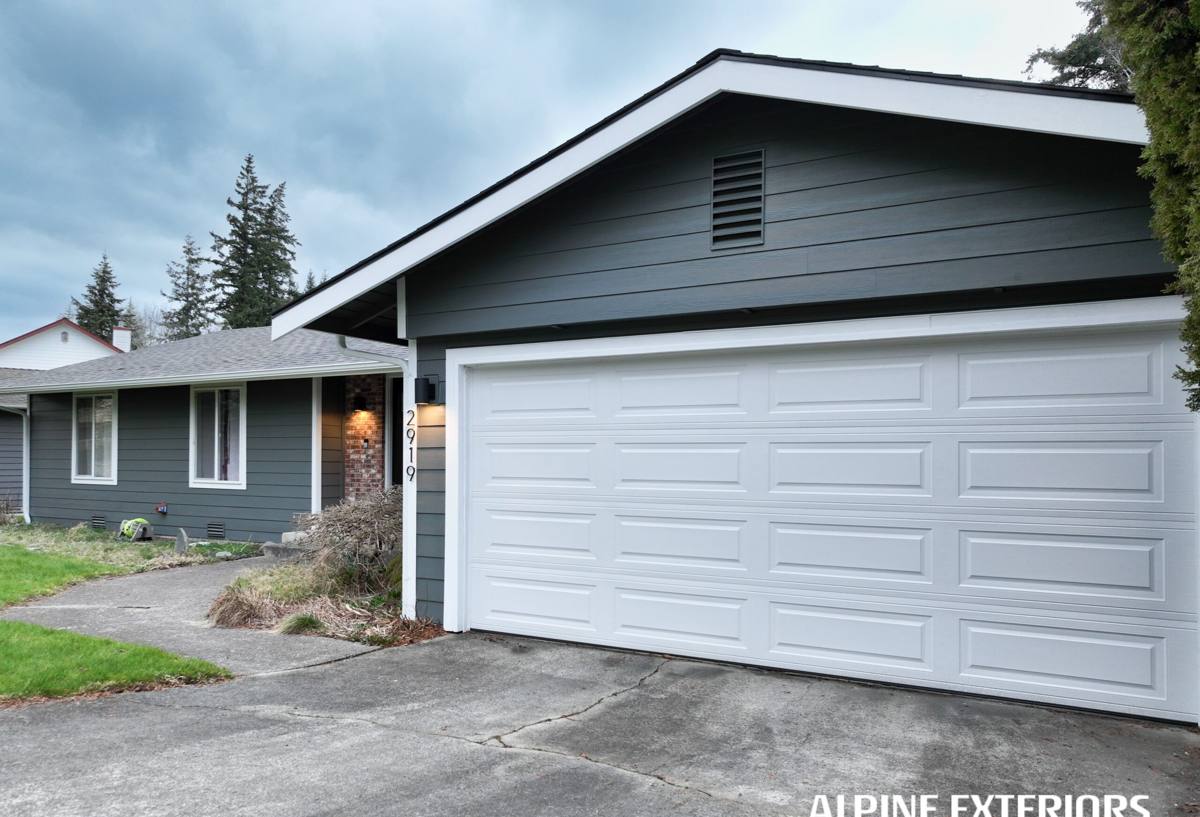
What Sudden Valley's Climate Does to Siding
Sudden Valley sits on Lake Whatcom, and homes here deal with a specific combination of conditions: persistent moisture off the lake and Puget Sound air, driving rain that comes in sideways during fall and winter storms, and long stretches of shaded, damp weather that grow moss and algae on anything that holds surface water. That combination is hard on siding in a way that's easy to underestimate until you've seen it happen over a decade.
Wood-based products swell, check, and eventually rot where moisture gets trapped. Vinyl can hold up structurally but shows its age in fading and warping. Anything with a field-applied paint finish is only as good as that paint job, and paint doesn't last forever in a climate this wet. We chose a product engineered specifically to resist moisture intrusion, because in Whatcom County, moisture is the variable that eventually wins if the material or the installation gives it an opening.
What Fiber Cement Actually Is
James Hardie siding is made from cement, sand, and cellulose fiber, cured into rigid boards and panels. It isn't wood, and it isn't plastic — it's a composite that behaves more like masonry than either of those materials. That composition is the reason it doesn't rot, doesn't attract wood-boring insects, and doesn't ignite the way wood-based siding can. It also doesn't expand and contract with humidity the way wood does, which matters a lot in a climate that swings from soaked to dry and back again through the year.
None of that means fiber cement is indestructible or maintenance-free. It still needs to be installed with the right clearances, fastened correctly, and caulked and painted where the manufacturer specifies. But the base material itself isn't the weak point the way it can be with other products — the weak point is workmanship, which is something a homeowner can actually control by hiring carefully.
Why Non-Combustibility Matters Here
Fiber cement siding is non-combustible, which is a real factor for homes near wooded areas — and much of Sudden Valley backs up to forested slopes around the lake. It won't contribute fuel to an exterior fire the way wood siding can, and some insurance carriers recognize that in how they price coverage on homes with fiber cement exteriors. We're not going to promise a specific insurance discount, since that depends on your carrier, but it's worth asking your agent directly.
The James Hardie Product Lines We Install
James Hardie makes several distinct siding profiles, and we select among them based on the style of the house and the look the homeowner wants — not based on price shortcuts. The table below covers the lines we use most often.
| Product Line | Look | Best Fit |
|---|---|---|
| HardiePlank | Traditional horizontal lap siding | Most common choice; wide range of exposure widths and textures |
| HardieShingle | Staggered or straight-edge shingle panels | Craftsman and cottage-style homes, accent gables |
| HardiePanel | Large-format vertical panels | Modern builds, board-and-batten look with batten strips |
| HardieTrim | Fascia, corner boards, window trim | Used alongside any of the above for a finished edge |
Every one of these is manufactured in Hardie's HZ5 climate configuration for our region — a formulation engineered specifically for areas with freeze-thaw cycles and sustained moisture exposure, which describes Whatcom County well. Homes in warmer, drier climates get a different HZ formulation. That regional engineering is one of the concrete reasons we trust the product here rather than treating siding as one-size-fits-all.
ColorPlus: The Finish Is Part of the System
One of the biggest differences between James Hardie and primed products that need field painting is the finish. ColorPlus is a multi-coat color baked onto the siding at the factory under controlled conditions, before it ever reaches the job site. That's a meaningfully different process than painting boards after they're nailed to a wall, where weather, temperature, and the painter's technique all affect how long the finish lasts.
A factory finish also means color consistency across every board on the house, and it comes backed by its own separate finish warranty from Hardie, distinct from the product warranty. In a climate where exterior paint jobs on other materials often need touch-up within five to eight years, a factory-cured finish is one less maintenance cycle a homeowner has to plan for.
- Choose ColorPlus for a factory-applied, warrantied finish with no field painting required at install
- Choose primed Hardie boards only if you specifically want a custom field-applied paint color — this shifts finish durability onto the paint job itself
- Either way, caulking and touch-up at cut ends and seams still needs to be done to spec during installation
The Warranty, and What It Actually Covers
James Hardie backs its siding with a 30-year, non-prorated limited warranty on the substrate, and a separate warranty on ColorPlus finishes. Non-prorated matters — it means the coverage doesn't shrink as the product ages the way some prorated warranties do. The warranty is also transferable to a subsequent homeowner within the coverage period, which is a real factor if you plan to sell the house at any point before the warranty term ends.
What a manufacturer warranty doesn't cover is installation error. That's why the warranty language ties coverage to installation performed according to Hardie's published specifications. This is the practical reason installation quality isn't a side issue with this product — get it wrong and you can void the coverage you're paying for, regardless of how good the siding itself is.
What Correct Installation Actually Involves
We bring up installation this much because it's genuinely the difference between fiber cement siding that lasts thirty-plus years and fiber cement siding that fails early for reasons that have nothing to do with the material. Here's what we hold every job to:
- Minimum ground clearance and roof-line clearance per Hardie's specifications, to keep splashback and roof runoff off the bottom courses
- Correct fastener type, length, and placement — over-driven or under-driven nails are one of the most common causes of early failure
- Proper flashing and weather-resistant barrier behind the siding, not just caulk at the surface
- Correct panel and lap overlap so water sheds outward instead of tracking behind the board
- Sealing and painting cut ends on-site, since factory finish doesn't extend to field cuts
- Adequate gaps at butt joints and penetrations to allow for the material's minor seasonal movement
Any contractor can hang fiber cement boards on a wall. Whether it performs the way Hardie's engineering and warranty assume depends entirely on whether these details were followed, which is why we treat installation spec as non-negotiable rather than a place to move faster.
Cost Factors Worth Understanding
We're not going to quote prices here, since every house is different, but these are the factors that actually move the cost of a fiber cement job up or down, and they're worth understanding before you start collecting bids.
| Factor | Why It Matters |
|---|---|
| Existing siding removal | Tear-off and disposal of old material adds labor beyond the new install |
| Wall sheathing condition | Rot or damage found underneath old siding needs repair before new siding goes on |
| Product line and profile | Shingle and panel styles generally run more labor-intensive than standard lap |
| ColorPlus vs. primed | Primed boards cost less up front but add a field-painting expense |
| House complexity | Dormers, multiple gables, and cutouts add labor time regardless of material |
Because we only install one product line, our estimates are straightforward comparisons of scope and house complexity rather than a menu of material tiers — which tends to make the bidding process more transparent, not less.
Why We Don't Diversify Our Product Line
We get asked occasionally about installing vinyl, engineered wood siding, or other fiber cement brands, and we turn that work down. It's not that every other product on the market is without merit — it's that we've built our crews, our fastening schedules, our flashing details, and our warranty conversations around one system that we know performs in this climate when installed to spec. Splitting that expertise across multiple products means getting good at none of them, and that's a trade we're not willing to make on someone's house.
If you're weighing a re-side or new siding for a home in Sudden Valley or anywhere else in Whatcom County, we're happy to walk your house, look at what's there now, and talk through what a correctly installed James Hardie system would look like for your specific situation. Reach out for a free, no-pressure estimate using the form below.