 Sudden Valley
 Living on Lake Whatcom Means Living With Moisture
Homes around Sudden Valley sit in one of the wettest microclimates in Whatcom County. The lake itself adds humidity that lingers in the air well after a storm has passed, tree cover along the shoreline keeps siding shaded and slow to dry, and the marine air that moves inland off the Salish Sea brings a steady mix of moisture and salt-tinged wind. Add a long, mild fall-through-spring stretch where surfaces rarely get a real chance to dry out, and you have a recipe for exteriors that work hard year-round.
None of that is unique to any one street in Sudden Valley — it's the nature of building on a forested lake in this part of the Pacific Northwest. But it does mean the siding choice on a Lake Whatcom home matters more than it would in a drier inland town. Products that perform fine in Spokane or Yakima often struggle here, and the difference shows up as moss, swelling, soft spots, and paint failure within a handful of years instead of a couple decades.
What the Climate Does to Common Siding Materials
Wood-Based Products
Cedar, primed spruce trim, and engineered wood siding all rely on paint and sealant to keep water out. In a climate where surfaces stay damp for days at a stretch and get shaded by conifers much of the year, that paint film breaks down faster than the manufacturer's warranty assumes. Once moisture gets past the coating, wood-based products can swell, delaminate at cut edges, or invite rot — especially at ground-contact areas, deck ledger connections, and anywhere gutters overflow onto the wall.
Vinyl Siding
Vinyl doesn't rot, but it isn't a great match for a shaded, mossy lake property either. It doesn't hold paint well if a homeowner ever wants to change the color, it can warp under strong afternoon sun on south-facing walls, and the moss and algae that thrive in Sudden Valley's damp shade show up clearly against its glossy finish — meaning more frequent washing to keep the house looking cared for.
Fiber Cement
Fiber cement is cement, sand, and cellulose fiber — it doesn't feed mold or rot the way wood does, and it doesn't expand and contract with temperature swings the way vinyl does. That's why it's the product we standardize on for lake and forest properties like the ones around Sudden Valley.
Why We Only Install James Hardie
We install James Hardie fiber cement exclusively — not LP SmartSide, not vinyl, not Cemplank or Allura, not primed cedar or spruce. That's a deliberate standard, not a lack of options. Hardie's HardiePlank and HardiePanel lines are engineered specifically for climate zones like ours (the HZ5 formulation used in the Pacific Northwest), the ColorPlus factory finish is baked on rather than field-painted, and the product carries a strong transferable warranty backed by decades of real-world performance in wet, forested regions.
We're honest that fiber cement isn't the cheapest option up front, and it's heavier and more particular to install correctly than vinyl or wood panel siding. But for a home that sits under tree cover a few hundred feet from lake water, we'd rather install something engineered for exactly that environment than something that needs to be re-caulked, re-painted, or replaced twice as often.
How Moss and Algae Actually Affect Siding
Moss doesn't just look bad — it holds moisture directly against the siding surface, which is the opposite of what you want on a wall that's already shaded and slow to dry. On wood or wood-composite products, that trapped moisture accelerates rot at the exact spots moss tends to colonize: north-facing walls, areas under eaves with reduced airflow, and lower courses near landscaping.
Fiber cement doesn't stop moss from landing on it — nothing does, short of full sun exposure, which most Sudden Valley lots don't get — but because the material itself doesn't absorb and hold water the way wood fiber does, moss growth stays a cosmetic issue rather than a structural one. A periodic soft wash keeps it in check without risking the siding underneath.
Simple Moss and Moisture Checklist for Lake Whatcom Homes
- Keep gutters clear so overflow doesn't run down the wall behind the siding
- Trim back branches and shrubs that keep siding in permanent shade close to the house
- Soft-wash siding and roof surfaces annually rather than letting moss build up over multiple seasons
- Check caulking at window and door trim each fall before the wet season sets in
- Watch for soft or spongy spots at the base of walls and deck ledger connections — early signs of trapped moisture
- Have flashing above windows and at roof-to-wall intersections inspected periodically, since that's where most water intrusion actually starts
Beyond Siding: Roofing, Windows, and Decks
A Lake Whatcom exterior is a system, not just a wall covering. We handle roofing, windows, and decks alongside siding because they all interact with the same moisture and shade conditions:
Roofing
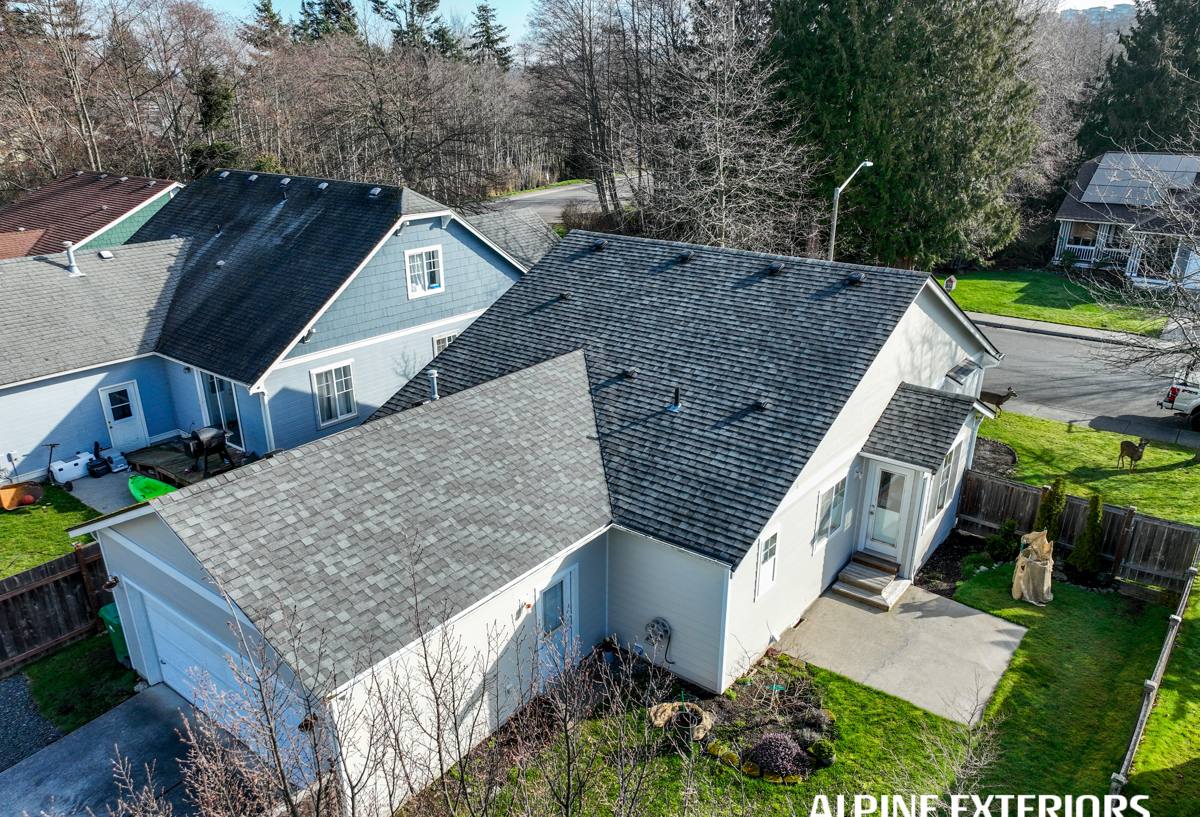
Moss on a roof does the same thing it does on siding — holds water against the surface and shortens the material's life. Roof condition also drives how water sheds onto and around your siding, so a roof that's shedding granules or holding moss puts extra strain on the walls below it.
Windows
Old or poorly flashed windows are one of the most common sources of hidden water intrusion in wet climates. When we replace siding, we check window flashing and trim details as part of the job, since re-siding around a leaking window just buries the problem.
Decks
Lake properties tend to get more deck use than average, and the connection point where a deck ledger meets the house wall is a classic spot for water to collect if it wasn't flashed correctly the first time. We look at that detail whenever we're working on siding nearby.
What Correct Installation Looks Like in This Climate
Fiber cement performs the way it's supposed to only when it's installed to manufacturer spec. In a damp climate, the details that matter most are:
- Proper clearance between the bottom edge of siding and grade, decks, or roof lines
- Correct nailing pattern and fastener type to avoid callback issues down the road
- Rain-screen or drainage plane behind the siding so any moisture that does get past the surface can escape
- Sealed and properly lapped house wrap or weather-resistive barrier before the first course goes up
- Factory-cut, factory-finished edges used wherever possible, with field cuts properly sealed
Skipping any of these doesn't usually cause a visible problem in year one. It shows up in year five or ten, as moisture damage behind siding that looked fine from the curb. That's a big part of why we treat installation quality, not just the product itself, as the thing that actually determines how long an exterior lasts here.
Cost Factors for a Lake Whatcom Siding Project
| Factor | Why It Matters Here |
|---|---|
| Home access and lot slope | Many Sudden Valley lots have grade changes and mature trees that affect staging and scaffolding |
| Existing siding removal | Older wood or vinyl siding may reveal moisture damage that needs repair before new siding goes on |
| Trim and detail work | Homes with more window and roofline complexity take longer to flash and finish correctly |
| Siding profile chosen | Lap width and panel style affect material cost and labor time |
| Color and finish | Factory ColorPlus finishes cost more upfront than field-painted trim but avoid a repaint cycle |
| Scope beyond siding | Bundling roofing, window, or deck work into the same project can reduce overall disruption and cost |
Why a Local Crew Matters for This Neighborhood
Sudden Valley isn't a typical suburban subdivision — narrower access roads, tree-lined lots, and homes built into sloped terrain around the lake all affect how a siding job gets staged and executed. A crew that regularly works Whatcom County properties knows to plan around those conditions instead of running into them mid-project. Local experience also means knowing which details actually matter for lake-adjacent, forest-shaded homes versus a generic install approach that assumes a drier, sunnier site.
We're also the crew that shows up if something needs attention after the fact. A transferable Hardie warranty is only as good as the installer standing behind the work, and being local to the area means we're not disappearing after the final walkthrough.
Get a Free Estimate
If your Sudden Valley or Lake Whatcom home has siding showing its age — moss buildup, soft spots, peeling paint, or gaps at the trim — we're happy to take a look and give you an honest assessment of what's going on and what it would take to fix it right. The estimate is free, there's no pressure, and we'll tell you plainly whether you need a full re-side or just targeted repairs. Use the form below to get started.