 Sudden Valley
 Siding in Sehome: A Neighborhood With Its Own Weather Problems
Sehome sits close enough to Bellingham Bay that salt-laden air is a regular part of the weather, but far enough into the hills that homes also catch heavy wind-driven rain rolling in off the water. That combination — salt exposure plus near-constant moisture for much of the year — is harder on exterior materials than either factor would be on its own. Add in the shaded, damp conditions that let moss and algae take hold on north-facing walls and rooflines, and you've got a neighborhood where the wrong siding choice shows its age fast.
We work throughout Whatcom County, and Sehome comes up often because it has a genuine mix of housing stock: older homes with original wood or aging composite siding, and newer builds where the original materials are already showing water staining, panel swelling, or moss streaking well before they should. This page is about what that climate actually does to a house, and how we approach siding, roofing, windows, and decks for homes in this part of the county.
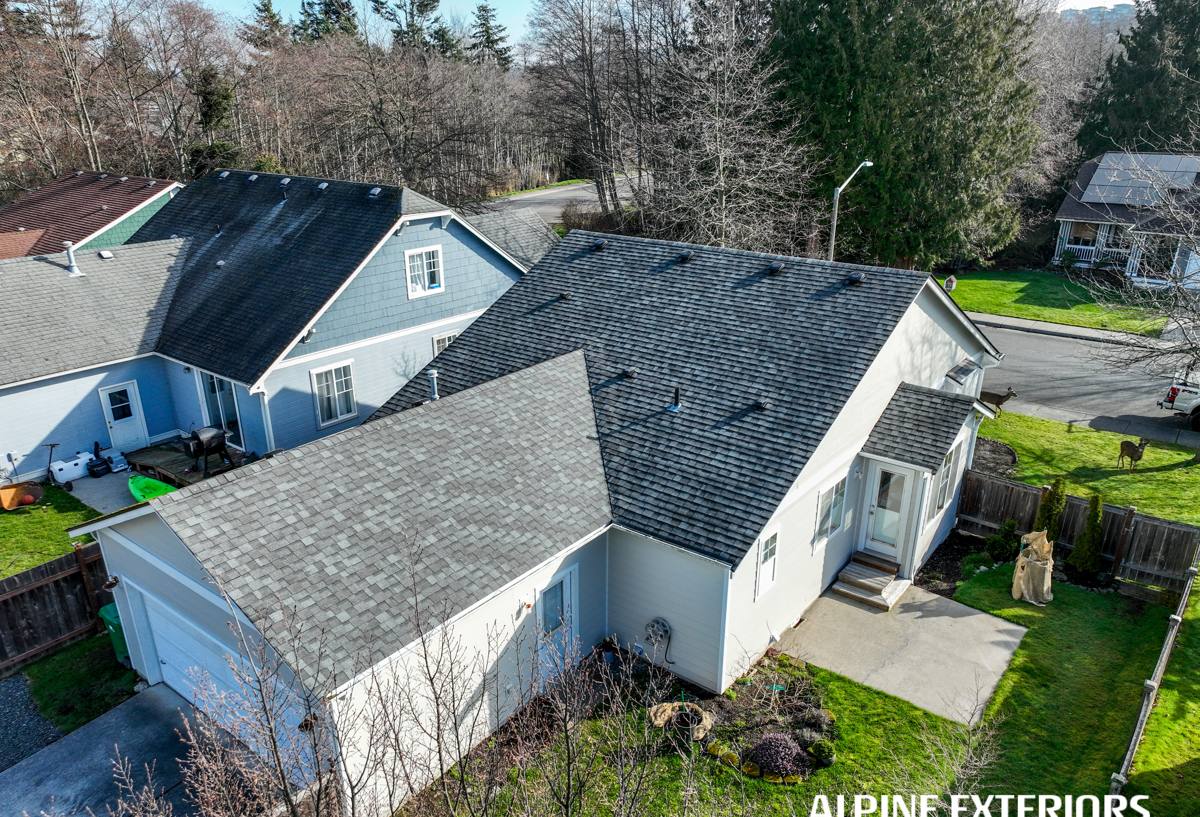
What Salt Air and Driving Rain Do to Exterior Materials
Coastal and near-coastal air in Whatcom County carries fine salt particulate that settles on exterior surfaces. On its own, that's mostly a cosmetic issue — a light film that rinses off. The real damage happens when salt air combines with moisture that doesn't dry out quickly, which is exactly the pattern here for much of the fall, winter, and spring.
Why Driving Rain Matters More Than Total Rainfall
It's not just how much rain falls — it's how it hits the house. Wind-driven rain pushes water sideways into laps, seams, and butt joints instead of letting it run straight down and off. Siding that isn't detailed correctly at those joints, or that absorbs water instead of shedding it, ends up staying wet for days at a time. That's the condition that causes swelling, delamination, and paint failure on materials that aren't built for it.
Moss Season Isn't Just a Roof Problem
Most homeowners think of moss as a roofing issue, and it is — but it also colonizes siding, especially on shaded elevations and under eaves where airflow is limited. Moss and algae hold moisture directly against the wall surface, which extends the amount of time that surface stays wet. On materials that are already moisture-sensitive, that's a slow but steady path to rot, mold, and paint failure.
How Different Siding Materials Hold Up in This Climate
We get asked a lot why we don't install every product on the market. The honest answer is that we've standardized on one — James Hardie fiber cement — because of how it performs specifically in conditions like Sehome's. Here's a straightforward comparison of how common siding materials handle salt air, driving rain, and moss exposure.
| Material | Moisture Behavior | Salt Air Exposure | Moss/Algae Resistance |
|---|---|---|---|
| Vinyl | Doesn't absorb water, but panels can warp and gap, letting water behind the cladding | Can fade and become brittle over time in coastal air | Provides no resistance on its own; growth sits on the surface |
| Primed spruce / cedar | Absorbs moisture readily; prone to swelling, cupping, and rot at joints | Salt accelerates finish breakdown and checking | Organic material is a food source for moss and mildew |
| LP SmartSide | Engineered wood strand product; edges and cut ends are vulnerable if not fully sealed and maintained | Coatings can wear faster in salt-heavy air, exposing substrate | Requires diligent maintenance to prevent moisture intrusion at seams |
| James Hardie fiber cement | Non-combustible cement composite; engineered for moisture and climate performance | Factory ColorPlus finish is formulated to resist coastal fading and wear | Doesn't feed organic growth the way wood-based products do |
None of the alternatives are "bad" products in every setting — vinyl and engineered wood siding have their place in drier, more sheltered climates. But in a neighborhood that deals with salt air, driving rain, and a long moss season every year, the maintenance burden and failure points on those materials show up faster and cost more to manage over the life of the siding.
Why We Only Install James Hardie Fiber Cement
James Hardie's HZ product lines are climate-engineered — there's a version formulated for the Pacific Northwest's wetter, cooler conditions, as opposed to the version sold in the hot, dry Southwest. That distinction matters more than most homeowners realize. A siding product built for a desert climate isn't the same product performance-wise as one built for coastal Washington, even if they look identical on a sample board.
ColorPlus Factory Finish
Instead of field-applied paint, Hardie's ColorPlus finish is baked on at the factory under controlled conditions, which gives a more consistent, durable topcoat than paint applied on-site in variable weather. That matters in a climate where field-applied finishes don't always get the dry cure time they need between rain events.
Non-Combustible, Not Organic
Fiber cement is not a food source for moss, algae, or insects the way wood-based products are. It doesn't mean a wall never needs a gentle wash, but it removes the moisture-and-organic-material combination that drives rot on traditional wood and engineered wood siding.
Warranty Backing
Hardie backs its siding with a strong, transferable limited warranty when the product is installed to spec. That's a meaningful detail if you ever sell the home — a warranty that follows the house, not just the original owner, is worth something to a buyer's inspector.
It's Not Just Siding — The Whole Exterior Faces the Same Weather
Siding doesn't work in isolation. The roof, windows, and any exterior structures like decks are all exposed to the same salt air, driving rain, and moss conditions, and they all interact with each other. A roof that sheds water poorly will overload the siding and trim below it. Windows with failed flashing will feed water directly into wall cavities no matter how good the siding is. We handle all four — siding, roofing, windows, and decks — because treating them as one connected system is the only way to actually keep water out of a house in this climate.
Roofing
Moss growth on roofing shingles is one of the most common calls we get from homeowners in this part of Whatcom County. Beyond moss, wind-driven rain finds its way under poorly sealed flashing at valleys, chimneys, and roof-to-wall transitions — exactly the details that matter most in a driving-rain climate.
Windows
Window flashing and integration with the surrounding siding is one of the most common sources of hidden water damage we find when we open up a wall. It's also one of the easiest things to get wrong if it's not done deliberately.
Decks
Exterior decks take direct rain and stay damp longer in shaded yards, which is common in a hillier neighborhood like this one. Material choice and proper drainage/fastening details matter just as much here as they do on the walls of the house.
What Correct Installation Actually Involves
Fiber cement siding is only as good as its installation. Hardie's own product performance depends on details that are easy to skip if a crew is moving fast or unfamiliar with the product.
- Proper starter strip and clearance at the foundation to keep the bottom edge of siding away from standing water and splashback
- Correct fastener type, spacing, and placement — under- or over-driven fasteners are a common source of early failure
- Weather-resistive barrier and flashing integration at every window, door, and penetration, not just the field of the wall
- Properly caulked and painted cut edges, since exposed raw edges are more vulnerable to moisture intake
- Adequate clearance and drip edges at roof-to-wall intersections so runoff doesn't dump directly onto siding seams
- Rain screen or drainage plane detailing where called for, to let any incidental moisture behind the cladding dry out
None of these steps are exotic — they're standard best practice. But they take time and attention, and they're exactly the steps that get shortcut when a crew is unfamiliar with fiber cement or is treating it like any other lap siding installation.
Why a Local Crew Matters in a Neighborhood Like Sehome
A crew that works throughout Whatcom County regularly sees how homes here actually age — which elevations take the worst of the driving rain, where moss builds up fastest, and which older installation shortcuts tend to fail first. That's different knowledge than a crew that mostly works in a drier inland climate and treats every job the same way.
Local also means accountability. If a warranty issue comes up two, five, or ten years down the road, you want a contractor that's still in the area, still reachable, and still standing behind the work — not a crew that came through on a storm-chasing run and is long gone.
Questions Worth Asking Any Contractor
- Are you a licensed and insured contractor in Washington State, and can you provide proof?
- Who is the manufacturer-certified installer on my specific project, not just the company as a whole?
- What's your plan for flashing and moisture management at windows, doors, and roof lines — not just the field siding?
- What warranty applies to the material, and separately, what warranty do you provide on labor?
- Can you walk me through why you recommend one product over another for my specific home and exposure?
Cost Factors to Expect
Every home is different, so we won't quote fake numbers here — but these are the factors that actually move a siding, roofing, window, or deck project's cost up or down.
| Factor | Why It Matters |
|---|---|
| Home size and wall complexity | More corners, gables, and trim details mean more labor and material cuts |
| Existing siding removal | Tear-off and disposal of old material, plus any sheathing repair found underneath |
| Moisture damage discovered mid-project | Rotted sheathing or framing found once old siding comes off needs to be addressed before new siding goes on |
| Product line and finish selection | Different Hardie profiles, textures, and ColorPlus colors carry different material costs |
| Access and site conditions | Steep lots, limited staging area, or multi-story walls affect labor time and equipment needs |
The only way to get real numbers is a walk-through of the actual house, which is exactly what a free estimate is for.
Ready to Talk About Your Home in Sehome?
Whether it's siding showing water damage, a roof with moss you can't keep ahead of, windows that leak in a hard rain, or a deck that needs attention, we're happy to come take a look and give you an honest assessment — no pressure, no obligation. Use the form below to request a free estimate.