 Sudden Valley
 Two Very Different Answers to the Same Problem
Engineered wood siding and fiber cement siding are often shopping-listed together because they solve the same problem: give a house the look of traditional wood lap or panel siding without the cost and upkeep of solid wood. That's where the similarity ends. One is built from wood fiber, resins, and wax, then coated to resist moisture. The other is built from sand, cement, and cellulose fiber, cured into a material that doesn't behave like wood at all. In a place like Sudden Valley, sitting on Lake Whatcom with salt-laden air drifting in off Bellingham Bay, driving winter rain, and a moss season that can run half the year, that difference in how the material handles water is the whole ballgame.
We get asked fairly often why we don't offer both. The honest answer is that after years of installing and repairing siding in this specific climate, we stopped installing engineered wood products, including LP SmartSide, and standardized on James Hardie fiber cement. This page explains what engineered wood does well, where it runs into trouble here, and why we made the call we did.
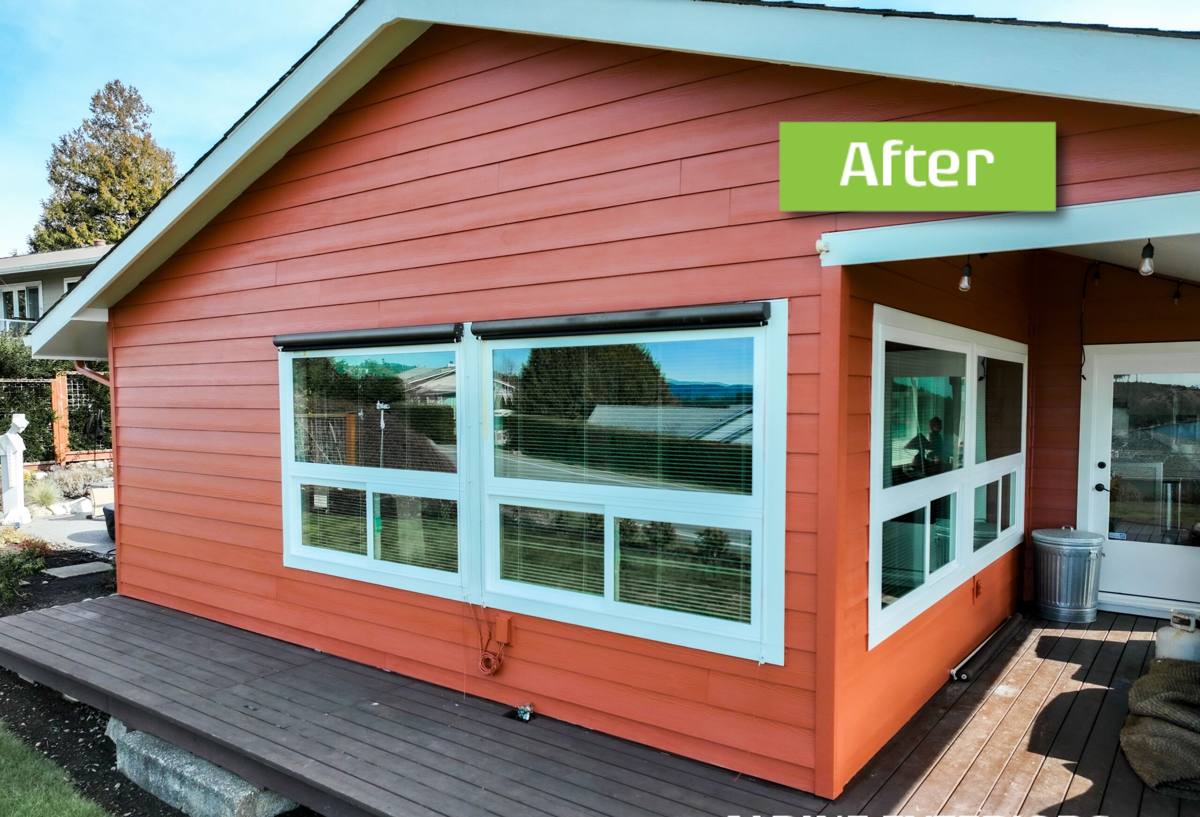
What Engineered Wood Siding Gets Right
It's worth being fair about this, because engineered wood is a legitimate, well-engineered product, not a corner-cutting one.
- Workability: It cuts, nails, and handles like wood, which keeps labor costs and install time down compared to fiber cement.
- Weight: It's significantly lighter than fiber cement, which matters on some retrofit and structural situations.
- Warmer appearance: Some homeowners prefer the texture and grain pattern of engineered wood's woodgrain finish over fiber cement's options.
- Upfront cost: Material and labor pricing typically comes in lower than a comparable fiber cement install.
If a house sat in a dry inland climate with moderate rainfall and no sustained moss pressure, engineered wood would be a reasonable, defensible choice for a lot of homeowners. That's not the house type most of our customers own.
Where the Trade-offs Show Up in This Climate
Salt air and coastal moisture
Whatcom County properties near Bellingham Bay and the Sudden Valley shoreline deal with a steady low-level salt aerosol that settles on exterior surfaces year-round. Salt is hygroscopic — it pulls moisture out of the air and holds it against whatever surface it lands on. Engineered wood's factory coating is designed to shed bulk water, but it isn't designed to fight a surface that stays perpetually damp from salt-drawn condensation. Over years, that steady dampness is exactly the condition wood-based products are most vulnerable to.
Driving rain and wind-driven wetting
Storms coming off the Strait of Georgia don't just fall straight down — wind pushes rain sideways into wall assemblies, seams, and cut edges. Any place the factory coating gets breached (a field cut, a nail hole, a scuff during install) becomes an entry point. Wood fiber that takes on water at an exposed edge can swell, and once that happens the coating's protection at that spot is compromised for good.
Moss season
Whatcom County's moss season isn't a two-week nuisance — shaded, north-facing walls under mature trees can carry moss and algae growth for much of the year. Moss doesn't just sit on the surface; it holds moisture directly against the siding face for extended periods, which raises the local moisture exposure of that section of wall well above the average rainfall numbers would suggest.
What this adds up to
None of this means engineered wood siding "fails" on a schedule. It means the product's long-term performance depends heavily on things outside the manufacturer's control — caulking maintenance, gutter and downspout function, moss removal, prompt repair of any coating damage. In a drier climate that maintenance margin is generous. Here, it's thinner, and the consequence of falling behind on it is moisture getting into the substrate itself.
How Fiber Cement Is Built Differently
James Hardie fiber cement is a cement-based composite, not a wood product. It doesn't have wood fiber's cellular structure, so it doesn't swell, rot, or provide the organic material that moss and mildew feed on the way wood-based substrates can. It's also non-combustible, which matters given wildfire-smoke seasons the Pacific Northwest has seen more of in recent years, and it holds up to freeze-thaw cycling without the expansion issues wood products face.
Hardie also engineers specific product lines for specific climates through its HardieZone system. HZ5 products, which cover the Pacific Northwest, are formulated for higher-moisture, freeze-thaw-prone regions — different from the HZ10 formulation used in hot, humid Southeastern climates. That's a meaningful distinction: the siding isn't a one-size-fits-all product, it's matched to the moisture load a region like Whatcom County actually sees.
ColorPlus factory finish
Most Hardie siding on the market goes on with a ColorPlus factory-applied finish rather than field-applied paint. The finish is baked on and cured before it ever reaches the jobsite, which gives a harder, more consistent coating than paint rolled or sprayed on site under variable weather. Field-applied paint depends on temperature, humidity, and cure time at install — none of which a factory line has to worry about.
Side-by-Side: What Actually Differs
| Factor | Engineered Wood (e.g., LP SmartSide) | James Hardie Fiber Cement |
|---|---|---|
| Base material | Wood strand/fiber with resin binders | Cement, sand, cellulose fiber |
| Moisture response | Coating-dependent; wood fiber can swell if breached | Non-organic; doesn't swell or rot |
| Combustibility | Combustible (wood-based) | Non-combustible |
| Finish options | Factory primed or pre-finished, paint typically field-applied over time | ColorPlus factory-baked finish or primed for paint |
| Climate-specific engineering | General product line | HardieZone HZ5/HZ10 formulations by region |
| Typical warranty | Manufacturer warranty, often shorter finish coverage | Long-term limited warranty, longer non-prorated ColorPlus finish coverage |
| Weight/handling | Lighter, faster to install | Heavier, more installation-sensitive |
| Upfront cost | Generally lower | Generally higher |
The table isn't meant to declare one product universally "better." It's meant to show where the real differences live: moisture behavior, combustibility, and how tightly the product is matched to a specific climate.
Installation Sensitivity Cuts Both Ways
Neither product is forgiving of a sloppy install, but the failure modes differ. Engineered wood that's poorly flashed or caulked lets moisture reach wood fiber that can then swell and degrade from the inside. Fiber cement that's poorly installed — wrong nail placement, insufficient gap at trim, joints not properly flashed — won't rot, but it can crack, or moisture can get trapped behind it and cause problems for the structure behind the siding rather than the siding itself.
This is exactly why we treat installation to manufacturer spec as non-negotiable rather than optional best-practice. Hardie publishes detailed installation requirements — clearances off grade, gaps at penetrations, fastener patterns, flashing details — and those specs exist because they're the difference between the material performing for decades and it failing early despite being the "right" product on paper.
Warranty and Long-Term Cost
Warranty terms change over time and should always be confirmed against current manufacturer documentation before a purchase decision, but the general structure is consistent: Hardie's fiber cement products carry a long-term limited warranty on the substrate, with separate coverage on the ColorPlus finish itself, and that coverage is transferable to a subsequent homeowner if the home sells — something buyers in this market do ask about. Engineered wood manufacturers offer their own warranties as well, but the coverage structure and terms differ, and it's worth reading the fine print on any product before treating "warrantied" as a blanket assurance.
The more practical long-term cost question is maintenance. Engineered wood siding generally needs more attentive upkeep in a wet, mossy climate — inspecting and resealing cut edges and joints, keeping moss and debris off the surface, repainting on a schedule as the finish ages. Fiber cement's ColorPlus finish is built to go longer between repaints, and the substrate underneath isn't at risk from the kind of moisture exposure that would concern us with a wood-based product.
Questions Worth Asking Before You Decide
- What is this product's actual moisture performance history in a Pacific Northwest coastal climate, not just a national average?
- Is the product formulated or rated differently for different climate zones, or is it one formulation nationwide?
- What does the warranty cover — substrate, finish, labor — and is it transferable if you sell the home?
- What's the manufacturer's required installation spec, and will the contractor commit to following it exactly?
- What's the realistic maintenance schedule — repainting, resealing, moss and algae treatment — and are you prepared to keep up with it?
- How does the material handle direct exposure on north-facing, shaded, or shoreline-facing walls specifically?
Why We Standardized on James Hardie
We didn't arrive at installing only James Hardie fiber cement as a marketing position. It came from watching how siding actually performs on homes around Lake Whatcom and the surrounding county over years of installs and repair calls — which walls held up under sustained moss and shade, which took damage from salt-driven moisture, and which needed the least intervention a decade in. Fiber cement, installed to spec, with a factory-cured finish and a formulation matched to this region's moisture load, has been the more consistent performer for the climate we actually work in. Refusing to install engineered wood isn't a judgment that it's a bad product everywhere — it's a decision that it isn't the product we want standing behind our name on a Sudden Valley roofline for the next thirty years.
If you're weighing siding materials for a home in Sudden Valley or elsewhere in Whatcom County, we're happy to walk the exterior with you, look at your specific exposure — shade, wind direction, proximity to the lake or bay — and give you a straight answer on what we'd recommend. Reach out for a free, no-pressure estimate using the form below.