 Sudden Valley
 Why Geneva's Siding Needs to Work Harder Than Most
Geneva sits close enough to Lake Whatcom and the broader Whatcom County weather pattern that siding here takes on a different kind of abuse than siding in a dry inland climate. Homes in this pocket of Sudden Valley deal with a near-constant mix of moist air off the water, driving rain that comes in sideways during fall and winter storms, and long stretches of shade and dampness that keep moss and algae established on north- and west-facing walls for much of the year. None of that is dramatic on its own, but stacked together over a decade or two, it's exactly the combination that finds every weak point in a siding system — every gap in caulking, every piece of trim that wasn't flashed correctly, every seam that was never meant to stay wet as long as it does here.
That's the backdrop for every siding decision a Geneva homeowner makes. It's not about picking a product that looks good on a sunny installation day — it's about picking one that still looks and performs the same way after ten winters of lake-effect moisture and moss season.
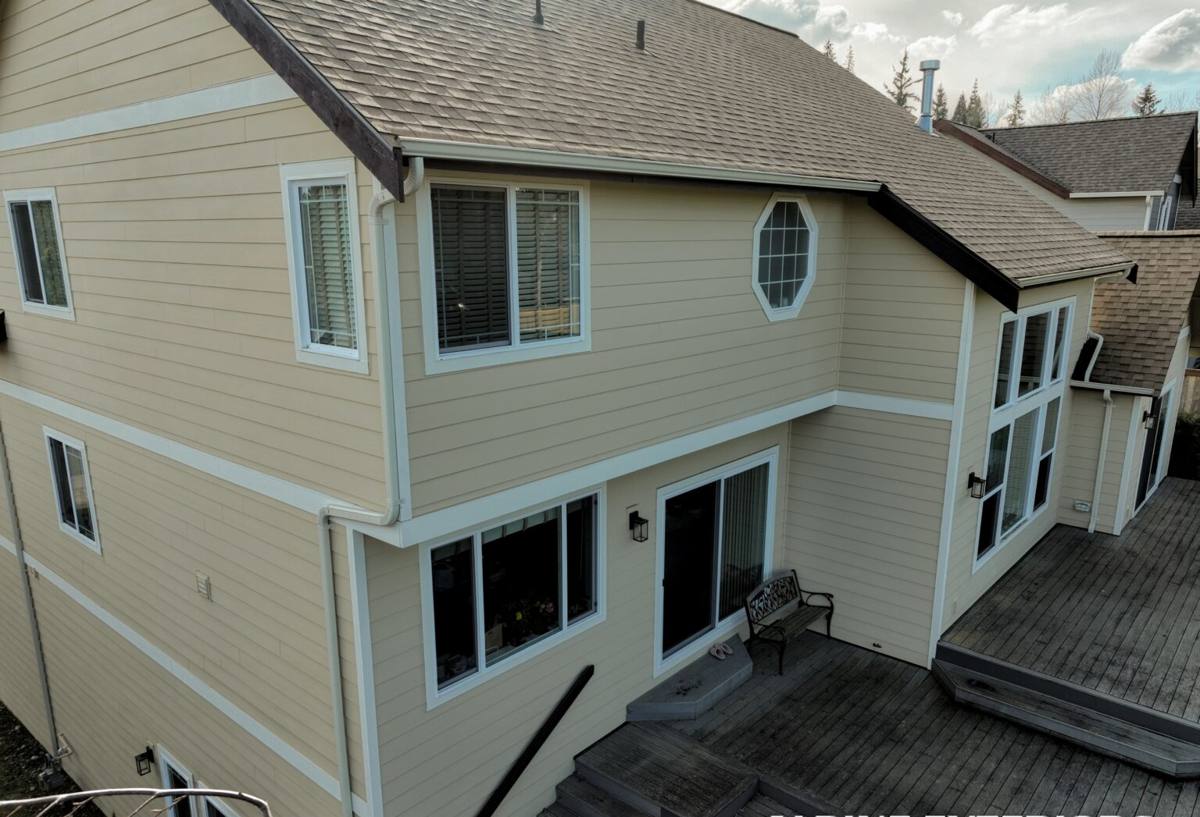
What "Correct" James Hardie Installation Actually Means Here
James Hardie fiber cement is engineered to handle wet climates, but the product only performs as designed when it's installed to spec. In a climate like Geneva's, the installation details matter more than they would somewhere dry, because any shortcut gets tested by real weather almost immediately.
The details that separate a correct install from a problem install
- Proper clearance between the bottom of the siding and grade, decks, and roof lines — Hardie's own guidelines call for minimum gaps that keep splash-back and standing moisture away from the board edges.
- Correctly lapped and sealed flashing at every window, door, and roof intersection, so driving rain has nowhere to work its way behind the cladding.
- Factory-cut and factory-primed edges used wherever possible, with field cuts properly sealed — raw, unsealed fiber cement edges are the single most common place moisture gets a foothold.
- Fastener placement and spacing that match Hardie's published specs for the specific product and exposure — under- or over-driven nails compromise the water-shedding lap.
- Rain-screen or drainage-plane detailing behind the siding where the wall assembly calls for it, so any incidental moisture has somewhere to drain instead of sitting against the sheathing.
None of this is exotic. It's just attention to a product that was engineered specifically for wet, marine-influenced climates like this one — and it only pays off if every one of those steps is actually followed on install day, not just referenced in a brochure.
Moss, Algae, and Salt Air: The Three Things Geneva Siding Fights Every Year
Sudden Valley's tree cover and lake proximity mean shaded, damp wall sections are common, and those are exactly where moss and algae take hold. On wood-based sidings — cedar, primed spruce, and even some engineered wood products — that constant dampness feeds rot at the cellular level over time. Fiber cement doesn't feed mold or moss the way wood does, because there's no organic wood fiber on the surface for it to root into. That doesn't mean Geneva homes are maintenance-free; moss and algae can still grow on any exterior surface, including Hardie board, if it stays shaded and damp long enough. The difference is what happens underneath. On fiber cement, surface growth is a cleaning issue. On wood siding, it's often the first visible sign of moisture already working into the substrate.
Salt-tinged, moisture-heavy air also accelerates coating failure on anything that depends on a field-applied paint job for protection. This is one of the clearest advantages of James Hardie's ColorPlus finish: it's baked on at the factory under controlled conditions, with a UV-cured finish that's formulated to resist fading and hold adhesion far longer than a site-applied paint coat exposed to Whatcom County's damp, low-sun winters.
James Hardie Product Lines Suited to This Area
Not every Hardie product is used the same way on every wall, and matching the right line to the right exposure on a Geneva home is part of doing this correctly.
| Product | Typical Use | Why It Fits This Climate |
|---|---|---|
| HardiePlank lap siding | Primary wall cladding | Most common Hardie product for full-home coverage; engineered lap profile sheds driving rain effectively when installed with correct exposure |
| HardieShingle | Accent gables, dormers | Gives a cedar-shake look without the moisture uptake and moss-friendly texture of real wood shingles |
| HardiePanel | Board-and-batten accents, porch ceilings | Clean vertical lines for modern or farmhouse-style facades common in this area |
| HardieTrim | Corner boards, window/door trim | Non-combustible, dimensionally stable trim that won't cup or split the way painted wood trim does in constant damp conditions |
All of these are part of Hardie's HZ5 product engineering for the Pacific Northwest's freeze-thaw and high-moisture zone — the boards are formulated for this region's weather rather than a generic national spec.
What Drives Cost on a Geneva Siding Job
Every home is different, so real numbers only come from an on-site look. But the factors that move the price on a Geneva project are consistent enough to explain up front.
| Factor | Why It Matters Here |
|---|---|
| Existing wall condition | Rot or moisture damage found after removing old siding adds repair scope before new siding can go on |
| Home access and roof pitch | Sudden Valley's hillside and lakefront lots often mean more scaffolding or lift work than a flat-lot property |
| Trim and detail complexity | Gables, dormers, and multiple roof intersections mean more flashing and cut work per square foot |
| Product mix | Straight lap siding costs less per square foot than a mix of lap, shingle accents, and board-and-batten |
| Color and finish | Standard ColorPlus colors versus custom field-painted finishes affect both material and labor cost |
Our Process for a Geneva Job
1. Walk-through and assessment
We look at the whole wall system, not just the visible siding — flashing condition, trim, window details, and any signs of past moisture intrusion, which are common finds on older Sudden Valley homes given the climate.
2. Tear-off and sheathing check
Once old siding is off, we inspect the sheathing underneath. This is often the first real look anyone has had at that wall in years, and it's where hidden rot or past water damage gets caught and addressed before new siding goes on top of it.
3. Weather barrier and flashing
We install or repair the drainage plane and flash every penetration — windows, doors, hose bibs, light fixtures — before a single piece of Hardie board goes up.
4. Installation to Hardie spec
Fastener spacing, board clearances, and joint treatment follow James Hardie's published installation guidelines for this climate zone, not shortcuts.
5. Final detailing and walkthrough
Caulking, touch-up, and a final walkthrough so you know exactly what was done and what basic upkeep (if any) it needs going forward.
Why It Matters That We Already Work in Geneva and Sudden Valley
Whatcom County's building requirements, the wet-climate detailing James Hardie recommends, and the practical realities of hillside and lakeside lot access all come together differently here than they would on a dry-climate job somewhere inland. A crew that already works Geneva and the surrounding Sudden Valley neighborhoods has already worked out the access logistics for these lots, already knows what past siding failures in this specific microclimate tend to look like, and isn't learning the region's moisture patterns for the first time on your house. That local repetition is what keeps flashing details consistent and callbacks rare.
Basic Upkeep for James Hardie Siding in This Climate
Correctly installed Hardie siding is low-maintenance, not zero-maintenance. A short seasonal routine keeps it performing the way it's designed to:
- Rinse siding annually, focusing on shaded north- and west-facing walls where moss and algae are most likely to establish
- Keep gutters clear so overflow doesn't run down the wall face during heavy rain events
- Trim back vegetation and tree cover that keeps any wall section damp and shaded longer than necessary
- Inspect caulking at trim and window joints every year or two and have any cracked or missing sections resealed
- Watch for and address any drainage or grading issues that push water toward the foundation and lower siding courses
If you're weighing a siding replacement in Geneva or elsewhere in Sudden Valley, we're glad to walk your home, point out what your current siding and trim are telling us, and put together a straightforward, no-pressure estimate for a James Hardie installation built for this climate — just fill out the form below.