 Sudden Valley
 Lake Whatcom Homes Take a Different Kind of Beating
Sudden Valley sits tucked against the south shore of Lake Whatcom, wrapped in second-growth forest that keeps the neighborhood shaded, quiet, and beautiful — and also keeps siding wet longer than it should be. Homes here don't dry out the way a house on an open, sunny lot does. Tree cover blocks wind and sun from reaching whole sections of a wall, morning humidity comes straight off the lake surface, and Whatcom County's marine climate delivers months of steady, driving rain on top of that. The combination is exactly what siding failure needs: prolonged moisture contact and not enough drying time in between storms.
That's why siding repair around Lake Whatcom looks different from a repair job in a drier, more open part of the county. It's rarely one dramatic problem. It's usually a handful of smaller, moisture-driven issues — a failed caulk joint, a shaded corner growing moss, a butt joint that's been wicking water for a season or two — that need to be caught and corrected before they turn into rot behind the wall.
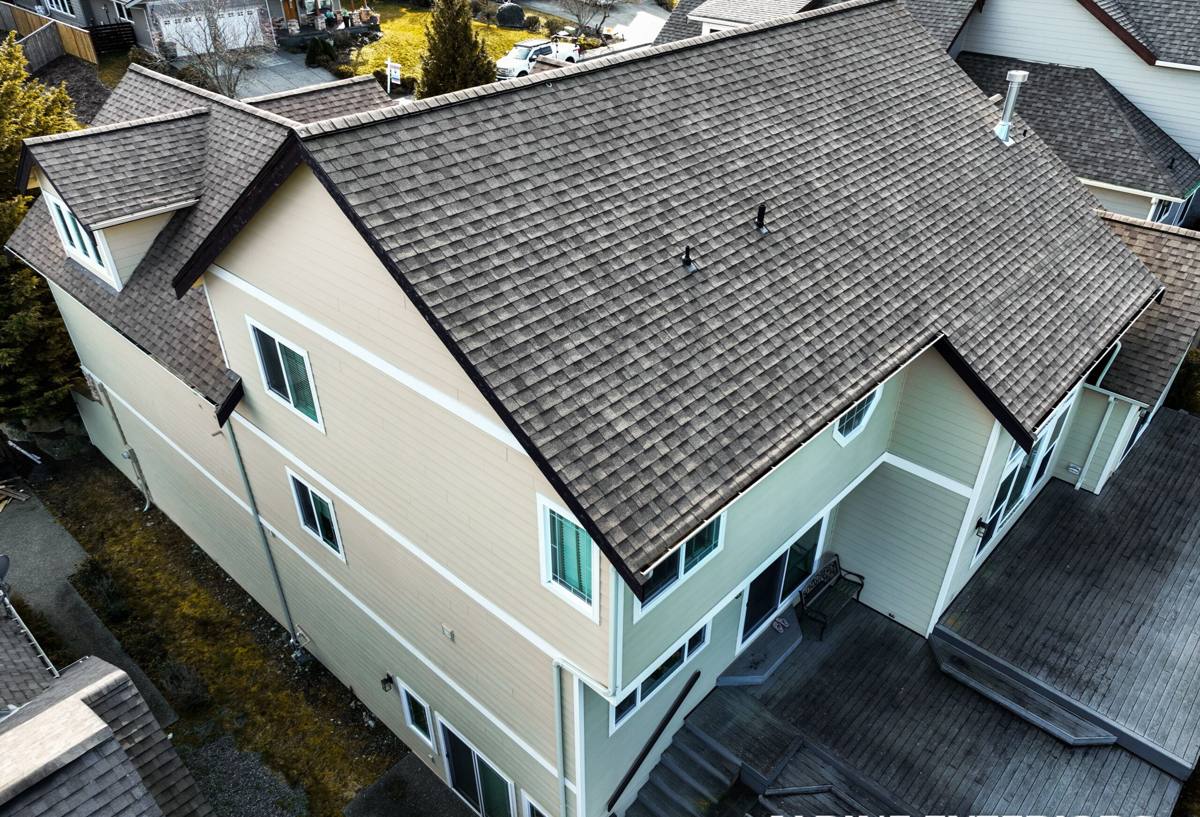
What Siding Repair Actually Means on a Lake Whatcom Home
"Repair" covers a wide range of work, and the right fix depends entirely on what's actually failing. On the homes we see around Sudden Valley, the recurring culprits are:
Moisture intrusion at joints and penetrations
Butt joints, corner boards, window and door trim, and anywhere siding meets a penetration (vents, hose bibs, light fixtures) are the weak points. Caulk shrinks and cracks over a few seasons of Pacific Northwest wet-dry cycling, and once water gets behind the siding plane, it doesn't evaporate quickly under a tree canopy — it sits.
Moss and algae staining, and what's underneath it
Shaded north- and east-facing walls near mature trees are prone to a long moss season — moss and algae can hang on for most of the year in the right spot. Surface growth is a cosmetic problem you can usually clean off. The issue is when growth has been present long enough that it's held moisture against the material underneath, which is a repair problem, not a cleaning problem.
Impact and mechanical damage
Branch strikes, ladder contact, pressure-washer damage from an overly aggressive cleaning, and settling cracks around fasteners all show up as chipped, cracked, or separated panels that need to be cut out and replaced rather than patched.
Rot at the base of walls and behind trim
Once water has been getting behind siding for a while, the sheathing and framing underneath can start to soften. This is the damage that turns a small repair into a bigger one if it's not caught early — which is the whole argument for inspecting instead of ignoring a stain or a soft spot.
Signs You Need a Repair, Not Just a Cleaning
Not every stain or soft-looking spot means trouble, but a few signs are worth taking seriously before winter rains set in:
- Paint or ColorPlus finish that's bubbling, peeling, or flaking in one specific area rather than evenly across the wall
- Siding that feels soft, spongy, or gives slightly when you press on it
- Visible gaps, cracks, or separation at butt joints and corners
- Dark staining that keeps returning to the same spot even after cleaning
- Caulk that's cracked, shrunk away from the edge, or missing entirely around trim and penetrations
- A musty smell near an exterior wall on the inside of the house
- Panels that are visibly bowed, warped, or pulling away from the wall
Any one of these is worth a look. Several of them together, especially on a shaded wall facing the lake or the tree line, usually means water has been getting in for a while.
Repair vs. Replacement: How We Make the Call
A good repair should fix the actual problem, not just cover it up — and it shouldn't turn into a full re-side if the damage is genuinely contained. Here's how we think through it on site:
| Situation | Typical approach | Why |
|---|---|---|
| A few damaged boards, sound sheathing underneath | Spot repair — cut out and replace affected sections | Isolated damage doesn't require touching sound siding elsewhere on the wall |
| Recurring moisture damage concentrated on one shaded wall | Targeted repair plus a look at the underlying cause (grading, gutters, tree cover) | Fixing the siding without addressing why that wall stays wet just buys time |
| Rot found at multiple points across several walls | Broader repair with sheathing inspection, possibly leading toward replacement | Widespread hidden damage usually means the original install or product has been failing systemically |
| Siding is 20+ years old and failing in several unrelated spots | Honest conversation about replacement | Patching an aging system repeatedly costs more over time than doing it right once |
We'll always tell you plainly which category your house falls into. If a repair is the right call, that's what we'll recommend — we're not trying to sell a full replacement to a homeowner who needs three boards fixed.
Why We Repair With — and Only Install — James Hardie
When we're cutting out damaged siding, what goes back up matters as much as the workmanship. Our company installs and repairs with James Hardie fiber cement exclusively — we don't carry vinyl, LP SmartSide, cedar, or other fiber cement brands as a repair option, even for a patch job.
For a climate like this one, the reasoning is straightforward. Hardie's HZ product line is engineered specifically for moisture-heavy, humid climates like the Pacific Northwest, which matters directly on a property surrounded by tree cover and lake-driven humidity. It's non-combustible, it doesn't rot the way wood-based products can, and the factory-applied ColorPlus finish holds its color and resists the fading and peeling that repainted wood or engineered wood trim is prone to in a climate that stays damp for months at a time. It also carries a strong transferable warranty when installed to spec — which is worth something on a repair, not just a full install, because it means the section we replace is backed the same way the rest of a correctly installed Hardie wall would be.
That's also why matching an existing repair matters. If your home already has Hardie siding, we can match the profile, exposure, and color closely so a repair blends in rather than standing out as a patch. If your home has a different product and needs a larger repair, we'll have a straightforward conversation about what a Hardie transition looks like on that section of the house.
Our Repair Process
- Inspection. We look at the damaged area and the wall around it — not just the spot you called about — including a check for soft sheathing, trapped moisture, and whether the root cause is the siding itself or something feeding water to it (grading, a gutter, a flashing detail).
- Diagnosis and plan. We tell you what's actually going on, what's driving it, and whether a spot repair is enough or the damage extends further than what's visible from the outside.
- Removal. Damaged siding and any compromised trim are cut out cleanly, without disturbing sound material beyond what's necessary.
- Sheathing and moisture barrier check. If water has been getting behind the siding, we address what's underneath — not just what's on the surface — before anything new goes back up.
- Reinstallation to spec. New Hardie material goes in following manufacturer installation requirements: proper fastening, correct gaps and clearances, and sealed joints — the details that determine whether a repair lasts or fails again in a season or two.
- Finish match and cleanup. We match color and profile as closely as the existing siding allows and leave the site clean.
Why It's Worth Hiring a Crew That Already Works Sudden Valley
Sudden Valley isn't a typical open subdivision. Lots are wooded, driveways and access can be tight, and many homes are part of a community association with its own exterior guidelines — so it's worth checking your covenants on color and material before finalizing a repair, particularly if you're matching or updating a visible wall. A crew that's already worked in the neighborhood knows to ask about that up front instead of finding out after the order is placed.
There's also a practical site-access piece to it: navigating tree-lined lots, working around landscaping close to the foundation, and being mindful of a lake-community setting where noise and driveway space are tighter than a typical street. None of that is complicated, but it's the kind of local familiarity that keeps a repair job from turning into a bigger disruption than it needs to be.
What a Repair Costs — Honestly
Every repair is different, so we won't quote a number without seeing the wall, but a few honest ranges to set expectations:
- A small, isolated repair (a few boards, one section of trim) is generally the least expensive category of exterior work — often a fraction of what a full re-side would run.
- Repairs that involve sheathing replacement or address hidden rot cost more, because the labor is in what's behind the siding, not just the visible panels.
- Repairs on multiple separate walls add up faster than one concentrated repair, simply from the added setup and material matching involved.
- If damage turns out to be widespread once we open the wall up, we'll stop and talk to you before doing more work than what was originally scoped.
We'd rather give you a real range after looking at the actual damage than a number that doesn't hold up once we're on a ladder.
If you've got a soft spot, a stained corner, or siding that's been bothering you for a season or two, we're happy to come take a look. We offer free, no-pressure estimates for Lake Whatcom and Sudden Valley homeowners — you'll get an honest read on what's going on and what it would take to fix it right.