 Sudden Valley
 Building New in Sunnyland Means Building for Local Weather From Day One
When you're framing a new home in Sunnyland, the windows aren't an afterthought you bolt on later — they're part of the building envelope from the first day of construction. That matters more here than in a lot of places. Sunnyland sits close enough to the water and open air of Whatcom County that new homes take on salt-laden moisture, wind-driven rain, and a long, damp moss season almost immediately. A window package that's correctly specified and correctly installed during the framing stage will outperform a retrofit window for decades. One that's rushed or mismatched to the site will start showing problems — fogging, staining, soft trim, moss creep along the sill — well before the rest of the house needs any attention at all.
New-construction windows are a different job than replacement windows in almost every technical sense. They use a nailing fin instead of a flush-mount frame, they integrate directly with the weather-resistive barrier and flashing tape rather than sitting inside an existing opening, and they get one shot at being right before siding and trim close everything up. Get that sequence wrong on a new build, and you're not patching a leak — you're opening up finished wall assembly to fix it.
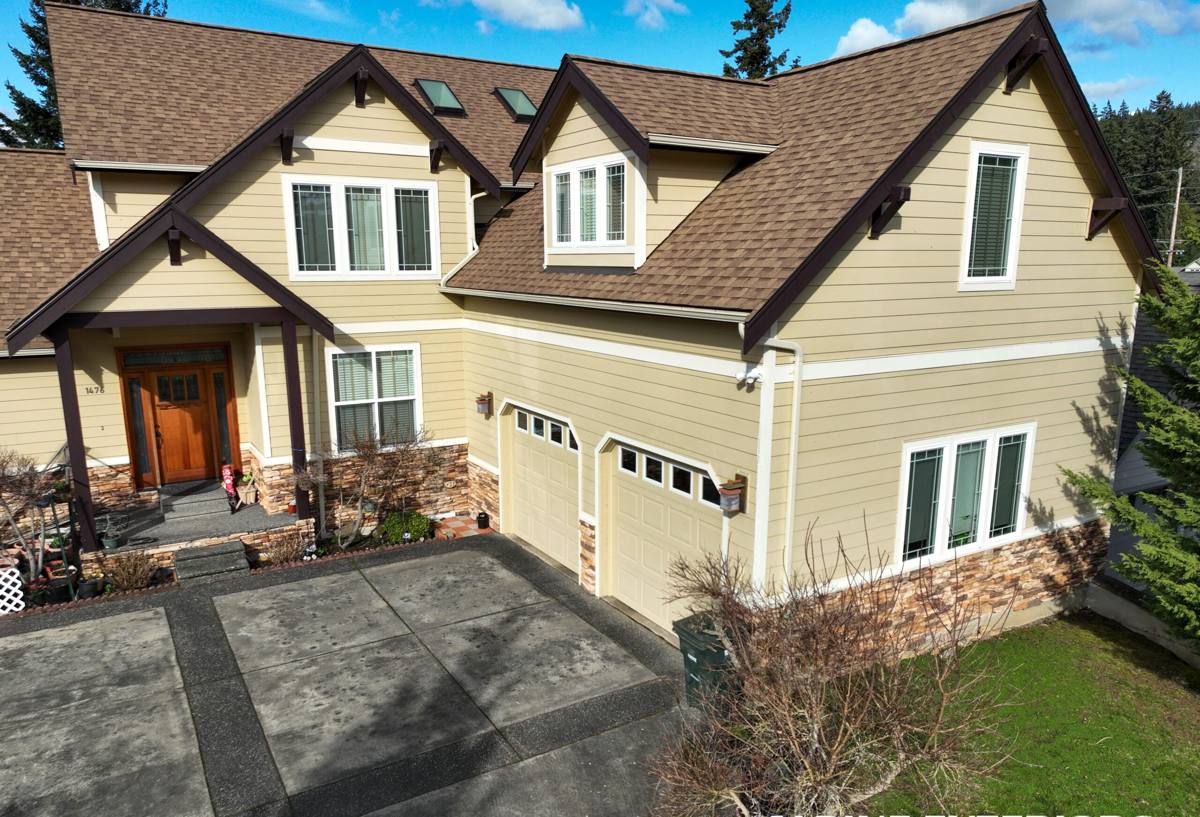
What Whatcom County's Climate Asks of a New Window Install
Sudden Valley Siding works new-construction jobs across Whatcom County, and Sunnyland presents a fairly specific combination of stresses:
- Salt air — even homes set back from the water pick up airborne salt that accelerates corrosion on fasteners, hinges, and lower-grade cladding fastened near window openings.
- Driving rain — wind-driven rain doesn't fall straight down; it gets pushed sideways into window heads and sills, which is exactly where a poor flashing detail fails first.
- A long moss season — cool, wet months stretch out here, and any horizontal surface near a window — sills, trim boards, drip caps — becomes a place moisture sits and moss colonizes if it isn't detailed to shed water.
None of that means anything exotic is required. It means ordinary building science has to actually be followed: correct flashing order (sill pan, then sides, then head, always shingled so water sheds outward and down), a continuous WRB tie-in, and sill details that pitch water away from the house instead of letting it pond.
Why This Matters More at the New-Construction Stage
On a retrofit, a homeowner can watch for problems and call someone back. On new construction, the window opening gets buried under siding, trim, and paint within weeks. If the flashing sequence is wrong, nobody sees it — until there's a stain on the interior drywall two winters later, and by then the fix means opening up finished wall. Getting it right the first time isn't a nicety on a new build. It's the whole game.
What a Correct New-Construction Window Install Actually Involves
A proper install isn't just "set the window and nail the fin." Here's the sequence we follow and why each step exists:
- Rough opening check — verify the opening is square, plumb, and sized correctly before the window ever shows up on site. Framing tolerances get caught here, not after.
- Sill pan flashing — a sloped, sealed pan under the window sill so any water that does get past the window has a path back outside instead of into the wall cavity.
- Window set and shim — the unit is set level and plumb, shimmed at load points (not just at the corners), and fastened per the manufacturer's schedule — not just "however many nails fit."
- Flashing tape, shingled correctly — sides first, then head, lapped so every layer sheds water onto the layer below it, tying into the WRB with no gaps.
- Sealant at the right layer, not every layer — modern window details rely on a drainage plane; sealing everything solid can trap water instead of letting it drain, which is a mistake we see on older or rushed installs.
- Interior air seal — a low-expansion foam or backer rod and sealant at the interior side, which does more for energy performance than people expect.
Skipping or reordering any of these steps is how a brand-new window ends up with a moisture problem in year three.
Choosing Window Products That Suit a Whatcom County New Build
Frame material and glass package both matter here, and the right choice depends on budget, exposure, and how much upkeep the homeowner wants to take on.
| Frame Material | How It Handles Salt Air & Moisture | Maintenance | Typical Fit |
|---|---|---|---|
| Vinyl | Won't corrode; performs well in coastal air | Low — occasional cleaning | Most cost-conscious new builds |
| Fiberglass | Excellent moisture and corrosion resistance, very stable | Low | Homes wanting higher-end durability |
| Aluminum-clad wood | Good if flashing and finish are maintained; wood interior needs monitoring | Moderate — finish upkeep on exposed elevations | Architectural or interior-wood-look preferences |
| Bare wood | Most sensitive to driving rain and prolonged moss-season dampness | High — regular repainting/sealing | We generally steer new builds away from this on exposed elevations here |
On glass, we recommend at minimum a dual-pane Low-E package for this area — the marine layer and cool wet stretches make the energy performance and condensation resistance worth it. Argon-filled units are a reasonable step up; triple-pane is rarely necessary here unless the homeowner has a specific energy target, since our climate doesn't swing to the temperature extremes that justify the added cost in most cases.
Cost Factors on a New-Construction Window Job
Pricing for new-construction windows depends on more than just the unit cost. The main variables we walk homeowners through:
| Factor | Why It Moves the Price |
|---|---|
| Window count and size | Bigger openings and more of them mean more material and labor hours |
| Frame material | Vinyl is the budget baseline; fiberglass and clad-wood cost more up front |
| Elevation exposure | Openings facing prevailing wind and rain sometimes warrant upgraded flashing details |
| Glass package | Low-E, argon fill, and impact-rated glass all add cost over standard dual-pane |
| Site access and timing | Coordinating install around framing and roofing schedules affects labor efficiency |
We won't quote a whole-house number without seeing the plans and the actual openings — anyone who does is guessing. What we can tell you honestly, up front, is which of these factors will move your number the most.
Mistakes We See on New Builds — and How We Avoid Them
Most window problems on new construction trace back to a handful of avoidable errors:
- Reverse-lapped flashing — flashing installed in the wrong order so water gets directed into the wall instead of away from it.
- Sealant used as the only defense — caulk fails eventually; if it's the sole barrier instead of a backup to proper flashing, the window will leak the day the sealant cracks.
- Wrong fastener into treated lumber or near dissimilar metals — accelerates corrosion, especially with the salt content in the air here.
- No sill pan — a surprisingly common shortcut that removes the one detail designed to catch water that gets past everything else.
- Windows installed before the WRB is properly lapped — creates a gap in the drainage plane that's invisible until it isn't.
Every one of these is a sequencing and attention problem, not a product problem — which is why the crew doing the work matters as much as the window brand.
Our New-Construction Process for Sunnyland Homes
We coordinate directly with your builder or general contractor so window install happens at the right point in the framing schedule — not too early, not after the WRB is already closed up around the openings. On site, that means:
- Reviewing rough openings against window schedule and plans before delivery
- Installing sill pan flashing and shingled house-wrap integration on every opening
- Setting, shimming, and fastening each unit to manufacturer spec
- Documenting flashing details before siding crews close up the wall
- Final walk-through checking operation, seals, and trim-ready condition
Because this is new construction, we're one piece of a larger sequence — framing, weatherproofing, siding, trim. We treat coordination with your other trades as part of the job, not an inconvenience.
Why It Matters That We Already Work in Sunnyland
A crew that's worked new builds across this part of Whatcom County already knows what the local moisture load does to a window opening over a Pacific Northwest winter, which flashing sequences actually hold up to driving rain off the water, and how much of a difference a properly pitched sill makes when moss season runs long. That's not something you learn from a spec sheet — it's something you learn from going back to jobs a few years later and seeing what held up and what didn't. On a new build, there's no do-over once the siding's on, so that local track record is worth something real.
Ready to Talk Windows for Your New Build?
If you're framing a home in Sunnyland or elsewhere in Whatcom County and want a window package specified and installed right the first time, we're happy to take a look at your plans. Use the form below to request a free, no-pressure estimate — we'll walk through your openings, your budget, and what actually makes sense for this climate.