 Sudden Valley
 Roofing Built for Deming's Climate, Not a Generic Spec Sheet
Deming sits in the shadow of Mount Baker, tucked into the Nooksack River valley just east of Sudden Valley, and that geography shapes what a roof has to survive here. You get more rainfall than the coastal towns, more shade from tree cover along the river corridor, and the same damp marine air that pushes moss growth almost year-round across Whatcom County. A roof spec that works fine in a drier, sunnier part of the state will often underperform out here within a few years. When we install a new roof in Deming, we're not just swapping shingles — we're building a system that's meant to handle standing moisture, moss pressure, and driving rain off the foothills.
This page covers new roof installation specifically for Deming homes: what the climate demands, what a correct installation actually involves, how our process works from first call to final walkthrough, and why it matters to hire a crew that already knows this stretch of Whatcom County.
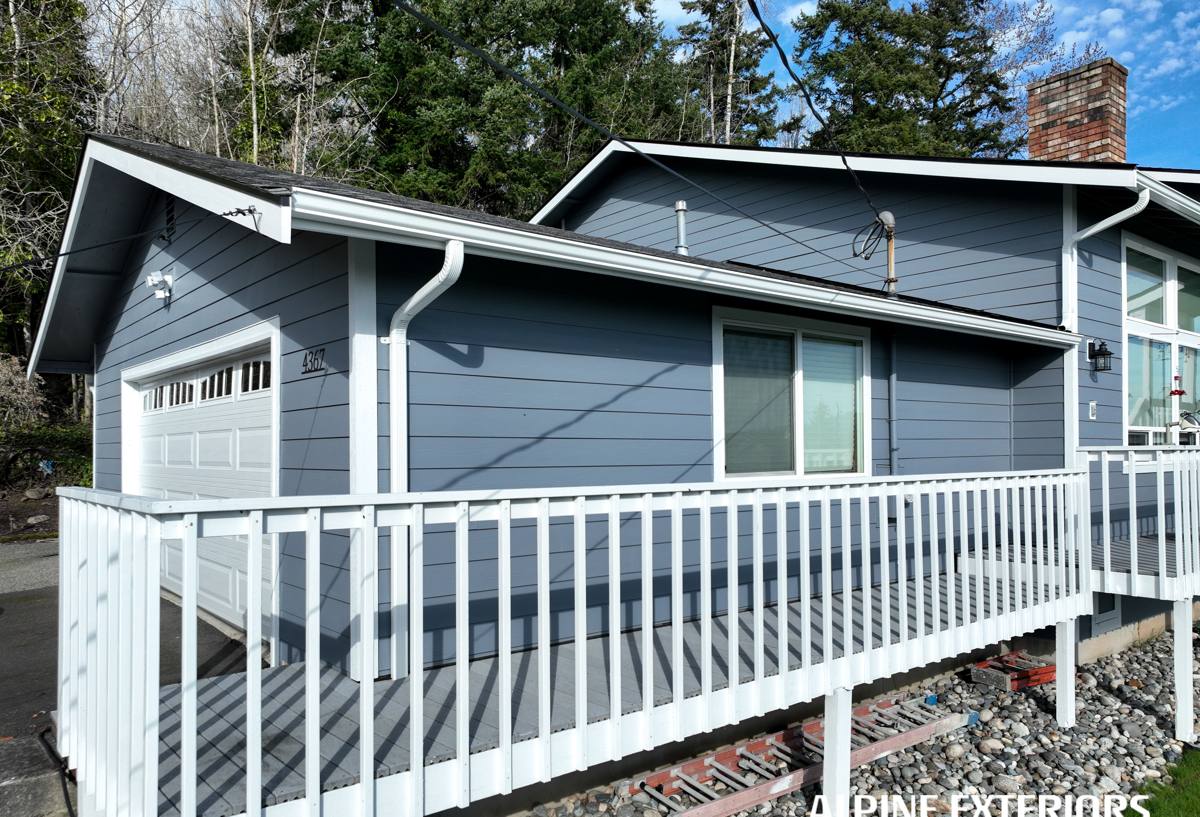
What Deming's Climate Does to a Roof
Three regional factors show up again and again on roofs we inspect out this way:
Moss Season Runs Long
Between the tree canopy, valley shade, and the region's extended wet season, north-facing slopes and shaded sections of roof stay damp for weeks at a stretch. Moss and algae take hold in that moisture, and once established they hold water against the shingle surface, work into granule beds, and lift edges over time. A roof with no moss-resistance strategy built in will need moss treatment or removal on a recurring basis — and repeated scraping shortens shingle life.
Driving Rain Finds Weak Points
Storms coming off the Sound and up through the foothills don't always fall straight down. Wind-driven rain gets pushed sideways into valleys, ridges, and any transition point on the roof — where a chimney meets the field, where a dormer breaks the plane, where two roof sections intersect. These are exactly the spots where underlayment quality and flashing detail matter more than shingle brand.
Salt Air's Reach
Deming is inland compared to the coastal parts of Whatcom County, but the broader region still carries salt-laden air off the Sound on prevailing winds, especially during winter storm systems. Salt exposure accelerates corrosion on exposed metal — nail heads, flashing, vent housings — which is why fastener and flashing material choice isn't a cosmetic decision here, it's a durability decision.
What a Correct Roof Installation Includes
A new roof is a system, not a single product. Skipping or downgrading any one layer undermines the rest. For Deming homes, we build every installation around these components:
- Tear-off and deck inspection — full removal of the old roofing so we can see the actual condition of the sheathing underneath, not guess at it.
- Sheathing repair — any deck sections that are soft, delaminated, or water-damaged get replaced before anything new goes down.
- Ice and water shield at vulnerable zones — valleys, eaves, and roof-to-wall transitions get a self-adhering waterproof membrane, not just standard underlayment.
- Synthetic underlayment across the field — a water-resistant barrier layer that gives the roof a backup line of defense if wind-driven rain ever gets past the surface material.
- Corrosion-resistant flashing — proper metal at chimneys, valleys, sidewalls, and vent penetrations, sized and lapped correctly rather than caulked as a shortcut.
- Ventilation review — balanced intake and exhaust airflow so the attic doesn't trap moisture, which both protects the deck and reduces the damp conditions moss thrives in.
- Manufacturer-spec fastening — correct nail pattern, placement, and count for the specific product and roof pitch, since under-fastening is a leading cause of early wind damage.
Roofing Material Considerations for This Area
There's no single "best" roofing material — the right choice depends on budget, roof complexity, and how much moss and moisture resistance you want built in versus maintained over time. Here's how the common options stack up for a Deming property:
| Material | Moss/Moisture Behavior | Typical Lifespan | Best Fit |
|---|---|---|---|
| Architectural asphalt shingle | Good with algae-resistant granules; needs decent ventilation | 25–30 years | Most homes; strong value and wide color range |
| Standard 3-tab shingle | Fair; less algae resistance in most product lines | 15–20 years | Budget-driven projects, secondary structures |
| Metal (standing seam or panel) | Excellent; sheds moisture fast, little surface for moss to grip | 40–60 years | Steep or shaded roofs, long-term owners |
| Synthetic/composite shingle | Good; consistent moisture resistance, low water absorption | 30–50 years | Homes wanting a wood or slate look without the upkeep |
We install asphalt, metal, and synthetic systems, and we'll walk through the honest trade-offs for your specific roof rather than pushing whatever's easiest to sell. On heavily shaded Deming lots, we're often recommending metal or a premium algae-resistant shingle specifically because of how much less maintenance it demands over the life of the roof.
Why We Don't Cut Corners on Underlayment or Flashing
Some crews treat underlayment and flashing as an afterthought because the shingles are what the homeowner sees. We treat them as the part of the roof doing the real waterproofing work, especially in a climate with this much sustained moisture exposure. Standard felt underlayment can absorb water and wrinkle under prolonged damp conditions; synthetic underlayment resists that and holds up better if there's ever a delay between tear-off and final cover during a wet stretch of weather. On flashing, we use corrosion-resistant metal and proper step-and-counter or continuous detailing at walls and chimneys rather than relying on sealant alone — sealant degrades with UV and temperature cycling, and a mechanically correct flashing detail doesn't depend on it holding up forever.
Our Installation Process
Every new roof project follows the same sequence, whether it's a straightforward gable roof or something with multiple valleys and dormers:
- On-site inspection and estimate — we look at the existing roof, attic ventilation, and any problem areas before quoting anything.
- Material selection — we go over options and honest trade-offs based on your roof's exposure, budget, and how it's shaded.
- Scheduling around weather — we plan installation windows with realistic buffer for the region's rain patterns so the deck isn't left exposed longer than necessary.
- Tear-off and deck inspection — old material comes off, deck condition gets assessed and documented before we cover anything up.
- Underlayment and flashing installation — the waterproofing layers go down correctly before the final roofing material is installed.
- Roofing material installation — installed to manufacturer fastening specs for your roof's pitch and exposure.
- Ventilation check and cleanup — intake and exhaust airflow confirmed, job site cleared of debris and old material.
- Final walkthrough — we go over the finished roof with you before calling the job done.
Signs a Deming Roof Needs Replacing, Not Just Repairing
Not every roof problem calls for full replacement, but there's a point where repeated patching stops making financial sense. Watch for:
- Heavy moss coverage that returns quickly even after cleaning
- Granule loss showing bare or shiny patches on shingles
- Curling, cracking, or lifted shingle edges across multiple areas
- Soft spots in the roof deck felt from inside the attic
- Water staining on ceilings or in the attic after storms
- Shingles original to a roof more than 20–25 years old
- Daylight visible through the roof deck from the attic
If you're only seeing one or two isolated issues, a targeted repair may be the more sensible move — we'll tell you that honestly rather than push a full replacement you don't need yet.
Why Local Experience in Deming Matters
A roofing crew that regularly works Whatcom County knows things a generalist contractor from further out has to learn on your project. That includes which shaded slopes hold moisture longest, how local permitting and inspection typically runs, what wind and rain exposure actually looks like on this side of the valley versus the more open areas near Sudden Valley proper, and how to sequence a tear-off around a forecast that can change fast this time of year. It also means we're a known, reachable crew if a warranty question or a storm-related concern comes up after the job is done — not a name you found once and can't easily get back in touch with.
Get a Free, No-Pressure Estimate
If your Deming roof is showing its age, holding onto moss no matter how often it's cleaned, or you just want an honest read on how much life it has left, we're glad to come take a look. The estimate is free, there's no pressure to book anything on the spot, and you'll get a straight answer about whether you need a new roof now or can reasonably hold off. Use the form below to get started.