 Sudden Valley
 Why Siding Wears Differently Around Alger
Homes in and around Alger sit in a pocket of Northwest Washington where three things gang up on exterior siding at once: salt-laden air moving in off the water, driving rain that comes in sideways during fall and winter storms, and a moss season that can run eight months or longer under heavy tree cover. Any one of these is manageable. Together, they shorten the life of siding materials that aren't built for it, and they punish installation shortcuts that would go unnoticed in a drier climate.
Salt air accelerates corrosion on fasteners and trim metal, and it breaks down cheaper paint films faster than inland weather does. Driving rain doesn't just wet the surface of a wall — it finds every gap in flashing, every under-caulked seam, and every spot where siding was nailed too tight or lapped too short, and it pushes water behind the cladding instead of down and off it. And moss doesn't just look bad on a north-facing wall; it holds moisture against the siding surface for weeks at a time, which is exactly the condition that rots wood-based products and delaminates weaker composites from the inside out.
None of this means siding replacement in this area has to be a losing battle. It means the material and the installation both have to be chosen for this specific climate, not a generic one.
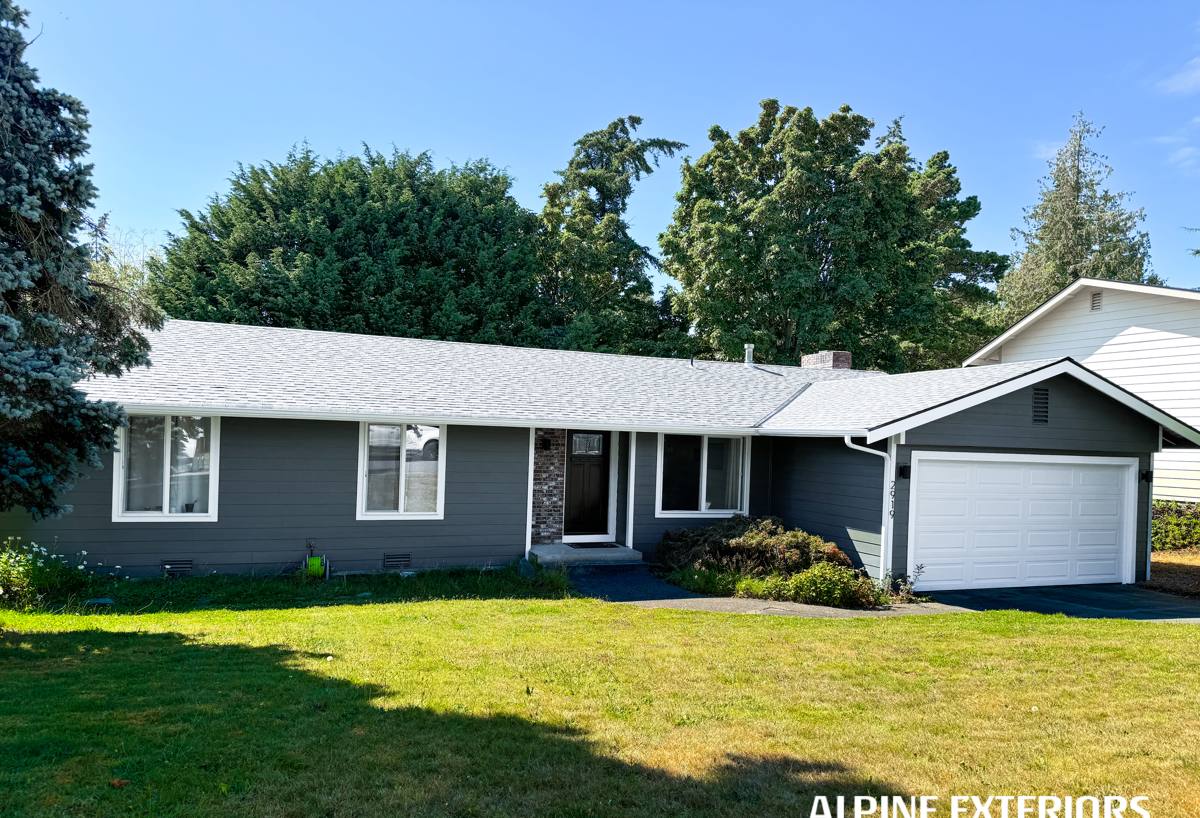
What a Correct Siding Replacement Actually Involves
Siding replacement is not just stripping old material off a wall and nailing up new boards. Done right, it's a full envelope job. Skipping any of the steps below is how a house ends up with the same rot problem again in ten years, just hidden behind new siding.
Full Tear-Off, Not Overlay
We remove the old siding down to the sheathing rather than installing new siding over the old. That's the only way to actually see what's underneath — and around Alger, what's underneath sometimes tells a different story than what the old siding suggested from the outside.
Sheathing and Framing Inspection
Once the wall is open, we check the sheathing and framing for soft spots, water staining, and rot, especially around window and door openings, at wall penetrations, and near ground level where splashback and moss buildup do the most damage over time. Any compromised sheathing gets replaced before anything new goes back on the wall.
Weather-Resistive Barrier
A correctly lapped and sealed weather-resistive barrier (WRB) goes on next. This layer, not the siding itself, is the wall's real first line of defense against wind-driven rain. Seams, penetrations, and transitions all get sealed and shingled the right direction so water is directed out, not trapped in.
Flashing at Every Vulnerable Point
Windows, doors, decks, roof-to-wall intersections, and any other penetration get proper flashing integrated with the WRB. This is the detail work that separates a siding job that holds up for decades from one that starts leaking behind the walls within a few wet seasons.
Correct Fastening and Clearances
Fiber cement siding has manufacturer-specified nailing patterns, fastener types, and minimum clearances from grade, roofing, and decking. Getting these wrong is one of the most common causes of premature siding failure, and it's also the kind of mistake that voids a manufacturer warranty even when the siding itself is a good product.
Why We Install Only James Hardie Fiber Cement
We get asked why we don't offer vinyl, LP SmartSide, or the cheaper fiber cement alternatives. It's a fair question, and the honest answer is that we looked at how each of those products actually performs in exactly the conditions Alger and the greater Sudden Valley area deal with — sustained moisture, moss, and salt-influenced air — and standardized on one product line that holds up to all three without asking homeowners to gamble.
Vinyl siding is affordable and low-maintenance in the sense that it doesn't need painting, but it's a plastic product that expands and contracts with temperature swings, can crack in impacts, and its color is baked into a thin material that fades unevenly over time. It also relies heavily on correct installation to manage moisture behind it, since it's not a rigid, monolithic barrier the way fiber cement is.
LP SmartSide and other engineered wood products use a wood-strand core with a resin coating. It's a genuine improvement over old-style wood siding, and it installs easily, but any engineered wood product depends on that outer coating staying fully intact for its entire life. In a climate with this much sustained moisture and moss, a scratch, a poorly sealed cut edge, or a failed caulk joint is a direct path for water into a wood-based core — and once that starts, it doesn't reverse.
Primed spruce and cedar are beautiful, and cedar in particular has real heritage in this region, but both are wood. Wood siding in a high-moisture, moss-prone environment needs a maintenance schedule — recoating, caulking, moss treatment — that most homeowners underestimate when they choose it, and falling behind on that schedule is expensive to catch back up on.
James Hardie fiber cement is cement, sand, and cellulose fiber — there's no wood core to rot and no plastic to crack or fade the way vinyl does. It's factory-finished with ColorPlus technology, a baked-on finish that resists fading and chipping far better than field-applied paint, and it's engineered specifically for climates like ours through Hardie's HZ5 product line, built for regions with more moisture cycling and freeze-thaw exposure than the milder HZ10 zones. It's also non-combustible, which matters as wildfire smoke and dry-season fire risk have become a bigger part of every Pacific Northwest homeowner's calculus, even in a generally wet county. That combination — moisture resistance, factory finish durability, and a transferable warranty backed by a large manufacturer — is why it's the only product we put on a house.
Comparing the Options for a Wet, Moss-Prone Climate
| Material | Moisture Behavior | Maintenance | Typical Lifespan Here |
|---|---|---|---|
| James Hardie fiber cement | Does not rot; resists moss-related surface damage better than wood-based products | Occasional wash-down; no repainting for 15+ years with ColorPlus | 30+ years to manufacturer specs |
| Vinyl | Won't rot itself, but relies on installation to manage water behind panels; can warp in heat | Low, but color fades and can't be touched up | 15–25 years, variable |
| LP SmartSide / engineered wood | Vulnerable at cut edges, scratches, and failed caulk joints | Regular inspection of coating and seams | 20–30 years if coating stays intact |
| Cedar / primed wood | Absorbs moisture readily; prone to moss growth and rot without upkeep | High — recoating, caulking, moss treatment on a set schedule | 15–25 years with diligent maintenance |
Our Process, Start to Finish
- Walkthrough and assessment — we inspect the current siding, look for signs of underlying moisture damage, and talk through what you're seeing and what concerns you.
- Written estimate — scope, product selection (Hardie line, profile, and color), and a clear price, with no pressure to decide on the spot.
- Tear-off and inspection — old siding comes off, sheathing and framing get checked, and we flag anything unexpected before moving forward.
- Envelope work — WRB, flashing, and any sheathing repairs, done before a single new board goes up.
- Hardie installation — installed to manufacturer fastening and clearance specs, not shortcuts.
- Final walkthrough — we go over the finished work with you before calling the job done.
Signs an Alger-Area Home Needs Siding Replacement
- Soft or spongy spots when you press on the siding, especially near the bottom courses or below windows
- Persistent moss or dark streaking that comes back within weeks of cleaning
- Visible warping, buckling, or gaps between boards or panels
- Paint that's peeling or bubbling rather than just fading
- Rising energy bills with no other clear cause, which can point to a compromised weather barrier
- Musty smells or visible staining on interior walls that back up to exterior siding
- Siding that's original to a home built more than 20–25 years ago, particularly if it's wood or an older composite
Why a Crew That Already Works Alger Matters
Siding installation isn't one-size-fits-all, even within the same county. A crew that regularly works the Alger area and the broader Sudden Valley region already understands how moss builds up on shaded north walls, how much wind-driven rain a given exposure typically takes in a winter storm, and where salt-influenced air tends to accelerate wear on trim and fasteners. That's not something you can fully substitute with a generic install checklist — it shapes small decisions on the job, like where to add extra flashing attention or how a specific wall orientation should be detailed.
Local experience also means fewer surprises on timeline and logistics. A crew that knows the area's typical weather windows plans tear-off and dry-in around it, instead of leaving a wall exposed longer than it should be. And when you need a warranty question answered or a follow-up visit five years down the road, you're dealing with a crew that's still working in your area, not one that did a single job and moved on.
What Affects the Cost of a Siding Replacement
Every home is different, so we won't quote a number without seeing the house, but the main cost drivers are consistent from job to job:
| Factor | Why It Matters |
|---|---|
| Home size and wall complexity | More square footage and more corners, gables, and dormers mean more material and labor |
| Condition of sheathing underneath | Rot repair found during tear-off adds cost but is far cheaper to fix now than after new siding goes up |
| Hardie product line and profile | Lap siding, shingle-style panels, and board-and-batten all price differently |
| Trim and accessory work | Fascia, soffits, and trim replacement alongside siding affects total scope |
| Access and site conditions | Steep lots, tree cover, and staging constraints common in this area can affect labor time |
We walk through all of this in the estimate so you know exactly what's driving the price, not just a lump-sum number.
If your siding is showing wear, or you're just planning ahead for a home in the Alger or Sudden Valley area, we're glad to come take a look. The estimate is free, there's no pressure to commit, and you'll get a straight answer about what your siding actually needs — use the form below to get started.