 Sudden Valley
 Bellingham's Siding Conditions Are Tougher Than They Look
Bellingham sits close enough to salt water and open exposure that homes here take a different kind of beating than siding manufacturers usually design for on paper. It's not one dramatic event that wears out a wall system — it's the accumulation of salt-laden air, wind-driven rain that gets pushed sideways under eaves and around corners, and long stretches of damp, low-light weather that keep moss and algae growing on north- and west-facing walls for months at a time. Add in Whatcom County's mix of coastal humidity and inland temperature swings, and you get a climate that punishes any siding product with weak seams, poor moisture management, or a finish that can't hold up to repeated wet-dry cycling.
Homes in and around Bellingham that sit closer to the water or in more exposed, wind-funneled locations see this faster than homes tucked into more sheltered lots. But over enough years, every home in the area feels some version of the same pressure. Siding decisions made for a drier, milder climate elsewhere don't hold up the same way here.
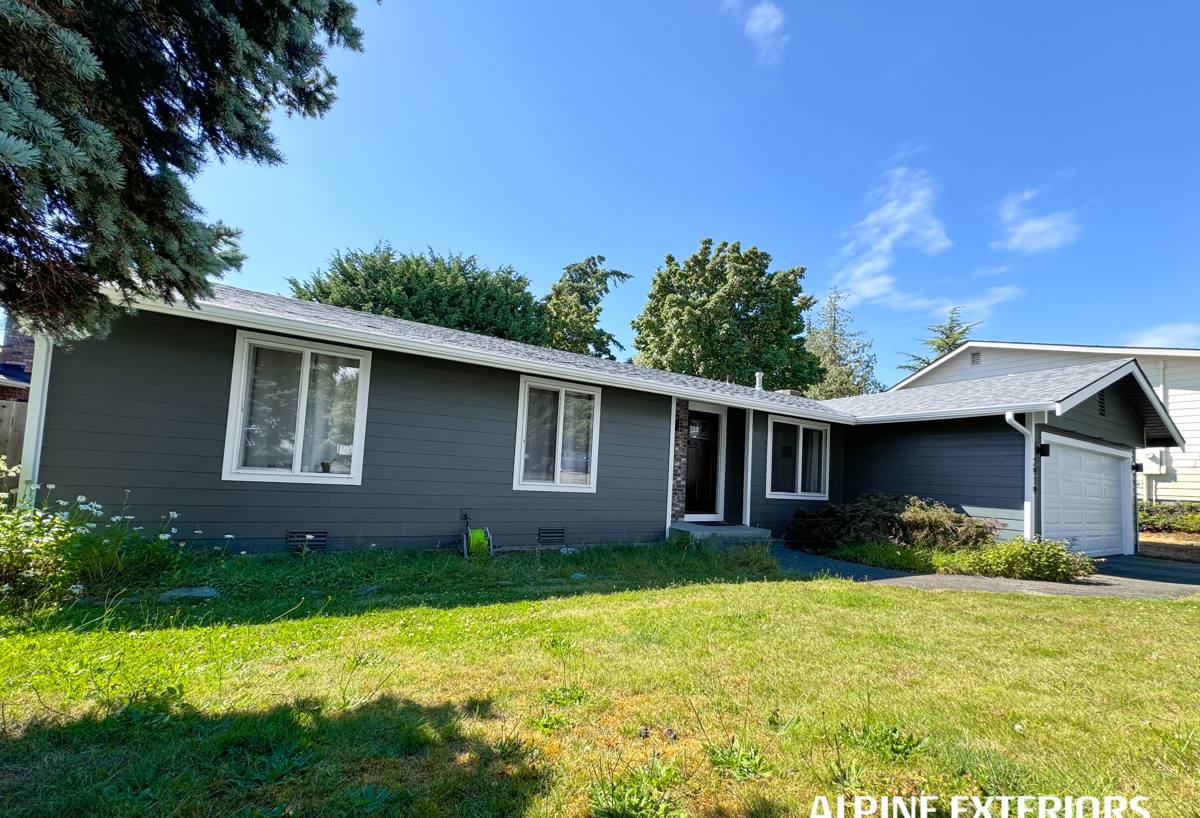
What Salt Air and Driving Rain Actually Do to Siding
Salt air accelerates corrosion on anything metal — fasteners, flashing, trim accessories — and it also breaks down cheaper paint and coating systems faster than inland exposure would. Driving rain is a separate problem: when wind pushes water horizontally instead of letting it run straight down, it finds every gap, seam, and undersized overlap in a siding system. Water that would just sheet off a wall in calmer weather instead gets forced up and under laps, into fastener penetrations, and behind trim.
Wood and wood-composite siding products are the most exposed to this combination. Once moisture gets behind or into the material, the long stretches of gray, low-evaporation weather common here don't give it much chance to dry out between rain events. That's the setup for rot, delamination, and paint failure — not because a product is poorly made, but because this climate doesn't give it the recovery time it needs.
Moss Season Isn't Cosmetic
Moss and algae growth on north-facing and shaded walls is mostly a maintenance and appearance issue, but it's not purely cosmetic. Moss holds moisture directly against the siding surface for extended periods, which matters most where the substrate underneath can absorb or be damaged by sustained dampness. Siding that's dimensionally stable and doesn't feed mold growth the way organic-based products can holds up far better through a long moss season.
Why We Standardized on James Hardie Fiber Cement
We install James Hardie fiber cement siding exclusively — not vinyl, not LP SmartSide, not cedar, not primed spruce, not other fiber cement brands. That's a deliberate standard, not a sales preference, and it comes directly from what holds up best against the conditions described above.
- Non-combustible core: fiber cement won't feed a fire the way wood-based products can, which matters for insurance and long-term risk, not just weather.
- Dimensionally stable in wet-dry cycling: it doesn't swell, cup, or delaminate the way engineered wood products can when moisture gets past the surface.
- ColorPlus factory-applied finish: a baked-on finish that resists fading and holds up to salt air and UV exposure far longer than field-applied paint on wood siding, and it comes with its own finish warranty separate from the substrate warranty.
- Climate-engineered HZ5 product line: James Hardie engineers specific formulations for wetter, more humid climate zones, and the Pacific Northwest falls into that HZ5 category.
We've made the call to walk away from installing products that don't hold up as well here, even when a homeowner asks for them by name, because we'd rather explain the trade-offs honestly than install something we know will need premature repair.
The HZ5 Difference: Built for This Climate, Not Adapted to It
James Hardie doesn't sell one product nationwide and call it done. The HZ5 line is formulated specifically for high-humidity, high-precipitation climates — which is exactly the profile of Whatcom County and the greater Bellingham area. That engineering shows up in how the material resists moisture absorption at the panel level, which is a meaningfully different starting point than a siding product designed primarily for dry-climate performance and shipped everywhere.
This matters most at the details: panel edges, cut ends, and fastener penetrations are where moisture intrusion actually starts on any fiber cement job. HZ5 formulation gives the material itself a better baseline, but the installation still has to protect those vulnerable points — which is where workmanship becomes just as important as the product.
What a Correct Installation Actually Involves
Fiber cement siding is only as good as the details behind it. A rushed or corner-cutting install can undercut even the best product line. On every Bellingham job, correct installation means:
- Proper weather-resistive barrier and flashing sequencing behind every panel, window, and door opening — installed so water sheds outward at every layer, not just at the surface.
- Sealed and primed cut ends on every field cut, since factory-primed edges don't extend to job-site cuts unless they're treated.
- Correct fastener type, spacing, and penetration depth — corrosion-resistant fasteners matter more here than in drier inland climates because of salt air exposure.
- Manufacturer-specified clearances at grade, roofline, and deck or patio surfaces, so splash-back and standing water don't sit against the bottom course.
- Rain-screen or drainage-gap detailing where the wall assembly calls for it, so incidental moisture behind the cladding has somewhere to go.
Skipping any one of these doesn't necessarily show up in year one. It shows up in year five or eight, as localized rot behind a poorly flashed window, or premature paint and caulk failure at an unsealed cut end.
How Our Process Works on a Bellingham Home
1. On-Site Assessment
We walk the exterior and look specifically at exposure — which walls take the most wind-driven rain, which stay shaded and hold moisture longest, and where existing trim, flashing, or drainage details need attention before new siding goes on.
2. Product and Color Selection
We help homeowners choose the right Hardie panel or plank profile and ColorPlus finish for the home's exposure and style — factoring in which walls will see the most sun fading versus which will see the most moss and algae pressure.
3. Prep and Moisture Detailing
Before any new siding goes up, we address the weather-resistive barrier, flashing at every penetration, and any drainage detailing the wall assembly needs. This is the step that determines how the siding performs in year ten, not year one.
4. Installation to Manufacturer Spec
Fastener type and spacing, clearances, cut-end sealing, and joint treatment all follow James Hardie's published installation requirements — which is also what keeps the manufacturer warranty valid.
5. Final Walkthrough
We review the finished job with the homeowner, including basic care expectations for this climate — what to watch for during moss season and how to keep gutters and drainage clear so water isn't dumped against the new siding.
Comparing Siding Options for This Climate
| Factor | James Hardie Fiber Cement | Vinyl | Wood / Engineered Wood |
|---|---|---|---|
| Moisture behavior in prolonged damp weather | Dimensionally stable, doesn't swell or delaminate | Can warp or bow with heat/cold cycling | Prone to swelling, rot if moisture gets behind it |
| Salt air / coastal exposure | Engineered finish resists fading and breakdown | Can chalk and become brittle over time | Finish breaks down faster, needs more frequent repainting |
| Fire resistance | Non-combustible core | Can melt or deform near heat sources | Combustible |
| Moss/algae susceptibility | Doesn't feed organic growth like wood substrates can | Growth stays on surface, low substrate risk | Substrate can be affected by sustained moisture under growth |
| Long-term maintenance | Periodic cleaning, no repainting for the life of the ColorPlus finish | Low maintenance but limited repair options if damaged | Regular repainting and moisture inspection required |
Moss, Mold, and What to Actually Expect Year to Year
No siding product stops moss or algae from landing on a wall — that's a function of shade, moisture, and airflow around the house, not the cladding material. What changes with Hardie is what happens underneath that growth. A stable, non-organic substrate doesn't feed the growth or degrade from prolonged contact with it the way some wood-based products can. Homeowners should still expect to rinse or gently clean shaded, north-facing walls periodically, especially through the wetter months, and keep gutters and downspouts directing water away from the foundation and lower courses.
Questions to Ask Before Hiring Anyone for This Job
- Do you install to James Hardie's published fastening, clearance, and flashing specifications, or your own shortcuts?
- Will cut ends be primed and sealed on-site, not just at the factory edge?
- What's your experience with homes in this specific exposure — close to water, wind-funneled lots, heavy shade?
- Does your installation keep the manufacturer's warranty intact, and can you show how?
- What's your plan for existing moisture damage or poor flashing found once old siding comes off?
A contractor who can answer these clearly, without hedging, is worth far more than one offering the lowest bid.
Why Local Experience on This Specific Job Matters
Bellingham's mix of coastal exposure, wind patterns, and long damp seasons isn't the same as a siding job forty minutes inland, and it isn't the same as the drier-climate installs a lot of national training materials assume. A crew that already works this area knows which walls need extra flashing attention, which lots hold moisture longest, and how to sequence a job around the area's weather windows instead of fighting them. That local pattern recognition is the difference between a siding job that looks right at handoff and one that's still performing correctly in year fifteen.
If you're weighing a siding replacement or new installation on a Bellingham-area home, we're happy to walk the property with you and talk through what your home's exposure actually needs. There's no pressure and no cost — just a straight assessment and a clear estimate using the form below.