 Sudden Valley
 Cordata's Climate Is Harder on Siding Than It Looks
Cordata sits inland from the water compared to some Whatcom County neighborhoods, but that doesn't spare it from what makes siding fail early here. Marine air moves through the county most of the year, driving rain comes in sideways during winter storms, and the shaded, tree-lined lots common in this area stay damp long after a storm has passed. That combination — salt-tinged moisture, wind-driven rain, and slow-drying shade — is exactly the environment that wears out the wrong siding system years before it should give out.
We're not describing a worst-case scenario. This is the normal weather cycle for a Whatcom County home, repeated every fall through spring, for as long as the house stands. Siding here isn't just a finish material — it's the thing standing between that weather and your framing, insulation, and interior walls. Get the product or the install wrong, and the consequences show up as soft trim, bubbling paint, or rot behind the wall long before the siding itself looks obviously bad.
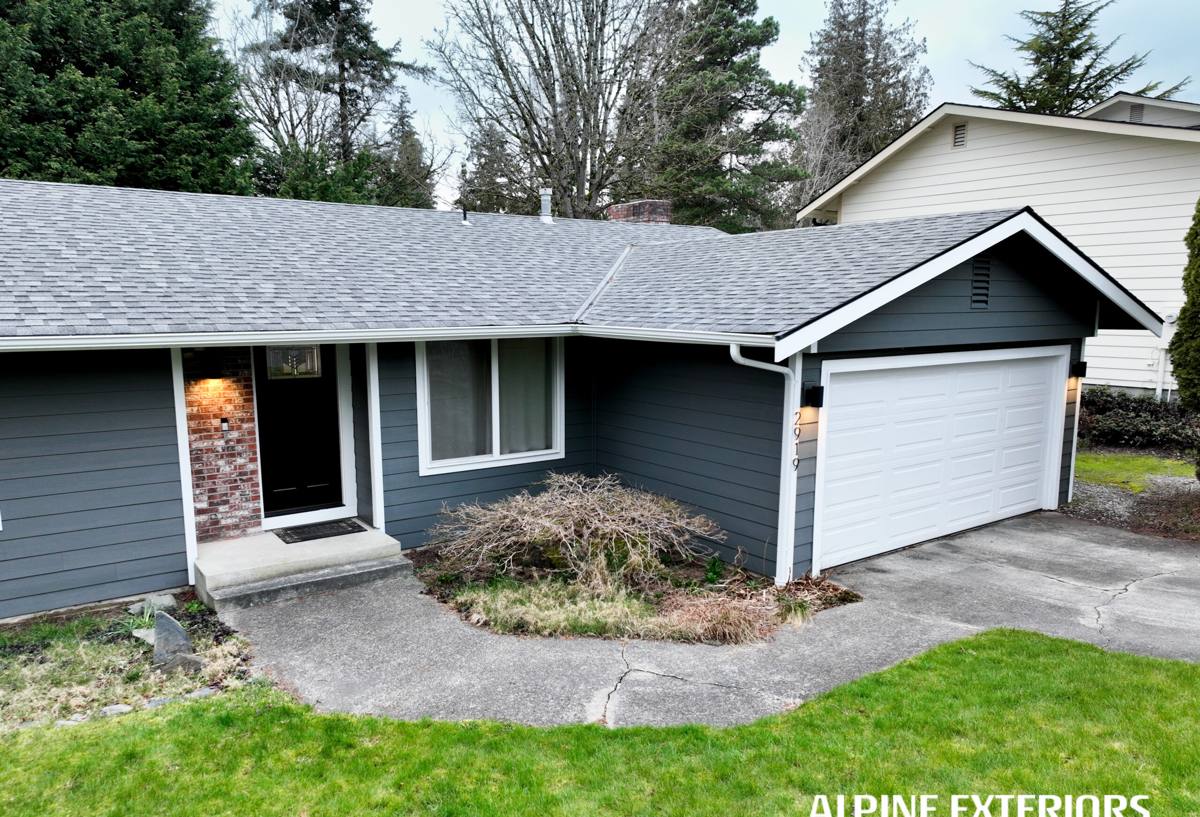
What Moss Season Actually Does to a House
Locals know "moss season" as a fact of life, but it's worth being specific about what it does to siding. Moss and algae need moisture and shade to establish, and north-facing walls, areas under tree cover, and low-sun corners of a Cordata lot supply both for months at a time. Once organic growth takes hold on a siding surface, it holds moisture against that surface around the clock instead of letting it dry between rains.
On wood-based products — cedar, primed spruce, or engineered wood siding — that sustained moisture is what drives swelling, delamination, and rot at the most vulnerable points: butt joints, the bottom edge of each course, and anywhere caulk has started to crack. Fiber cement doesn't feed or absorb moisture the same way, which is one of the reasons it holds up so much better through a Whatcom County moss season. But even fiber cement needs a correct installation to keep water from getting behind it in the first place — the material only performs as well as the install.
What a Correct Siding Installation Actually Involves
Most siding problems we get called out to inspect in this area aren't material failures — they're installation shortcuts. A proper install manages water at every layer, not just at the visible face of the siding.
The Drainage Plane Comes First
Before any siding goes up, the wall needs a continuous weather-resistive barrier with a drainage gap behind the siding panels. This gives any moisture that does get past the siding a path to drain and dry out instead of sitting against the sheathing. Skipping or shortcutting this layer is invisible once the siding is on — and it's the single biggest cause of hidden rot we find behind old siding in this region.
Flashing at Every Penetration
Windows, doors, hose bibs, light fixtures, vents — every penetration through the siding is a place water can get behind the wall if it isn't flashed correctly. In a climate with as much driving rain as this one, flashing details matter more than they would in a dry climate, because wind pushes water sideways and upward, not just straight down.
Fastening, Gaps, and Clearances
James Hardie fiber cement has specific fastening patterns, clearances from grade, roof lines, and decks, and gap requirements at butt joints and trim. These aren't optional preferences — they're in the manufacturer's installation instructions, and following them is what keeps the warranty valid and the siding performing as designed. A crew that treats these as suggestions is setting the homeowner up for problems that show up years later, after the crew is long gone.
Why We Only Install James Hardie Fiber Cement
We made a deliberate decision to install James Hardie fiber cement siding exclusively — not vinyl, not LP SmartSide or other engineered wood, not primed spruce or cedar, and not other fiber cement brands. That's not a marketing angle; it's the product we're willing to stand behind on homes in this climate.
Fiber cement is non-combustible, doesn't feed moss and mildew growth the way wood-based products can, and holds a factory-applied ColorPlus finish that's engineered to resist fading and doesn't need repainting on the schedule that field-painted wood or vinyl often does. James Hardie also builds climate-specific HZ product lines, so the siding specified for a Pacific Northwest install is formulated differently than what would go on a house in Arizona or Florida. That regional engineering matters in a county that sees this much sustained moisture.
We're not going to tell you other siding products are junk — vinyl and engineered wood both have legitimate uses and plenty of homes wearing them without issue. But for the maintenance burden, moisture behavior, and long-term appearance we're willing to warranty our labor against, James Hardie is the product we trust on Whatcom County homes, and it's the only one we install.
Our Installation Process
- On-site assessment. We look at your home's current siding condition, existing sheathing and moisture barrier, and any problem areas — shaded walls, low clearance spots, prior water damage — before we quote anything.
- Removal and inspection. Once old siding comes off, we inspect the sheathing underneath for rot or damage. This is often the first time hidden problems become visible, and we'll show you what we find before covering it back up.
- Repair and prep. Any damaged sheathing gets replaced. Flashing is installed or corrected at windows, doors, and other penetrations before the weather-resistive barrier goes on.
- Drainage plane and barrier installation. A continuous weather-resistive barrier and drainage gap go on per manufacturer spec, not shortcuts.
- Hardie installation. Panels or lap siding go up following James Hardie's fastening schedule, clearances, and joint treatment exactly as specified.
- Trim, caulking, and final detail work. Final trim, touch-up, and a walkthrough so you understand what was done and why.
Cost Factors for a Cordata Siding Project
Every home is different, but these are the factors that actually move the price on a siding installation in this area — useful to know before you're comparing quotes.
| Factor | Why It Matters |
|---|---|
| Condition of existing sheathing | Hidden rot found during tear-off adds repair cost that can't be quoted until the old siding is off |
| Home size and wall complexity | More corners, dormers, and trim detail mean more labor and material cuts |
| Siding profile chosen | Lap siding, shingle-style panels, and board-and-batten carry different material and labor costs |
| Access and site conditions | Tree cover, slope, and tight lot lines common in this area can affect staging and labor time |
| Trim and detail work | Window and door trim, fascia, and soffit work add scope beyond the flat wall area |
Because so much of the real cost depends on what's found once old siding comes off, we walk every home in person before quoting rather than pricing off square footage alone.
Signs a Cordata Home May Need New Siding
- Visible moss or algae growth that keeps returning after cleaning
- Soft spots or flex when you press on the siding, especially near the bottom edge
- Paint that's bubbling, peeling, or failing faster than it used to
- Gaps, cracking, or warping at panel joints and corners
- Rising utility bills that suggest the wall assembly isn't performing as it should
- Visible staining or discoloration below windows or at wall penetrations
Any one of these on its own might be minor. Several together, especially on a north-facing or shaded wall, are worth having looked at before they turn into a sheathing repair.
Why a Crew That Already Works in This Area Matters
Siding installation isn't just about following a spec sheet — it's about applying that spec correctly to the conditions a specific house actually faces. A crew that regularly works Whatcom County homes already knows which walls in this kind of terrain hold moisture longest, where moss takes hold first, and how driving rain off the water tends to hit a house depending on its orientation. That's the kind of judgment that comes from doing the work here repeatedly, not from a general contractor passing through once.
It also means we're accountable locally. If a question comes up after installation, we're not a company that did one job in the area and left — we're set up to service homes in this region on an ongoing basis.
Maintenance After Installation
James Hardie siding is low-maintenance compared to wood or vinyl, but "low-maintenance" doesn't mean "no maintenance" in a climate like this one. A periodic rinse to knock off moss spores before they establish, keeping gutters clear so water doesn't cascade down a wall, and trimming back vegetation that keeps a wall shaded and damp all go a long way toward keeping the siding looking and performing the way it should for the long haul.
If you're ready to talk about siding for your Cordata home, we're happy to walk the property, give you an honest read on what your current siding is doing, and put together a free, no-pressure estimate — no obligation either way.