 Sudden Valley
 Sunnyland's Climate: Salt Air, Driving Rain, and a Long Moss Season
Sunnyland sits close enough to Bellingham Bay that salt-laden air is a real factor in how exterior materials age here, not a theoretical one. Add in the wind-driven rain events that roll through Whatcom County every fall and winter, plus a stretch of mild, wet months long enough to give moss and algae months to establish themselves on north-facing walls and shaded siding, and you have a climate that is genuinely tough on the outside of a house. This isn't a place where siding just sits there looking nice. It's constantly being tested by moisture cycling in and out, by salt air working on fasteners and finishes, and by organic growth that thrives in shade and dampness.
Homes in this part of Bellingham also tend to have mature trees and landscaping close to the structure, which keeps certain wall sections shaded and slow to dry after a storm. That combination — coastal moisture, driving rain, and shade — is exactly the environment where the wrong siding choice, or a correct product installed poorly, shows problems fastest. Swelling, soft spots, peeling paint, and moss staining aren't cosmetic annoyances here; they're early signs the wall assembly is losing the fight against water.
What Fiber Cement Siding Needs to Do in This Environment
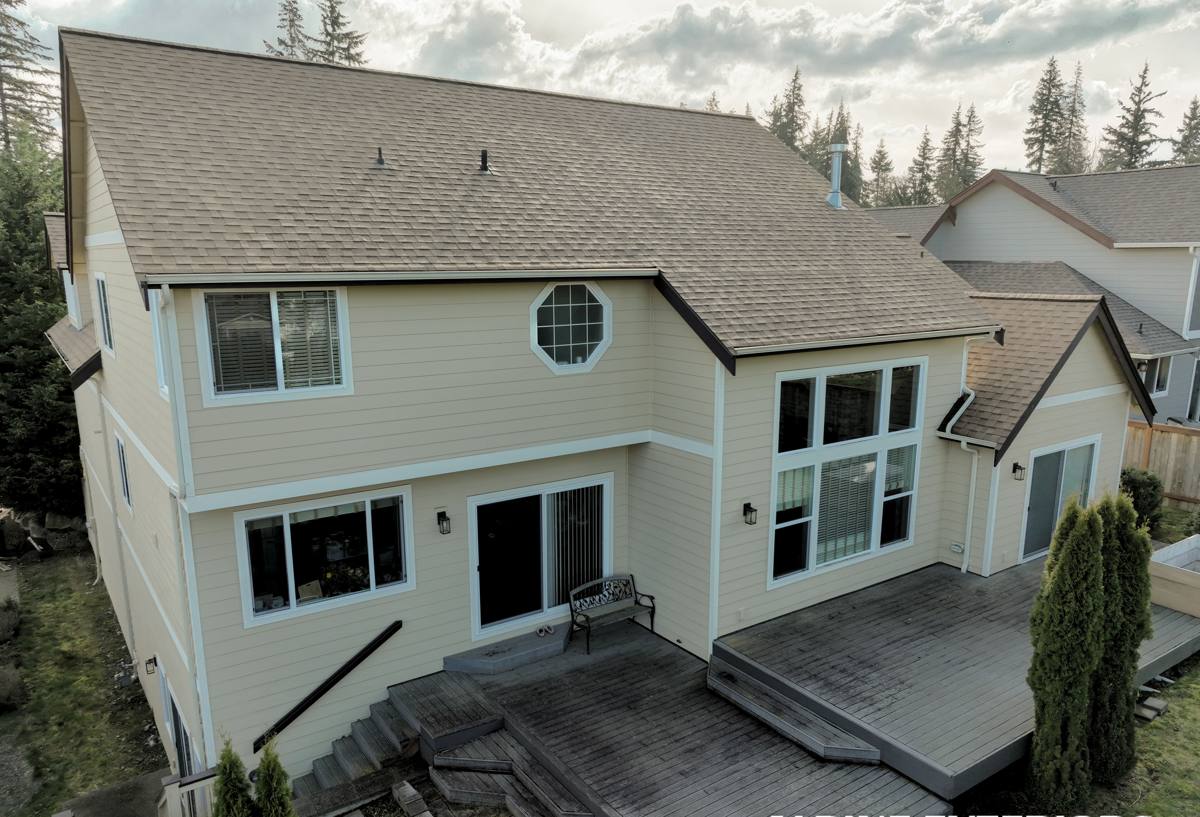
Fiber cement earns its place in coastal Pacific Northwest climates because it doesn't behave like wood-based products when it gets wet. It doesn't swell at cut edges, it doesn't provide an organic food source for the mold and mildew that thrive in prolonged dampness, and it holds paint and factory finish far longer than wood or wood-composite siding exposed to the same rain and humidity. For a Sunnyland home, that translates into a few concrete requirements:
- A siding material that resists moisture absorption at cut edges and butt joints, where most water intrusion problems start
- A factory finish that can handle UV exposure and salt air without chalking or fading within a few years
- A surface that doesn't feed algae and moss the way bare wood or some composite products do
- Fastener and flashing details that account for wind-driven rain, not just vertical rainfall
- Enough structural rigidity to resist impact and denting from storm debris and yard equipment
Fiber cement checks these boxes when it's the right product and it's installed correctly. Neither half of that sentence is optional — the material has to be engineered for this climate, and the installation has to respect the manufacturer's specifications, or you're just delaying the same moisture problems by a few years instead of solving them.
Why We Install Only James Hardie Fiber Cement
We standardized on James Hardie products years ago and we don't install LP SmartSide, vinyl, Cemplank, Allura, primed spruce, or cedar. That's not brand loyalty for its own sake — it's a decision based on how these products actually perform over a full ownership cycle in a wet coastal climate.
James Hardie makes climate-engineered HZ product lines specifically for regions like ours, meaning the formulation accounts for the moisture load and temperature swings of the Pacific Northwest rather than a one-size-fits-all national spec. The ColorPlus factory finish is baked on under controlled conditions, which gives it better fade and adhesion performance than field-applied paint, and it comes with a warranty on the finish itself, not just the substrate. Fiber cement is also non-combustible, which matters more every wildfire season, and Hardie's transferable warranty is a real asset if you ever sell the house.
We're not going to tell you other products are junk — LP SmartSide has genuine engineering behind it, vinyl is inexpensive and low-maintenance in the right application, and cedar has a look some homeowners specifically want. But each of those comes with a trade-off we're not willing to install and stand behind: SmartSide is a wood-strand product that depends entirely on intact factory sealant at every cut and edge; vinyl expands, contracts, and can crack or warp in ways that are hard to repair invisibly; cedar demands a maintenance commitment most homeowners underestimate, especially in a climate this wet. We'd rather install one product extremely well than offer five and cut corners on all of them.
What a Correct Installation Involves
Fiber cement is a forgiving material in some ways and completely unforgiving in others. The product itself resists moisture, but a poorly installed job can still trap water behind the siding and cause the same rot and mold problems people install fiber cement to avoid. A correct job includes:
Weather Barrier and Flashing
A properly lapped weather-resistant barrier behind the siding, correct flashing at every window, door, and roofline intersection, and kick-out flashing wherever a roofline meets a wall. This is where wind-driven rain gets stopped before it reaches the sheathing, and it's the step most likely to get rushed on a cut-rate job.
Clearances and Gaps
Manufacturer-specified clearance from grade, roofing, decks, and horizontal surfaces, plus gapping at butt joints so the panels aren't installed edge-to-edge with zero room for seasonal movement. Skipping these clearances is one of the most common causes of moisture damage in fiber cement installations, and it's invisible from the ground.
Fastening
Corrosion-resistant fasteners, driven to the correct depth — not too deep, not too shallow — and spaced according to the manufacturer's engineering, not guesswork. Overdriven or underdriven nails are a leading cause of premature siding failure and they're easy to miss on a walk-through.
Field Cutting and Sealing
Every field-cut edge sealed per manufacturer spec before installation, particularly important near the coast where salt air accelerates the breakdown of any exposed, unsealed edge.
Material Comparison for Sunnyland Homes
| Material | Moisture Behavior in Coastal Climate | Maintenance Burden | Typical Lifespan Here |
|---|---|---|---|
| James Hardie Fiber Cement | Resists swelling and rot; factory finish sheds moisture well | Occasional wash; repaint only if beyond ColorPlus warranty window | 30+ years with correct install |
| LP SmartSide / Wood-Strand | Depends on intact factory sealant; vulnerable at cuts and edges | Regular inspection of seams and touch-up sealing | Variable; sensitive to installation quality |
| Vinyl | Doesn't rot, but can warp, crack, or gap in wind and temperature swings | Low, but damaged sections are hard to color-match later | 20–30 years, shorter with impact damage |
| Cedar / Primed Spruce | Absorbs moisture readily; needs a sound paint film at all times | Repainting and moisture monitoring on a recurring cycle | Highly dependent on upkeep |
None of these numbers are guarantees — every material's real-world lifespan depends on installation quality, sun and shade exposure, and how consistently a homeowner keeps up with basic care. But the pattern holds across coastal Whatcom County: materials that tolerate moisture at the cut edge and hold a factory finish outperform materials that depend on an unbroken paint film or perfect sealant application to stay dry.
Our Process, Start to Finish
- Walk-through and assessment — we look at your current siding, trim, flashing, and any moisture or moss patterns specific to your home's exposure
- Product and color selection — choosing the right Hardie plank profile, panel size, and ColorPlus finish for your home's style and sun exposure
- Removal and sheathing check — old siding comes off and we inspect the sheathing underneath for any hidden rot or damage before anything new goes up
- Weather barrier and flashing installation — the part of the job that determines whether the siding stays dry for decades or fails early
- Fiber cement installation — installed to Hardie's published specifications for clearance, fastening, and sealed cuts
- Final inspection and walk-through — we go over the finished job with you before we consider it done
Maintenance in a Long Moss Season
Even the right siding, installed correctly, still lives in Whatcom County's climate. A long stretch of wet, mild weather every year gives moss and algae time to take hold, especially on shaded north- and west-facing walls common on lots with mature trees. ColorPlus finish resists staining better than field-applied paint, but it isn't immune, and shaded siding will collect more organic growth than siding in full sun regardless of material.
A simple annual rinse with a garden hose or low-pressure wash, keeping gutters clear so water isn't sheeting down the wall, and trimming back vegetation that keeps a wall shaded and damp will do more for your siding's long-term appearance than almost anything else. Avoid high-pressure washing directly at seams and butt joints — it can force water behind properly installed flashing that was never designed to handle that kind of pressure from the wrong angle.
Signs It's Time to Replace Your Siding
- Soft spots or visible swelling when you press on the siding, especially near the bottom courses or around windows
- Paint that's peeling or bubbling rather than just fading — often a sign moisture is trapped behind the surface
- Persistent moss or algae staining that returns quickly after cleaning
- Visible gaps, warping, or cracking at panel joints and corners
- Rising energy bills that track with drafts or cold spots along exterior walls
- Siding that's original to a home built more than 25–30 years ago and has never been fully inspected behind the surface
Any one of these on its own might just need a repair. Several together, especially combined with visible damage at flashing points, usually means it's worth a full inspection before deciding between patching and replacing.
Why Hire a Crew That Already Works in Sunnyland
Correct fiber cement installation isn't exotic, but it is detail-dependent, and those details change with local conditions. A crew that regularly works Sunnyland and the surrounding Bellingham neighborhoods already knows how wind-driven rain typically hits which sides of a house here, which lots tend to hold shade and moisture longest, and how salt air factors into fastener and finish choices near the bay. That's the kind of judgment that shows up in flashing details and clearance decisions you won't see on a spec sheet, and it's the difference between siding that performs for thirty years and siding that needs attention again in five.
If you're weighing a siding replacement or just want an honest read on what your current siding is telling you, we're happy to take a look. Reach out for a free, no-pressure estimate — someone will walk the exterior with you, answer your questions, and give you a straight assessment of what your home actually needs.