 Sudden Valley
 Why South Hill Homes Need Siding Built for This Climate
South Hill sits up above the rest of Sudden Valley, which means the homes here take weather a little differently than houses closer to the lake. More wind exposure, more direct rain off passing fronts, and depending on the lot, more shade from mature trees that keeps north- and east-facing walls damp long after a storm has cleared. None of that is unusual for Whatcom County — it's just the reality of building here. But it does mean the siding on a South Hill home is doing more work than siding on a house in a drier climate, and it needs to be a product engineered for that job, not just priced for it.
This is a local service page, not a general one, because the details actually change block to block. A wall that catches wind-driven rain needs different flashing attention than a sheltered wall. A shaded, tree-lined lot needs siding that won't feed moss and mildew the way some materials do. Elevation and exposure on the hill change how snow load and freeze-thaw cycles play out over a winter. We install James Hardie fiber cement exclusively, and on South Hill specifically, that choice earns its keep in ways a cheaper product just can't match.
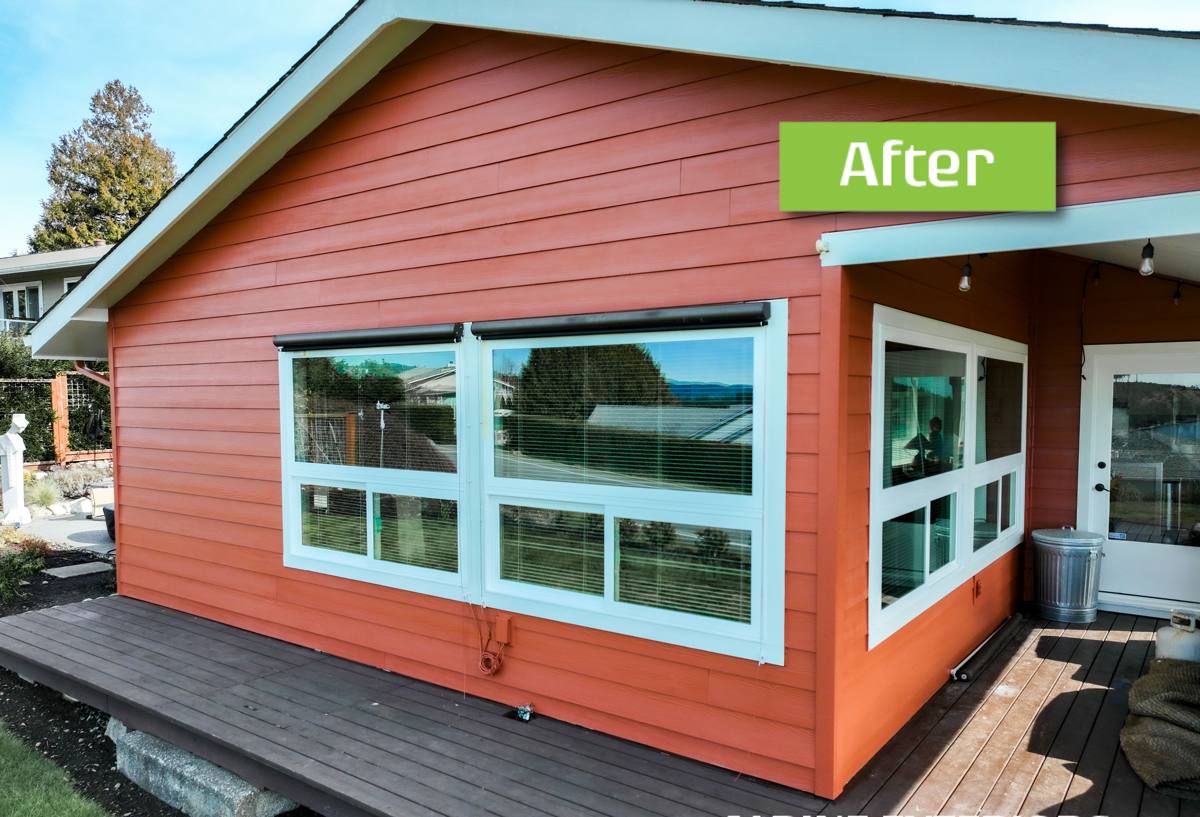
What Driving Rain and a Long Moss Season Do to the Wrong Siding
Whatcom County's marine climate means long stretches of steady, driving rain rather than short violent storms — the kind of weather that finds every gap in flashing and every weak seam over time. Add in salt-tinged marine air working its way inland off the Salish Sea and Bellingham Bay, and you've got a slow, constant pressure test on anything installed on the exterior of a home. Moss season here isn't a few weeks — shaded, north-facing walls can stay damp for months at a stretch, which is exactly the environment moss, algae, and mildew need to take hold.
Wood siding absorbs that moisture and swells, cracks, and rots from the inside out, usually before the visible damage tells you anything's wrong. Vinyl siding doesn't rot, but it flexes and gaps in temperature swings, giving moisture a place to collect behind it where nobody can see it happening. Engineered wood products like LP SmartSide use wood strand cores that, when moisture does get past the coating (usually at cut edges or fastener points), can swell and delaminate. None of these are hypothetical failure modes — they're the predictable result of putting a moisture-sensitive material in a climate that stays wet for most of the year.
Why We Install James Hardie — and Only James Hardie
James Hardie fiber cement is cement, sand, and cellulose fiber, not wood and not vinyl. It doesn't rot, it doesn't feed insects, and it doesn't warp or delaminate the way wood-based products can when they take on water. That's the baseline reason we standardized on it. The deeper reason is that Hardie engineers its products by climate zone, and the HZ5 formulation made for the Pacific Northwest is built specifically around the wet, temperate conditions South Hill sits in.
The HZ5 Engineering Behind Every Board
HZ5 fiber cement is formulated for moisture-heavy, moderate-temperature climates — engineered to resist moisture intrusion and hold its dimensional stability through the freeze-thaw cycles and constant damp that define a Whatcom County winter. It's not a cosmetic difference from Hardie's other regional formulations; it's a different mix designed for a different set of conditions. Installing anything other than the climate-matched product on a home exposed to this much sustained moisture is asking for problems the material was never built to handle.
ColorPlus Factory Finish vs. Field-Painted Siding
Most Hardie siding we install carries the ColorPlus finish — a color baked on in a controlled factory environment, cured, and backed by its own finish warranty, rather than painted on site after installation. In a climate where paint has to cure between rain events that can be days apart, factory finishing removes a major variable. It also resists fading and holds its finish integrity longer than field-applied paint typically does in this kind of weather, which matters when a homeowner is deciding between paying more up front for a coating that lasts, or repainting every several years.
What a Correct James Hardie Install Looks Like in South Hill
The siding board itself is only part of the equation. Most siding failures we get called out to inspect — regardless of brand — trace back to installation details, not the material. That's especially true in a climate this wet, where a small gap in flashing or a fastener driven wrong doesn't cause a problem next month, it causes one in three or five years, quietly, behind the wall.
Water Management Details That Matter Most Here
- Correct weather-resistive barrier installed and lapped properly behind the siding, not just stapled up as an afterthought
- Flashing at every window, door, and roofline transition, sequenced so water sheds outward and down, never behind the barrier
- Proper clearance between the bottom of the siding and decks, patios, roof lines, and grade — Hardie specifies these gaps for a reason, and skipping them is one of the most common causes of moisture damage we see
- Fasteners set to Hardie's specification for depth and spacing, not just "close enough" — overdriven or underdriven nails compromise the board's ability to move and shed water correctly
- Caulking used only where Hardie's install guide calls for it, not as a substitute for correct flashing
Product Lines That Fit South Hill's Homes
Hardie's lap siding profiles work well on the traditional and craftsman-style homes common through Sudden Valley, giving a clean, low-maintenance exterior that doesn't invite moss the way a rougher-textured wood product does. For homes with more architectural detail — gables, dormers, accent walls — Hardie shingle siding or the Artisan Collection can add that texture without giving up the moisture performance of fiber cement. Panel siding is a good fit for modern or contemporary designs, particularly on garages, accent sections, or homes going for a cleaner look. Which line makes sense depends on the home's design and exposure, and that's part of what we walk through on a site visit rather than guessing from a photo.
How James Hardie Compares in This Climate
| Material | Moisture & Rot Resistance | Moss/Mildew Behavior | Maintenance in This Climate |
|---|---|---|---|
| James Hardie fiber cement | Does not rot; HZ5 formulated for wet climates | Non-organic surface resists moss growth better than wood substrates | Occasional wash; ColorPlus finish holds color for years |
| Cedar / primed wood | Absorbs moisture; prone to rot without diligent upkeep | Organic surface is a food source for moss and mildew | Regular painting, sealing, and moss treatment required |
| Vinyl siding | Doesn't rot but can trap moisture behind panels | Moss and algae can grow on the surface, especially shaded walls | Low upfront upkeep, but hidden moisture issues go unseen |
| LP SmartSide (wood-strand) | Coated, but core can swell/delaminate if moisture reaches cut edges or fasteners | Better than raw wood but still an organic substrate | Edge and fastener sealing needs regular inspection |
What Drives the Cost of a South Hill Siding Job
| Factor | Why It Matters Here |
|---|---|
| Home size and wall complexity | More gables, dormers, and cut lines mean more labor and material waste |
| Current siding condition | Rot or hidden moisture damage found during tear-off may need sheathing repair before new siding goes on |
| Product line chosen | Lap, shingle, panel, and the Artisan Collection are priced differently |
| Site access and slope | Sloped South Hill lots can add setup and staging time compared to flat, easy-access properties |
| Trim and finish detail | Corner boards, accent trim, and color combinations add labor beyond the field siding itself |
We give firm numbers only after seeing the home in person — anyone quoting a whole-house siding job over the phone is guessing, and on a hillside property with real weather exposure, guessing is how corners get cut later.
Our Process, Start to Finish
We start with an on-site walk-around, looking at wall exposures, existing moisture damage, roofline and deck transitions, and anything specific to the lot — shade patterns, wind exposure, drainage. From there we remove the old siding and inspect the sheathing underneath, which is often the first time hidden rot or moisture damage actually gets found. Any damaged sheathing gets repaired before anything new goes up — covering a compromised wall with new siding just hides the problem for a future owner to deal with. Then it's weather-resistive barrier, flashing at every penetration and transition, and Hardie siding installed to the manufacturer's specification for fastening, clearance, and lap. We walk the finished job with the homeowner before calling it done.
Why a Crew That Already Works South Hill Matters
Siding installation instructions read the same on paper everywhere. What changes is judgment calls in the field — how much clearance to leave on a wall that catches more wind than the plan drawings would suggest, which walls on a shaded lot need extra attention to drainage detailing, how a hillside lot's drainage affects the bottom course of siding near grade. A crew that's worked houses on South Hill and elsewhere in Sudden Valley has already seen how this specific stretch of Whatcom County weather behaves against a wall, and that experience shows up in the details — not in anything a homeowner would notice on install day, but in whether the siding is still performing the way it should ten and twenty years out.
Maintenance That Keeps South Hill Siding Performing
- Rinse siding annually, and more often on shaded or north-facing walls prone to moss
- Keep gutters clear so water isn't overflowing directly onto siding runs
- Trim back vegetation and tree branches that keep walls shaded and damp longer than they need to be
- Inspect caulking at trim and penetrations every year or two, and have any gaps addressed promptly
- Have flashing and clearance points checked periodically, especially after major storms
A correctly installed James Hardie system needs very little of this compared to wood, but "very little" isn't "none" — a few minutes of attention a couple times a year is what keeps a good install performing for decades instead of just years.
If you're planning a siding project on South Hill or anywhere in Sudden Valley, we're glad to come take a look, walk the exterior with you, and put together a straightforward estimate — no pressure, no upsell to a product we wouldn't put on our own homes. Use the form below to get started.