 Sudden Valley
 Why Lake Whatcom Homes Wear Siding Differently
Houses around Lake Whatcom sit in a microclimate that's tougher on exterior siding than a lot of homeowners realize until they're standing in front of a wall that's failing years ahead of schedule. Sudden Valley wraps around the lake's southeast shore, and that proximity to open water means siding here deals with near-constant ambient moisture, long shaded stretches under second-growth timber, and a moss and algae season that can run eight or nine months out of the year. Add Whatcom County's driving winter rain — the kind that comes in sideways off the water during a southerly blow — and you have an environment where the wrong siding choice, or a right siding choice installed wrong, shows up as a problem in half the time it would take somewhere drier.
This page is specifically about siding replacement for homes in and around Lake Whatcom and Sudden Valley — not new construction, not a generic overview of siding in general. If you're looking at a home here where the siding is cupping, staining green-black in the shaded elevations, or has soft spots at the bottom courses, this is the situation we deal with regularly in this exact neighborhood.
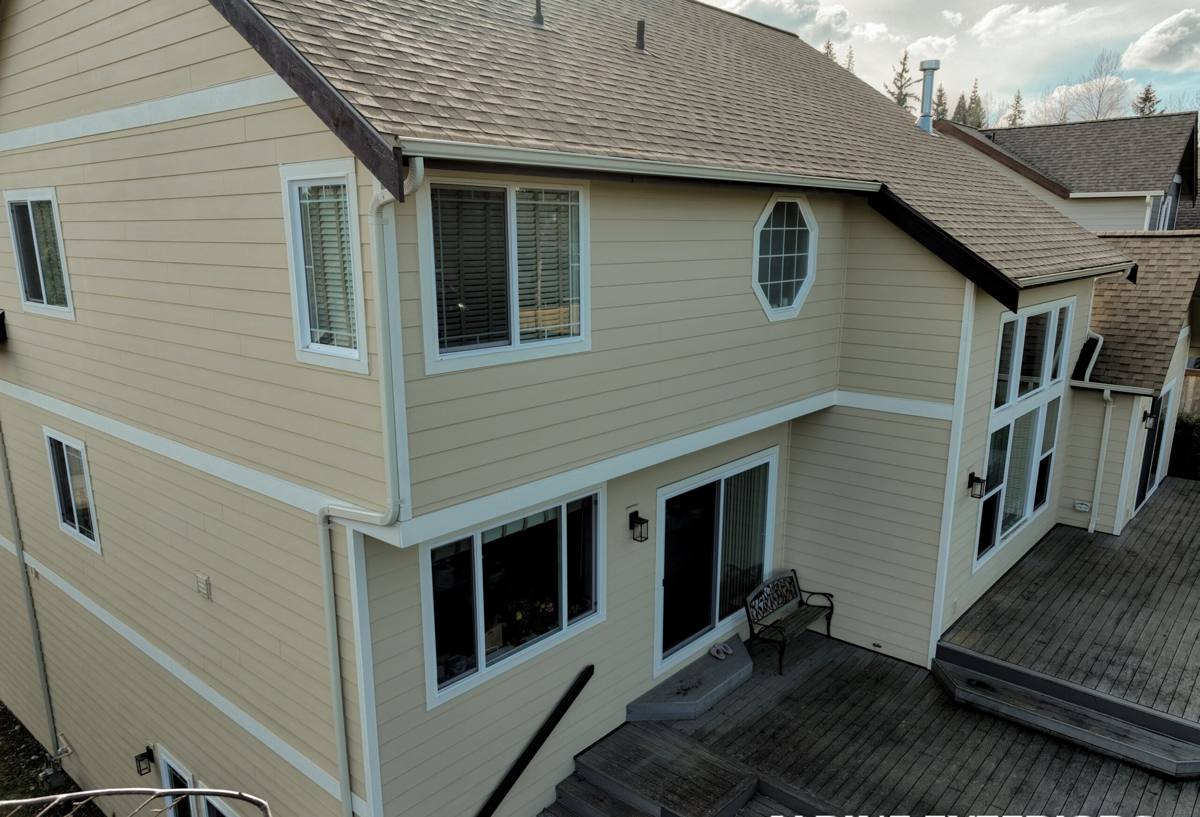
What the Lake Environment Actually Does to Siding
Moisture that doesn't dry out between rains
A lot of siding failure isn't about how much rain falls — it's about how long a wall stays wet between rain events. Homes tucked into tree cover on the lake side of Sudden Valley get less direct sun and wind exposure to dry out siding surfaces, especially on north and east elevations. Wood-based products (cedar, primed spruce, and engineered wood siding like LP SmartSide) are particularly sensitive to this because they rely on an intact paint or factory coating to keep moisture out of the wood fiber. Once that coating is compromised at a seam, a fastener, or a cut edge, the wood underneath can wick moisture and start to swell, delaminate, or rot from the inside out — often before it's visible from the ground.
Moss, algae, and organic growth
The combination of shade, humidity, and lake-effect moisture makes Sudden Valley prime territory for moss and algae growth on north-facing and lake-facing walls. This isn't just cosmetic. Moss holds moisture against the siding surface far longer than an open, sun-exposed wall would experience, which accelerates any moisture-related degradation underneath. Homes here often show a visible line where moss stops on a south wall and starts thickening toward the shaded, lake-facing side — a pretty direct visual record of where the wall has been staying wettest the longest.
Salt and mineral content from windborne moisture
While Lake Whatcom is freshwater, wind-driven moisture off the lake still carries mineral content and organic matter that settles on siding and trim, especially on homes closer to the shoreline or on exposed lots. Over years, that residue combines with UV exposure and humidity cycling to break down coatings faster than the same product would wear on a drier, more inland lot.
Signs a Lake Whatcom Home Needs Siding Replacement, Not Just Repair
- Soft or spongy siding when pressed near the bottom courses, around window sills, or at deck ledger connections
- Persistent dark staining or moss that returns within weeks of cleaning, especially on shaded elevations
- Visible cupping, warping, or separation at panel seams
- Paint that's failing in patches rather than evenly — often a sign of moisture trapped behind the surface
- Siding that feels cold and damp to the touch well after a dry spell
- Trim boards rotting at outside corners or window returns before the field siding shows obvious damage
- Any visible gap where siding has pulled away from the wall, allowing water behind the cladding
If you're only seeing isolated damage — a few boards near a downspout, for example — targeted repair may still make sense. But once moisture damage shows up on multiple elevations or has been recurring for more than a season or two, it's usually a sign the whole assembly (siding, house wrap, flashing) needs to come off and be redone correctly rather than patched again.
Why We Only Install James Hardie Fiber Cement Here
We don't install vinyl, LP SmartSide, cedar, primed spruce, Cemplank, or Allura. That's not a marketing line — it's a standard we hold specifically because of what we see on lake-adjacent homes in this area. Wood and wood-composite products depend on an intact factory or field coating to keep moisture out of an organic substrate, and in an environment with this much sustained humidity and shade, that coating gets tested constantly. Vinyl handles moisture fine on its own but has its own weaknesses here: it can warp under sustained heat-and-shade cycling, and it doesn't hold up well against the kind of impact and UV stress this region's weather delivers over a couple of decades.
James Hardie fiber cement is manufactured from cement, sand, and cellulose fiber — there's no organic wood core to rot, and it doesn't provide a food source for moss and mildew the way wood-based products can. Hardie's ColorPlus factory finish is baked on and warrantied separately from the substrate, which matters in a climate where field-painted surfaces face more UV and moisture cycling than the national average. Hardie also engineers regional HZ5 product formulations specifically for climates with sustained moisture exposure, which is exactly the profile Whatcom County and the Sudden Valley lake shore fit. We install it because it's the product we're confident will still look right and perform correctly on this specific site fifteen and twenty years out — not just at the walkthrough.
What Hardie doesn't fix on its own
To be fair to the product and to the homeowner: fiber cement siding is not immune to moisture problems if it's installed wrong. Hardie's own installation guidelines are specific about clearances, fastening, caulking, and flashing details, and skipping those steps on a lake-exposed home is how you end up with a Hardie job that still fails early. The product buys you a non-combustible, rot-proof substrate with a strong factory finish — it doesn't buy you immunity from bad water management behind the wall. That's why installation quality matters as much as the product choice itself, especially here.
What a Correct Siding Replacement Involves on This Site
Full tear-off and wall inspection
We remove the existing siding down to the sheathing rather than siding over it. On lake-adjacent homes this step matters more than usual — it's the only way to find hidden rot at window openings, deck ledgers, and bottom plates before it's covered up again for another decade.
House wrap and flashing correction
A proper water-resistive barrier, correctly lapped and taped, along with corrected flashing at every window, door, and penetration, is what actually keeps water out of the wall assembly — the siding itself is the second line of defense, not the first. In a high-moisture environment like this, we pay particular attention to head flashing above openings and kick-out flashing where roof lines meet walls, since these are the details that fail quietest and cause the most hidden damage.
Correct fastening and clearances
Hardie specifies minimum clearances from grade, roofing, and decking surfaces, plus specific fastener patterns and caulking requirements at butt joints. On shaded, damp elevations we hold to the tighter end of those tolerances rather than the loose end, since these are the walls that will stay wettest longest through the year.
Trim, caulking, and paint detailing
Even with a factory-finished product, field-cut edges and trim joints need to be properly sealed and back-primed where required. This is where a lot of the moss and staining problems we see on older homes actually started — an unsealed cut edge or a gap at a trim joint that let moisture in behind an otherwise sound wall.
Comparing Siding Options for a Lake Whatcom Home
| Factor | Vinyl | Cedar / Primed Spruce | James Hardie Fiber Cement |
|---|---|---|---|
| Moisture resistance | Good on its own, but can warp under shade/heat cycling | Depends entirely on coating integrity; vulnerable once breached | Non-organic substrate; doesn't rot or feed moss |
| Moss/algae resistance | Surface growth possible, doesn't affect substrate | Growth accelerates coating and wood breakdown | Surface growth cleanable without substrate risk |
| Fire resistance | Melts/deforms under heat | Combustible | Non-combustible |
| Finish longevity | Color can fade/chalk over time | Repaint cycle typically every 5-8 years | Factory ColorPlus finish, warrantied separately |
| Installation sensitivity | Moderate | High — coating and joinery details critical | High — requires correct clearances and fastening |
Our Process for Lake Whatcom and Sudden Valley Projects
- On-site assessment: we walk the exterior, check for soft spots, moisture readings where warranted, and evaluate which elevations are taking the most moisture and shade exposure
- Written scope and estimate: a clear breakdown of tear-off, wall repair allowances if needed, house wrap and flashing work, Hardie product and color selection, and labor
- Tear-off and hidden damage review: we don't finalize pricing on rot repair until the wall is open and we can actually see what's there
- Weather barrier and flashing correction: this is the step most corner-cutting jobs skip — we don't
- Hardie installation to manufacturer spec: correct clearances, fastening, and joint sealing, with extra attention on shaded and lake-facing walls
- Final walkthrough: we go over the finished work with you before calling the job complete
Why local experience with Sudden Valley homes matters
A crew that hasn't worked lake-adjacent homes before can install a technically correct product and still miss the site-specific judgment calls — where moss pressure is worst, which elevations need tighter clearances, where a previous owner's shortcuts are likely hiding. Working this neighborhood repeatedly means we've already seen where Sudden Valley homes tend to develop problems and we build the job around avoiding those, not just around a generic spec sheet.
Timing and Planning Considerations
Siding replacement in this area is best scheduled around Whatcom County's drier stretches, generally late spring through early fall, to keep sheathing and house wrap exposed to the weather for as little time as possible during tear-off. That said, moisture damage doesn't wait for good scheduling — if you're seeing active rot or water intrusion, it's worth getting an assessment regardless of season so you know what you're dealing with and can plan the work for the right window.
If you're seeing moss buildup, soft siding, or persistent staining on a Lake Whatcom or Sudden Valley home, we're happy to take a look and give you a straightforward, no-pressure estimate on what a correct replacement would involve — no obligation, just a clear picture of where things stand.