 Sudden Valley
 What Alger and Sudden Valley Siding Has to Stand Up To
Homes around Alger and Sudden Valley don't fail their siding because the material is old — they fail because the material was never suited to the conditions in the first place. This stretch of Whatcom County sits inside a pattern that's tough on exterior walls: salt-tinged marine air moving in off the water, long stretches of driving, wind-blown rain rather than gentle vertical rainfall, and a moss and algae season that can run most of the year on shaded, north-facing walls and anything tucked under tree cover. Add the tree canopy that surrounds most lots out here — more shade, slower drying, more organic debris landing on siding and trim — and you've got a climate that punishes any product that depends on a painted surface or a perfect factory seal to keep water out.
That combination is exactly why siding installation in this area needs to be treated differently than a job in a drier inland town. The material, the water-management details behind it, and the crew's familiarity with how this specific climate behaves all matter more here than they would somewhere with a shorter wet season.
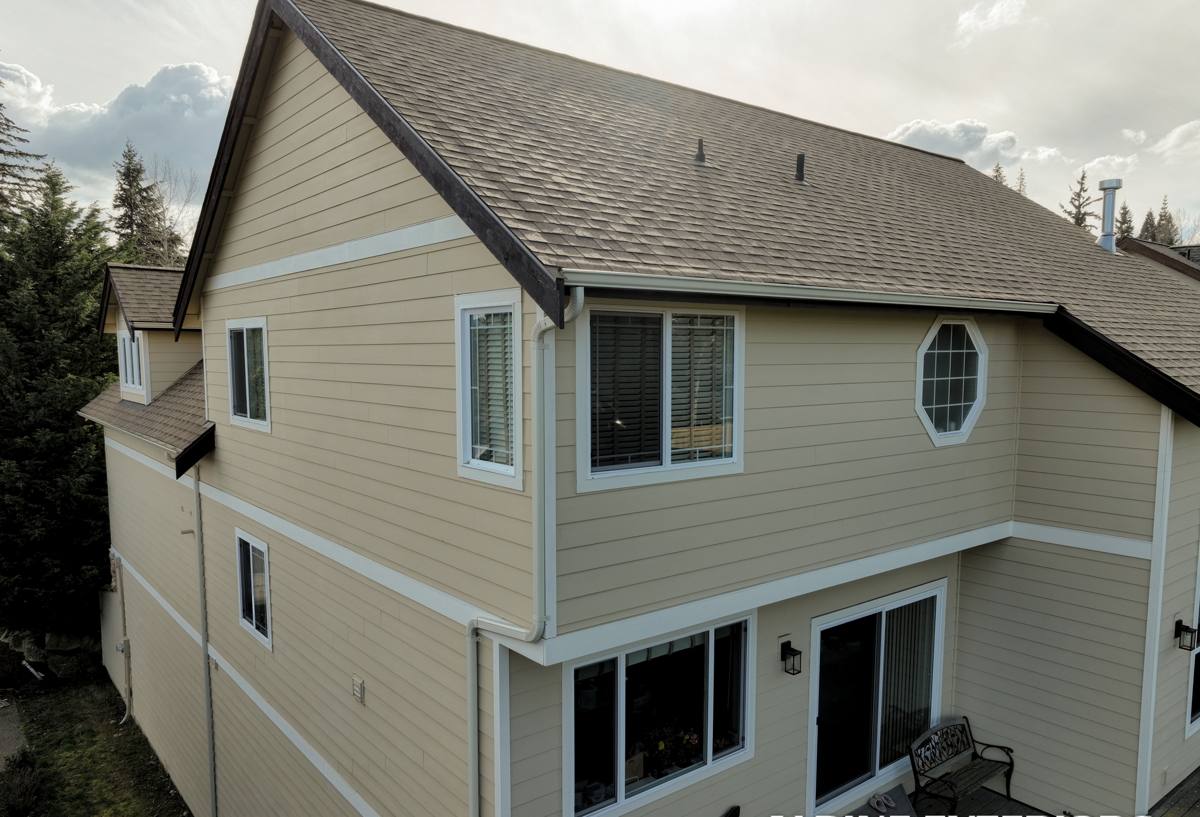
What "Correct" Siding Installation Actually Involves
Siding installation isn't just fastening boards to a wall. The siding itself is the visible 10% of the system — the other 90% is what's happening behind it, and that's where most premature failures start.
Water Management Comes First
Before a single board goes up, the wall needs a continuous water-resistive barrier, properly lapped and taped at every seam, with flashing integrated at every window, door, and horizontal transition. In a climate with sustained driving rain, any gap in that layer becomes a slow, hidden leak path — the kind that shows up two or three years later as rot in the sheathing, long after the siding itself looks fine from the street.
Fastening and Clearances
Fiber cement siding has specific fastening requirements — nail type, placement, and spacing that differ from wood or vinyl. Getting this wrong doesn't show up immediately; it shows up as buckling, cracking at fastener points, or boards that work loose over a few winters. Ground clearance, deck and roof-to-wall clearances, and gaps around penetrations also need to follow manufacturer specification, not just "close enough" — those clearances exist specifically to keep splash-back and standing moisture away from the bottom edge of the siding, which is the first place failure shows up on homes in wet, shaded settings like this one.
Caulking and Sealant Discipline
Certain joints need to be sealed, and certain joints should be left open to drain and dry. A crew that treats every seam the same way — either caulking everything or nothing — is setting up trapped moisture behind the cladding. This is a small detail that has an outsized effect on how a wall performs over a 15- or 20-year span in a marine climate.
Why We Install Only James Hardie Fiber Cement
We standardized on James Hardie fiber cement siding for every job we take on, including here in the Alger and Sudden Valley area, and we don't install vinyl, LP SmartSide, or other fiber cement alternatives. That's not a marketing position — it's a decision based on what actually holds up in this climate.
Fiber cement is non-combustible, doesn't rely on a plastic substrate that can soften or warp in sun exposure, and doesn't have the engineered-wood core that makes some competing products sensitive to sustained moisture exposure at cut edges and seams. James Hardie's HZ product lines are engineered specifically for different climate zones, and the HZ10 line used in the Pacific Northwest is built around the wetter, milder conditions this region sees — including the extended damp season that drives moss and algae growth on north- and shade-facing walls.
The ColorPlus factory finish is also a real advantage in a climate like this. It's baked on in a controlled environment rather than field-applied, which means better adhesion and color consistency, and it comes with its own finish warranty separate from the substrate warranty. On a home surrounded by trees and damp shade for much of the year, a finish that resists fading and doesn't need repainting on the same cycle as site-applied paint is a meaningful, practical difference — not a cosmetic one.
| Factor | What It Means for an Alger / Sudden Valley Home |
|---|---|
| Non-combustible core | No ignition risk from embers or radiant heat during wildfire smoke/ember events, unlike vinyl or wood-based products |
| HZ10 climate engineering | Formulated for sustained moisture exposure rather than dry, hot climates |
| Factory ColorPlus finish | Better fade and moisture resistance than field-painted or unfinished siding under heavy tree shade |
| Rigid fiber cement panel | Doesn't sag, ripple, or soften in sustained damp conditions the way some engineered-wood siding can at exposed edges |
| Transferable warranty | Coverage that follows the home if it's sold within the warranty period |
Our Installation Process for This Area
Every job follows the same sequence, adjusted for the specifics of the house:
- Site walk and existing wall assessment. We check for hidden rot, prior water damage, and the condition of the sheathing before quoting anything, since that determines whether repair work is needed before new siding goes on.
- Tear-off and substrate inspection. Old siding comes off, and the sheathing underneath gets a real look — this is where we find the moisture damage that's often invisible from outside.
- Water-resistive barrier and flashing. A continuous, properly lapped barrier goes on with flashing detailed at every window, door, and horizontal break, sized for the driving-rain exposure this area sees.
- Furring or drainage plane, where the wall assembly calls for it. On shaded, slow-drying walls, a drainage gap behind the siding helps the wall dry out between wet stretches instead of staying damp.
- Hardie panel or plank installation to manufacturer fastening specification — correct nail type, spacing, and clearances at grade, roofline, and penetrations.
- Trim, caulking, and touch-up using ColorPlus-matched materials so the finish reads as one continuous system, not a patchwork.
- Final walk-through where we go over clearances, drainage points, and basic care with the homeowner directly.
Signs Your Siding Is Overdue for Replacement
Homeowners in this area often wait longer than they should because siding problems don't always look dramatic from the curb. Watch for:
- Persistent moss or algae streaking that comes back within weeks of cleaning, especially on shaded or north-facing walls
- Soft spots, visible warping, or a spongy feel when you press on the siding near the bottom courses
- Paint that's peeling or bubbling in a pattern that follows seams or joints rather than general sun wear
- Visible gaps opening up at butt joints, corners, or trim where the siding meets windows and doors
- Rising utility bills that track with an aging or gapped exterior wall assembly
- Any sign of rot, discoloration, or a musty smell near the base of exterior walls or inside adjacent rooms
Any one of these on its own isn't necessarily an emergency, but two or three together usually mean the water-management layer behind the siding — not just the visible surface — has been compromised for a while.
What Siding Installation Costs and What Drives the Number
We don't quote pricing without seeing the house, but the range for a full siding replacement on a typical single-family home in this area is broad because so many factors change the scope. What actually moves the number:
| Factor | Why It Matters |
|---|---|
| Wall square footage and home shape | More corners, dormers, and cutouts mean more labor and material waste |
| Condition of the sheathing underneath | Rot repair adds cost but is far cheaper to fix now than after new siding is installed over it |
| Siding profile chosen | Lap, shingle, and panel styles carry different material and labor costs |
| Trim and detail work | Corner boards, window casing, and fascia detail add labor time |
| Access and site conditions | Steep lots, tree cover, and tight setbacks — common around Sudden Valley — can slow staging and scaffolding |
| Existing siding removal | Multiple old layers or asbestos-era materials require extra handling |
The honest answer is that a firm number only comes from a site visit — anyone quoting a whole-home price over the phone is guessing, and that guess is usually wrong in one direction or the other once the crew opens the wall.
Why It Matters That We Already Work This Area
A crew that's worked around Alger and Sudden Valley knows the practical realities that don't show up in a spec sheet: which orientations hold moss the longest, which lots stay shaded and slow-drying through most of the year, how tree debris and needle buildup behave against a wall over a wet winter, and what water-resistive barrier detailing actually needs to look like to survive a driving-rain season here rather than a dry-climate rain event. That local pattern recognition shows up in small decisions — where to add extra flashing, where a drainage gap is worth the added step, which clearances need to be generous rather than minimum-code — that a crew unfamiliar with the area might not think to prioritize.
It also means a shorter, more predictable timeline. Knowing local permitting expectations, typical weather windows for tear-off and dry-in, and the realities of getting equipment onto wooded or sloped lots all reduces the guesswork that drives delays and change orders on a siding project.
Caring for Hardie Siding After It's Installed
Fiber cement is low-maintenance compared to wood or field-painted alternatives, but "low-maintenance" isn't "no-maintenance," especially in a climate with a long moss season. A yearly rinse-down with a garden hose (not a pressure washer aimed directly at seams) keeps moss and organic buildup from taking hold, particularly on shaded walls. Keeping tree branches trimmed back from the siding reduces both shade-driven moisture retention and physical debris buildup at the base of walls. Caulked joints should be checked periodically and re-sealed if they crack or pull away, and any landscaping or mulch beds should be kept from piling material directly against the bottom edge of the siding, since that's the fastest way to trap moisture against an otherwise well-installed wall.
Get a Straight Answer for Your Home
If your siding is showing wear, or you're planning ahead for a home in the Alger or Sudden Valley area, we're glad to take a look and give you a straightforward assessment — no pressure, no inflated urgency. Request a free estimate below and we'll walk the property with you and talk through what your home actually needs.