 Sudden Valley
 Siding Repair Built for Sunnyland's Conditions, Not a Generic Checklist
Sunnyland is one of the older, established residential neighborhoods in the Bellingham area, and homes here carry the marks of Whatcom County's marine climate more visibly than newer construction farther inland. Salt air moving in off Bellingham Bay, wind-driven rain that hits siding sideways instead of falling straight down, and a moss season that can run most of the year all put steady pressure on exterior walls. Siding repair in this neighborhood isn't just about patching what's visibly cracked or peeling — it's about understanding why that particular section failed in the first place, and making sure the repair doesn't just recreate the same failure a year or two later.
We work Sunnyland regularly, which matters more than it might sound like. A crew that only shows up for a single job has to relearn the neighborhood's quirks every time — which elevations take the worst weather, which older homes have siding details that don't match current building practice, which repairs tend to need more than they first appear to. A crew that already knows the area starts the job with that knowledge instead of discovering it partway through.
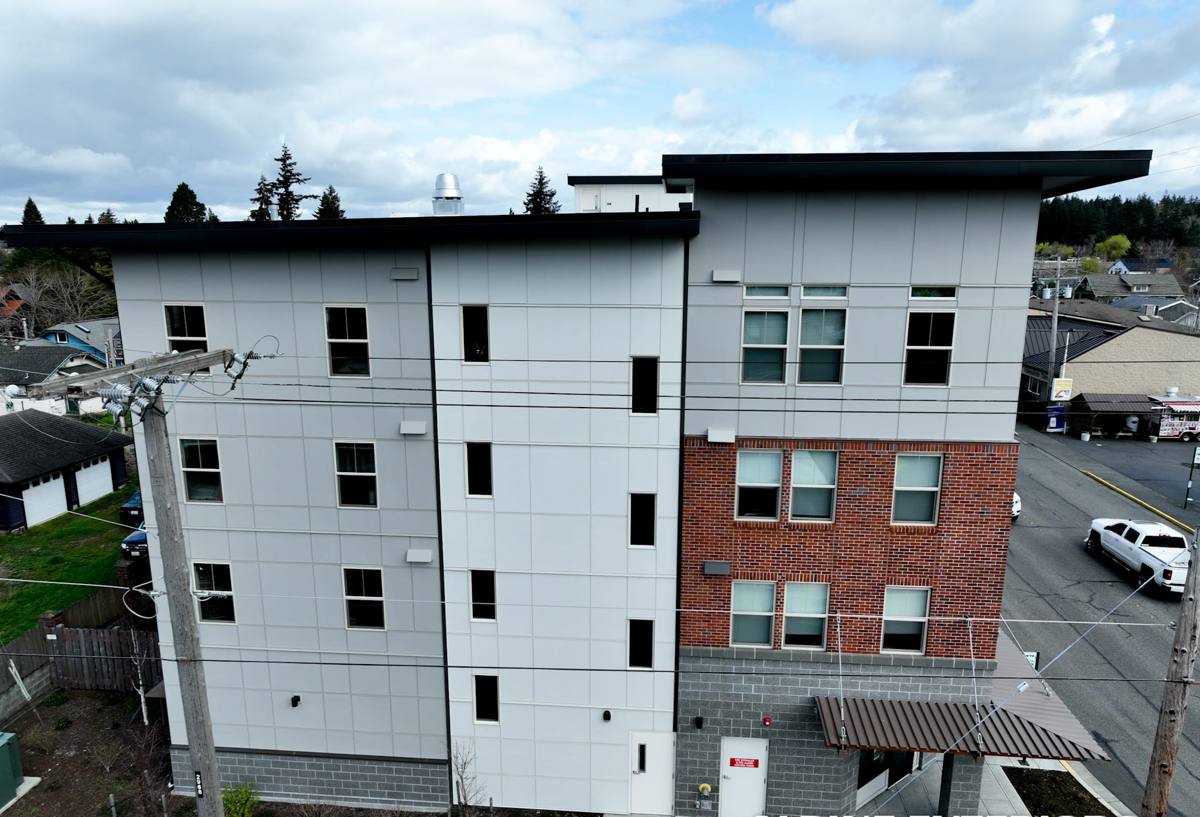
What Sunnyland's Climate Actually Does to Siding
Salt Air and Slow Corrosion
Proximity to Bellingham Bay means homes in this part of town deal with airborne salt in a way that inland Whatcom County properties don't. Salt air accelerates corrosion in exposed fasteners, flashing, and any metal trim components, and it can degrade lower-quality paint and coatings faster than a straightforward rain-and-sun climate would. On siding, the practical effect shows up as rust streaking around nail heads, premature coating breakdown, and corrosion at seams and joints where metal components meet the siding material.
Driving Rain That Hits Walls Sideways
Whatcom County's weather doesn't just fall — it blows. Wind off the water pushes rain horizontally into wall assemblies, especially on west- and south-facing elevations that catch the prevailing weather. That matters for repair work specifically because a patch that would hold up fine under vertical rainfall can still fail under driving rain if the lap, caulk line, or flashing detail isn't built to shed water moving sideways and upward under wind pressure, not just downward under gravity.
A Long Moss and Mildew Season
Cool temperatures, high humidity, and tree cover across much of Sunnyland keep moisture sitting on exterior surfaces for long stretches of the year. Moss and mildew don't just look bad — they hold moisture directly against the siding surface, which is exactly the wrong condition for any material that's sensitive to sustained dampness. On older or already-compromised siding, that constant damp contact is often what turns a small crack or gap into a genuine moisture intrusion problem.
How to Tell Your Siding Needs Repair, Not Just Cleaning
A lot of Sunnyland homeowners call about "dirty" siding that turns out to be something more serious once we're up close. Here's a practical way to sort one from the other before you call anyone:
- Soft or spongy spots when you press on the siding — almost always moisture damage underneath, not surface dirt.
- Visible cracking or splitting, especially along butt joints or near corners — an entry point for water even if it looks minor.
- Peeling or bubbling paint that keeps coming back after repainting — usually a sign moisture is moving through the material, not a coating problem.
- Dark staining or streaking that doesn't wash off — can indicate ongoing moisture tracking rather than surface grime.
- Gaps opening up at seams, corners, or trim boards — often a sign of movement, warping, or fastener failure underneath.
- Moss or mildew that returns quickly after cleaning — points to a wall assembly that isn't drying out between wet spells.
If what you're seeing is limited to surface grime and green film with no softness, cracking, or staining underneath, a wash may genuinely be all that's needed. Everything on that list above it usually isn't.
What a Correct Siding Repair Actually Involves
A repair that just covers the visible damage without addressing the cause tends to fail again, often faster than the original problem took to develop. Here's what we actually do on a Sunnyland siding repair call:
1. Diagnose Before Touching Anything
We start by figuring out why that section failed — a flashing gap, a caulk joint that opened up, siding installed too close to grade or a roofline, a fastener that backed out, or simple material fatigue after years of salt air and driving rain. Repairing the symptom without identifying the cause is how the same spot ends up needing repair again in two years.
2. Check for Hidden Moisture Damage
Visible siding damage is often the smallest part of the problem. We check the sheathing, house wrap, and framing behind the affected area for moisture intrusion, soft wood, or the start of rot. A siding-only repair over compromised sheathing is a temporary fix at best — the water damage keeps spreading behind a patch that looks fine from the outside.
3. Correct the Water Management Detail, Not Just the Board
If the original failure traces back to a flashing, caulking, or clearance issue, we fix that detail as part of the repair — not as an afterthought. Replacing a damaged board without correcting the water intrusion path it failed at just resets the clock on the same failure.
4. Match Material and Finish Properly
On Hardie siding, this means matching the correct plank profile, exposure, and factory finish so the repair blends in rather than creating an obvious patch. On other materials, matching is often harder — which is one of the practical reasons material choice matters even at the repair stage, not just at installation.
5. Reinstall to Spec
Correct fastener type and spacing, proper clearances from grade and rooflines, and properly lapped and sealed joints — the same installation standards that apply to a full siding job apply to a repair section. A repair installed loosely will fail again regardless of how sound the material itself is.
Repair vs. Replacement: Making the Right Call
Not every damaged section needs a full re-side, and not every repair is worth doing instead of replacement. The right call depends on how much of the wall is actually affected and what's driving the damage.
| Situation | Repair Usually Makes Sense | Replacement Usually Makes Sense |
|---|---|---|
| Damage extent | Isolated to one or two sections, single elevation | Spread across multiple walls or the whole house |
| Underlying cause | Identifiable, fixable point issue (flashing, impact, one bad joint) | Systemic — original material or installation is failing broadly |
| Sheathing condition | Sound, no rot found behind the damaged area | Soft, stained, or rotted sheathing found during inspection |
| Material age | Siding is relatively young and otherwise performing well | Siding is near or past its realistic service life |
| Material type | Hardie fiber cement, where sections match well | Older or discontinued products that are difficult to match |
We'll tell you honestly which side of that table your house falls on. If a repair is genuinely the right call, that's what we'll recommend — we don't upsell a full re-side to a homeowner who doesn't need one. If the damage points to a broader problem, we'll explain exactly why before you spend money on a fix that won't hold.
Why We Only Repair and Install James Hardie Fiber Cement
We install and repair James Hardie fiber cement siding exclusively. We don't work with LP SmartSide, vinyl siding, Cemplank, Allura, primed spruce, or cedar, and that's a deliberate professional standard, not a supply limitation.
- Non-combustible core: Fiber cement doesn't feed a fire the way wood-based products can, which matters for both homeowner safety and insurance considerations.
- Factory-applied ColorPlus finish: Baked on under controlled conditions rather than field-applied, it holds up to salt air and sustained moisture far longer than site-applied paint, and repaired sections can be matched to it more reliably.
- Climate-engineered HZ formulations: Hardie's HZ5 product line is built for regions with heavy moisture exposure and freeze-thaw cycling, which fits Whatcom County's coastal, wet-winter conditions.
- Dimensional stability: Fiber cement resists the swelling, cupping, and warping that engineered wood and some composite products develop after repeated wetting cycles — a real factor in a neighborhood that rarely gets a long dry stretch to fully recover.
- Strong transferable warranty: Hardie backs its products with a substantial warranty structure when installed to spec, which also applies to correctly performed repairs on existing Hardie siding.
Each of the products we don't install has a legitimate place in the market, and other contractors use them well. Our decision comes from what we've consistently found on service and repair calls in exactly this kind of coastal, wet climate — not from a claim that any of them are broadly defective. We'd rather stand fully behind one system, including how it repairs and ages over time, than offer a cheaper option and leave the long-term maintenance risk with the homeowner.
Repairing Non-Hardie Siding
If your home has vinyl, LP SmartSide, cedar, or another material we don't install new, we can still assess it honestly and tell you what your realistic options are — including whether a straightforward repair makes sense, or whether the smarter long-term move is transitioning that section, or the whole exterior, to Hardie fiber cement during the repair. We won't pretend a material we don't sell is worse than it is just to steer you toward our product — we'll give you the same honest read we'd want if it were our own house.
Our Sunnyland Siding Repair Process
- On-site inspection: We look at the damaged area and the surrounding wall assembly, not just the spot you called about — related issues often show up nearby.
- Honest diagnosis: We explain what caused the failure, in plain terms, before we talk about fixing it.
- Clear scope and pricing: You get a written scope of what needs to happen and why, so there's no ambiguity about what you're paying for.
- Repair or replace, done to spec: Correct materials, correct fasteners, correct water management details — no shortcuts because it's "just a repair."
- Cleanup and walkthrough: We show you the completed work and explain any maintenance that will help it last, given Sunnyland's climate.
What Sunnyland Homeowners Should Watch For Between Repairs
Even well-executed repairs benefit from a little seasonal attention in a climate like this one. A few habits go a long way toward catching problems while they're still small and inexpensive to fix:
- Rinse moss and mildew off siding gently once or twice a year rather than letting it build up and hold moisture against the surface.
- Check caulk lines around windows, doors, and trim annually — driving rain finds gaps quickly in this climate.
- Keep gutters clear so overflow doesn't run down and saturate wall sections repeatedly.
- Trim back vegetation and tree limbs that keep siding shaded and damp longer than it needs to be.
- Have any soft spots, new cracks, or returning stains looked at promptly rather than waiting for the next scheduled maintenance.
None of this replaces a professional inspection when something looks genuinely wrong, but it does reduce how often you need one.
Get an Honest Look at Your Siding
If you're seeing damage, staining, or recurring moss on your Sunnyland home's siding and aren't sure whether it needs a repair or something more, we're glad to take a look. We'll tell you plainly what we find, what caused it, and what it will actually take to fix it right — no pressure, no inflated scope. Reach out for a free estimate using the form below.