 Sudden Valley
 Roofing on Yew Street Isn't the Same Job as Roofing Somewhere Else
Homes along Yew Street sit inside a specific set of conditions: tree cover that keeps roofs shaded and damp longer than open lots nearby, moisture-laden marine air rolling in off the water, and a rain pattern that leans toward long, soaking systems rather than short downpours. None of that is unique to one house — it's the whole Sudden Valley footprint — but it adds up differently on a roof that sits under fir and cedar canopy most of the year than it does on a roof out in the open. If you've owned a home here for more than a couple of winters, you already know the roof does more work than the siding, the windows, or almost anything else on the exterior.
This page is about one product, in one place: standing seam and exposed-fastener metal roofing for Yew Street homes. Not a general "why metal roofing is great" pitch — the specific decisions that matter when the roof in question is going to spend most of its life shaded, damp, and exposed to Whatcom County's version of coastal weather.
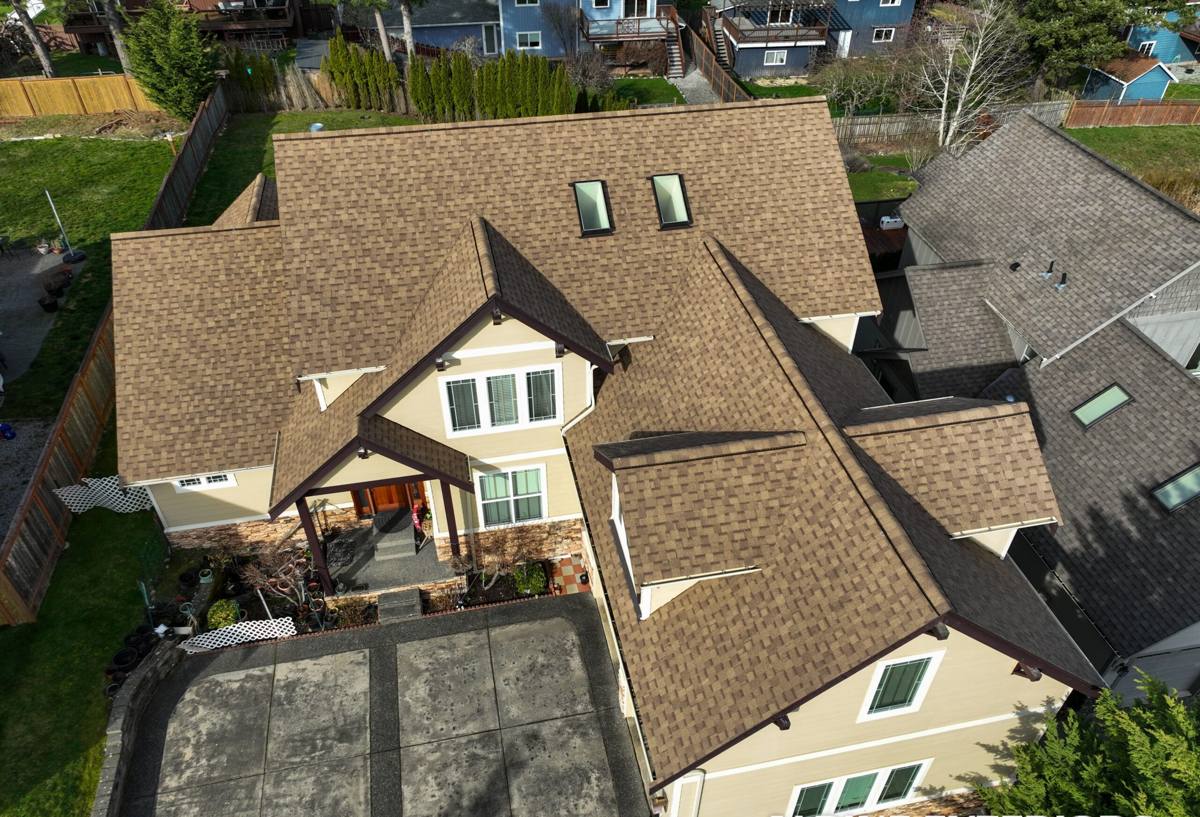
What Whatcom County Weather Actually Does to a Roof
Moisture that doesn't leave
Whatcom County gets a lot of rain, but the bigger issue for roofing is how long a roof surface stays wet after the rain stops. Driving rain during winter storms pushes water sideways under flashing details that aren't built for it, and tree-shaded sections of roof dry out slowly, sometimes taking days. Materials that hold moisture against their surface — organic-mat shingles, aging wood shakes, anything with exposed fastener heads that aren't properly sealed — pay for that slow drying over time.
Moss and organic growth
A long moss season is the most visible sign of this climate at work. Moss doesn't just look bad; it holds water against the roofing material, lifts shingle edges, and works its way into laps and seams. On a roof with a lot of shade, moss can get established within a year or two of a cleaning if the roofing surface gives it something to grip.
Salt-influenced marine air
Homes in this area also deal with a steady dose of marine air — not the direct salt spray you'd get right on the open coast, but enough airborne moisture and mineral content over years to matter for anything metal. It's a slow, cumulative effect: fasteners, flashing, and unprotected metal edges corrode faster here than they would in a dry inland climate.
Why Metal Roofing Is a Strong Fit for Yew Street Homes
Metal roofing isn't the right call for every home or every budget, but for the specific conditions on Yew Street, it addresses the two biggest problems directly:
- Moss resistance: a smooth, hard metal surface gives moss and moisture far less to hold onto than shingle granules or wood grain, so growth is slower and easier to remove when it does start.
- Water shedding, not water absorption: metal panels shed driving rain instead of soaking it up, which matters on a roof that already stays damp longer under tree cover.
- Long service life relative to maintenance: a correctly installed metal roof in this climate typically outlasts asphalt shingles by a wide margin, which matters when re-roofing means bringing in equipment through a wooded lot.
- Fire-conscious material: metal is noncombustible, which some homeowners weigh heavily given how close tree canopy sits to the roofline in parts of the neighborhood.
None of that means metal roofing is maintenance-free. It means the maintenance it does need is different — and more manageable — than what a shaded shingle roof needs in this same climate.
What a Correct Metal Roofing Job Involves Here
Deck and moisture barrier
Before a single panel goes down, the roof deck needs to be sound and dry, and it needs a proper underlayment — typically a synthetic, high-temp ice-and-water-style membrane at eaves, valleys, and penetrations where driving rain is most likely to find a way in. Skipping or skimping on this step is the single most common cause of hidden leaks on metal roofs installed in wet climates.
Fastener and seam detailing
Exposed-fastener panels rely on properly torqued screws with intact rubber washers — over-driven or under-driven fasteners are a leading cause of early leaks and are worth catching during installation, not years later. Standing seam systems avoid exposed fasteners altogether by using concealed clips, which holds up better long-term in a climate with this much sustained moisture.
Flashing at every transition
Valleys, chimneys, skylights, and wall transitions are where roofs actually fail — the field of the roof rarely leaks; the details around it do. Flashing has to be layered correctly with the underlayment and panel laps so wind-driven rain can't get pushed backward under an edge.
Ventilation
A shaded roof that doesn't breathe traps moisture in the attic space, which shortens the life of the deck underneath the metal regardless of how good the panels are. Ridge and soffit ventilation sized correctly for the roof matters just as much as the roofing material itself.
Panel Types and What They Trade Off
| Option | Best for | Trade-offs |
|---|---|---|
| Standing seam (concealed fastener) | Homes wanting the longest service life and cleanest look, minimal maintenance | Higher upfront cost, requires experienced installation crew |
| Exposed-fastener panel (screw-down) | Budget-conscious re-roofs, outbuildings, simpler rooflines | Fasteners and washers need periodic inspection; more seams exposed to weather |
| Stone-coated steel | Homeowners wanting a shake or tile look with metal's durability | More cost than basic panel, coating detail matters for long-term appearance |
| Aluminum vs. steel substrate | Aluminum: added corrosion resistance in marine-influenced air | Steel: lower cost, still performs well with correct coating and fastener choice |
We don't push one option as universally "best." A steep, simply-shaped roof on an open lot has different needs than a lower-slope roof buried in tree shade a few doors down. The panel choice should follow the roof's actual conditions, not a one-size answer.
How Our Process Works
1. On-site assessment
We look at the existing roof deck, the amount of tree cover and shading, current ventilation, and where moss or moisture damage has already started. This is also where we talk through panel type, color, and budget honestly — including telling you if metal isn't the right call for your situation.
2. Written estimate
You get a clear scope: tear-off or overlay, underlayment spec, panel type, flashing details, and ventilation work, with a firm price — not a range that grows once the crew is on the roof.
3. Installation
Deck repair or replacement as needed, underlayment, panels, and flashing installed in sequence with attention to the transitions that actually cause leaks. We work efficiently around tree-shaded, tight-access lots common in this neighborhood.
4. Walkthrough and cleanup
We walk the finished roof with you, cover care and inspection basics specific to your panel type, and make sure the site is cleaned up — fasteners, packaging, and debris don't get left in the yard or gutters.
Signs a Yew Street Roof Needs a Look
- Moss visible on the roof surface for more than one season in a row, even after cleaning
- Granule buildup in gutters (a sign shingles are breaking down) or visible rust streaking on existing metal
- Soft spots, sagging, or discoloration on ceilings after heavy rain events
- Loose, lifted, or missing shingles/panel edges after wind storms
- Daylight visible through the attic roof deck, or damp insulation near the eaves
- Fascia or soffit wood that's soft, discolored, or peeling near the roofline
Any one of these is worth a look before it becomes a bigger repair. On a shaded, moisture-heavy roof, small problems tend to get worse faster than they would in a drier climate.
Maintenance That Actually Fits This Climate
Metal roofing lowers the maintenance burden here, but it doesn't eliminate it. A realistic maintenance rhythm for a Yew Street home looks like periodic gutter and valley clearing (tree cover means more debris than open lots), an annual visual check of flashing and fastener condition, and gentle moss removal — not pressure washing, which can drive water under laps and strip protective coatings. Marine-air corrosion is slow but steady, so fastener and cut-edge condition is worth checking every few years even on a well-installed roof.
Why a Crew That Already Works This Neighborhood Matters
Roofing crews that only see a street once don't build the pattern recognition that comes from working the same conditions repeatedly. A crew that's roofed multiple homes in this specific area already knows which valleys tend to collect debris fastest under this tree cover, how much moss growth to expect between cleanings in shaded sections, and which flashing details need extra attention given the driving-rain pattern this part of Whatcom County gets in winter storms. That's not a marketing point — it's the difference between a roof that's installed to a generic spec and one that's installed for the conditions it will actually sit in for the next several decades.
It also means faster, more informed service after the install — for inspections, storm damage checks, or questions about how the roof is holding up, without starting from zero on unfamiliar site conditions every time.
Get a Straight Answer for Your Roof
If you're weighing a metal roof for a Yew Street home, the honest first step is a look at your specific roof — its shade, slope, current condition, and what's realistic for your budget. We offer free, no-pressure estimates and will tell you plainly whether metal roofing is the right fit before we ever talk about a price. Use the form below to get a time on the calendar.