 Sudden Valley
 Building a Deck That Actually Holds Up in Alger
Homes in and around Alger sit close enough to the water that the air carries a faint edge of salt most of the year, and the region's long, wet stretch from fall through spring puts any outdoor structure through a real test. A deck here isn't just a weekend carpentry project — it's an exterior structure that has to survive standing moisture, shaded moss growth, and the slow corrosion that salt-tinged air causes in fasteners and hardware. We build decks specifically for this environment, not a generic deck template pulled from a drier part of the country.
This page covers what a deck in the Alger area actually needs, what a correct build looks like from the footings up, and how our process works for homeowners near Sudden Valley who want something that lasts decades instead of needing a rebuild in eight or ten years.
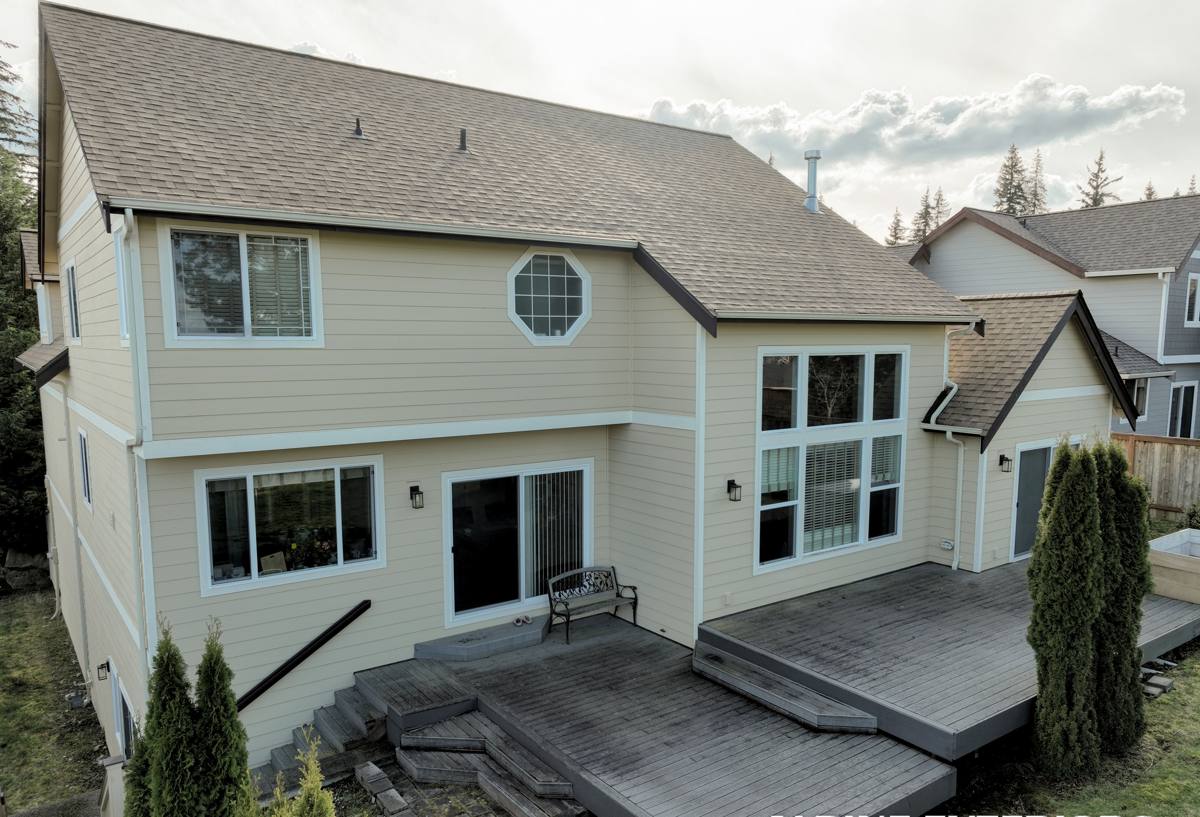
What This Climate Demands From a Deck
Three things drive almost every deck failure we see in this part of Whatcom County and the surrounding area: moisture that never fully dries out between rain events, shaded or low-airflow spots that grow moss and algae fast, and metal hardware that corrodes faster than homeowners expect because of the salt content in the air near the water.
Driving Rain and Standing Moisture
Western Washington rain rarely falls straight down — wind pushes it sideways into ledger connections, under decking boards, and into any gap that wasn't properly flashed or sealed. A deck built without attention to water shedding will trap moisture in the framing long after the surface looks dry.
The Long Moss Season
Shaded decks, north-facing decks, and decks tucked under trees stay damp for months at a stretch. Moss and algae aren't just cosmetic here — they hold moisture against the decking surface and turn boards slippery, which is a real fall hazard on stairs and landings.
Salt Air and Corrosion
Fasteners, joist hangers, and structural screws that would last for years in a drier inland climate can start showing rust streaks and weakening within a few seasons near the water. This is one of the most common causes of premature deck failure we're called out to inspect.
The Ledger Connection: Where Most Decks Fail First
The ledger board — where the deck attaches to the house — is the single most important detail on any deck, and it's the spot we see cut corners on most often in older or DIY-built decks in this area. If the ledger isn't flashed correctly, water runs behind the siding and into the rim joist and wall framing, often for years before anyone notices rot or soft spots.
A correct ledger connection includes:
- Proper flashing installed so water sheds outward and away from the house, never trapped behind it
- A gap or flashing detail that keeps the ledger from sitting flush against wet siding
- Lag bolts or through-bolts rated for the load — not just deck screws
- Sealant used as backup, never as the primary water barrier
When we're called to look at a failing deck near Sudden Valley or the wider Alger area, the ledger is the first place we check, and it's the source of the problem more often than the decking surface itself.
Decking Material Comparison
There's no single "right" decking material — it depends on budget, how much maintenance a homeowner wants to keep up with, and how shaded or exposed the deck's location is. Here's how the common options compare for a climate like this one:
| Material | Upfront Cost | Moss/Moisture Behavior | Maintenance | Realistic Lifespan |
|---|---|---|---|---|
| Pressure-treated wood | Lowest | Absorbs moisture; needs sealing to resist moss and rot | Annual cleaning + re-sealing every 2-3 years | 10-15 years with upkeep |
| Cedar | Moderate | Naturally more rot-resistant but still needs sealing | Sealing/staining every 2-3 years | 15-20 years with upkeep |
| Composite decking | Higher | Doesn't absorb water like wood; still needs surface cleaning where moss can grow on top | Periodic washing, no sealing | 25-30 years |
| PVC/capped composite | Highest | Best moisture resistance; sheds surface algae most easily | Occasional washing | 30+ years |
For homeowners in shaded, moss-prone lots near Sudden Valley, we usually steer the conversation toward composite or capped decking for the walking surface — not because wood is a bad product, but because a wood deck in a low-airflow spot demands a maintenance commitment a lot of owners don't end up keeping up with. That's an honest trade-off conversation, not a sales pitch for one brand over another.
Framing, Fasteners, and Hardware
The framing underneath the decking does the real structural work, and it's where corrosion resistance matters most because it's the hardest part to inspect once the deck is finished.
What We Use and Why
- Stainless steel or heavy hot-dip galvanized fasteners rated for the salt exposure in this area, not standard zinc-coated screws that show rust within a season or two
- Joist hangers and structural connectors rated for exterior/coastal exposure
- Ground-contact rated lumber for any framing member within reach of splashback or standing moisture
- Joist tape over the tops of framing lumber to keep water from soaking into end grain and fastener holes
Cutting corners on hardware is invisible on move-in day and expensive five years later, when hangers are rusted through and boards start to feel spongy underfoot.
Footings, Drainage, and Ground Conditions
Footing depth and drainage matter more here than in drier climates because saturated soil around a footing can shift over a wet winter. We dig footings to the depth required for the site conditions and local frost/soil guidance, and we make sure the ground under and around the deck can actually shed water instead of pooling against posts.
On sloped or low-lying lots — common in the hillier terrain around Sudden Valley and the Alger area — we also look at whether the deck's footprint is creating a dam effect that traps runoff against the house foundation. A deck that solves one problem while creating a drainage problem isn't a good outcome, even if the decking itself looks great.
Handling Moss and Slip Risk
No decking material is fully moss-proof if it sits in deep shade with poor airflow, but design choices make a real difference:
- Spacing decking boards correctly so air and water move through, not just across the surface
- Orienting the deck and railing layout to maximize whatever sun exposure the lot allows
- Choosing a decking surface texture that sheds algae more easily where full shade is unavoidable
- Planning stair treads and landings with extra attention to slip resistance, since these see the most foot traffic in wet conditions
Our Deck-Building Process
The process is the same whether the project is a full rebuild or new construction, and it doesn't skip steps to move faster:
- On-site assessment — we look at the house's ledger location, drainage patterns, sun exposure, and existing structure (if it's a rebuild)
- Design and material selection — sized to the site, with an honest conversation about decking material trade-offs for that specific spot
- Permitting — we handle the permit application and coordinate any required inspections
- Footings and framing — footings poured to the required depth, framing built with corrosion-resistant hardware throughout
- Ledger flashing and attachment — done to code, checked before it's covered by decking
- Decking, railings, and stairs — installed with proper spacing and fastening for the material chosen
- Final walkthrough — we go over the finished deck and what maintenance (if any) it needs going forward
Permits and Local Code
Most new decks and many deck replacements in this area require a building permit, especially once the deck reaches a certain height off the ground or is attached to the house. Requirements around guardrail height, stair geometry, and footing depth are set by the local building code, and they get enforced at inspection — not something to guess at after the fact. We handle the permit process as part of the build rather than leaving it to the homeowner to sort out.
Maintenance Checklist for Alger-Area Decks
Whatever material a deck is built with, a short annual routine catches problems while they're still cheap to fix:
- Inspect the ledger flashing and the area where the deck meets the house for staining or soft spots
- Check fasteners and hardware for rust streaks, especially on decks close to the water
- Clean moss or algae buildup before it gets thick enough to hold moisture against the surface
- Reseal wood decking on the schedule appropriate for the product (typically every 2-3 years)
- Confirm gaps between decking boards haven't closed up from swelling, which blocks drainage
- Check footings and posts for movement after a particularly wet winter
Why a Crew That Already Works This Area Matters
A deck built by a crew unfamiliar with this specific stretch of Washington tends to make assumptions that don't hold up here — using standard hardware instead of corrosion-resistant fasteners, underestimating how fast a shaded deck grows moss, or missing how local soil handles a wet winter. A crew that already works job sites around Sudden Valley and the Alger area has seen which details actually matter on this ground, in this weather, and builds accordingly from the first footing.
If you're planning a new deck or need to replace one that's showing its age, we're happy to come take a look and talk through what makes sense for your specific lot. Reach out for a free, no-pressure estimate using the form below.