 Sudden Valley
 Building Decks for Columbia's Rain, Moss, and Lake-Valley Climate
The Columbia area of Sudden Valley sits in a part of Whatcom County where a deck earns its keep. Tree cover, a wet fall-through-spring stretch, and the damp marine air that moves through this part of Western Washington all work against wood and hardware that isn't installed correctly. A deck built to a lowest-common-denominator spec somewhere drier might look fine for a year or two here before problems start showing at the ledger board, the framing underneath, or the surface itself. A deck built for this climate is a different job from the start — not a different product, a different set of decisions.
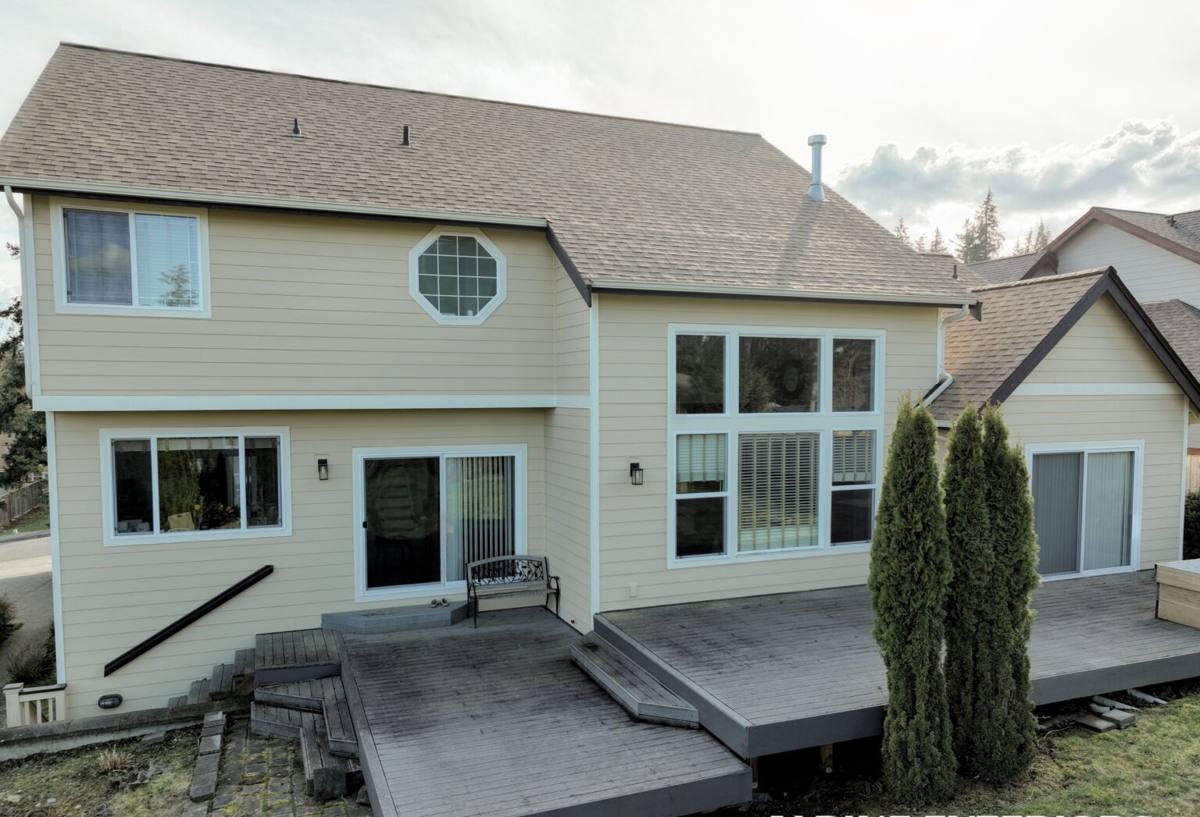
We build and repair decks throughout Sudden Valley, including the homes in and around Columbia, and the patterns repeat: shaded lots that never fully dry out, sloped ground that puts a deck well above grade, and a moss season that runs longer here than homeowners moving in from elsewhere expect. None of that is a reason to avoid a deck — it's a reason to build one the right way the first time.
What a Correctly Built Deck Actually Involves Here
Ledger Attachment and Flashing
The single most common point of failure on decks in wet Pacific Northwest climates isn't the decking boards — it's the ledger board, the piece that bolts the deck to the house. Water gets behind an improperly flashed ledger, soaks the house's rim joist, and rot spreads into the structure before anyone notices from the surface. Correct flashing (metal flashing plus a water-resistant barrier behind it, properly lapped so water sheds outward) is non-negotiable on a Whatcom County deck, and it's the detail that's easiest to shortcut and hardest to inspect once the decking is down.
Framing and Fasteners
Joists, beams, and posts need to be either naturally decay-resistant or pressure-treated for ground contact where they're close to soil or sit in a shaded, slow-to-dry spot. Fasteners matter more here than in a dry climate — coated or stainless-steel screws and structural connectors resist the corrosion that comes from sustained moisture and the salt-tinged marine air that moves inland off the Sound, while cheaper fasteners can start bleeding rust stains into the decking within a season or two.
Drainage Beneath the Deck
On elevated decks — common on Sudden Valley's sloped lots — what happens to the water that runs off the surface matters as much as what happens on top of it. Gaps between boards need to be sized to let water through rather than pool, and the ground or under-deck space below should be graded or drained so water doesn't sit against posts and footings.
Choosing Decking Material for Columbia's Moss Season
Every decking material handles this climate differently. There's no single right answer — it's a real trade-off between upfront cost, appearance, and how much maintenance you're willing to do to keep moss and algae from taking over a shaded deck.
| Material | Moss / Algae Resistance | Maintenance | Typical Lifespan |
|---|---|---|---|
| Pressure-treated wood | Low — moss takes hold quickly in shade without upkeep | Annual cleaning, periodic sealing/staining | 10–15 years with upkeep |
| Cedar | Moderate — naturally decay-resistant but still needs care | Regular cleaning and re-sealing to hold color and resist moisture | 15–20 years with upkeep |
| Composite decking | Higher — surface sheds moisture, though grime and film still build up in shade | Periodic washing; no staining or sealing | 25–30 years |
| PVC / capped decking | Highest — fully synthetic surface resists moss growth best | Occasional washing | 25–30+ years |
In a heavily shaded, moss-prone spot — which describes a fair number of lots around Columbia — composite or capped decking earns its higher upfront cost back in reduced maintenance. On a sunnier, more open lot, a well-maintained wood deck still makes sense and costs less to start. We'll walk your specific lot with you rather than push one material as the automatic answer.
Footings, Elevation, and Sudden Valley's Hillside Lots
Sudden Valley is built on hills around Lake Whatcom, and a lot of Columbia-area decks end up elevated well above grade to get a level surface off a sloped lot, or to reach a walkout basement or a view. Taller decks carry more structural load and more wind and seismic consideration, which changes the footing size, post spacing, and beam sizing required. Footings need to be sized and set to the correct depth for the soil they're going into, not just "deep enough to look right." On a steep or fill-heavy lot, that sometimes means a soils check or engineering input before we pour anything — better to find that out at the design stage than after footings are in the ground.
Railings, Stairs, and Whatcom County Permit Requirements
Most custom decks in Whatcom County require a building permit, and elevated decks almost always do — the threshold usually comes down to height above grade and whether the deck is attached to the house. Guardrails are required once a deck reaches a certain height (commonly 30 inches, though the exact trigger and required height depend on current code), stair railings and graspable handrails have their own spec, and baluster spacing has to meet a maximum gap to pass inspection. We handle the permit submittal and inspection scheduling as part of the job so you're not the one tracking down code requirements.
One more thing worth checking before you finalize plans: many properties in Sudden Valley fall under a community association with its own design review process separate from the county permit. It's worth confirming early rather than after a deck is designed, and we're glad to help you figure out what applies to your property.
Keeping a Columbia Deck Moss-Free and Sound Year After Year
A well-built deck in this climate still needs seasonal attention. Most of the deck failures we get called out to repair started as small maintenance items that got put off for a few too many wet seasons.
- Sweep leaves and debris off the deck surface regularly, especially in fall — trapped organic matter holds moisture and feeds moss growth
- Wash the surface at least once a year with a deck cleaner appropriate to the material; pressure washing wood too aggressively can damage the grain
- Check and re-seal or re-stain wood decking on the manufacturer's recommended schedule, not just when it looks faded
- Inspect fasteners and structural connectors annually for rust staining or looseness
- Look at the ledger board flashing where the deck meets the house for any sign of staining, gaps, or soft wood
- Keep gutters and downspouts near the deck clear so roof runoff isn't dumping extra water onto or under the deck
- Trim back overhanging branches to cut down on shade and debris that accelerate moss growth
Our Process for a Columbia Custom Deck Project
- Site visit and design conversation — we look at your lot's slope, shade, drainage, and how you actually want to use the space before talking materials.
- Material and layout selection — honest trade-offs on wood versus composite or PVC decking, railing style, and layout based on your budget and how much upkeep you want to take on.
- Permit and, if applicable, association review — we prepare and submit what's required and handle inspection scheduling.
- Build — correct ledger flashing, appropriately sized footings and framing for your lot's elevation, and corrosion-resistant fasteners throughout.
- Final walkthrough — we go over the finished deck with you, including what maintenance it needs and on what schedule.
What a Custom Deck Typically Costs in the Sudden Valley Area
Deck pricing depends on more than square footage. These are the factors that move the number most:
| Cost Factor | Why It Matters Here |
|---|---|
| Decking material | Composite and PVC cost more upfront than wood but cut long-term maintenance in shaded, moss-prone spots |
| Elevation / substructure | Sloped Sudden Valley lots often need taller posts, larger footings, or engineering — this adds cost fast |
| Railing style | Code-compliant railings range from simple to custom glass or cable systems |
| Access for equipment | Wooded, hillside lots can limit equipment access and add labor time |
| Permit and design review | County permitting and, where applicable, association review add time and modest fees to the timeline |
Because of these variables, a straightforward, low deck on flat ground and a large elevated deck on a steep, shaded Columbia lot can land in very different price ranges even at the same square footage. We give you a real, itemized number after seeing the site — not a generic per-square-foot quote that changes once the crew shows up.
Why Hiring a Crew That Already Works in Columbia Matters
A deck built by a crew unfamiliar with this specific stretch of Whatcom County is more likely to under-spec the flashing, guess at footing depth for hillside soil, or recommend a decking material that looks fine in a showroom but grows moss within a season in a shaded Sudden Valley yard. A crew that already builds and repairs decks in this neighborhood has seen which details fail here and builds past them the first time, rather than learning on your project. We're also positioned to respond quickly if something needs a look after the fact, without a long drive or a scheduling gap.
If you're thinking about a custom deck for your Columbia-area home, we're happy to walk the site with you and put together a straightforward estimate — no pressure, no obligation. Use the form below to get started.