 Sudden Valley
 Why Decks in Geneva Wear Out Faster Than Homeowners Expect
Geneva sits close to the water within the larger Sudden Valley community, and that proximity is a mixed blessing for anything built outdoors. The same lake air that makes a deck enjoyable seven months a year is also what breaks it down. Salt-tinged moisture works into end grain and fastener holes, driving rain finds its way under ledger boards and between deck planks, and the long stretch of gray, wet Whatcom County winters gives moss and algae months at a time to colonize any surface that doesn't dry out quickly. A deck that would last two or three decades in a dry inland climate often shows real structural problems in half that time here if it wasn't built — or maintained — with this specific environment in mind.
Most of the deck failures we see in this area aren't dramatic. They're slow: a soft spot near the stairs, a joist that flexes more than it used to, fasteners that have started to weep rust stains down the face boards. By the time those signs are obvious, the deck usually needs more than a fresh coat of stain.
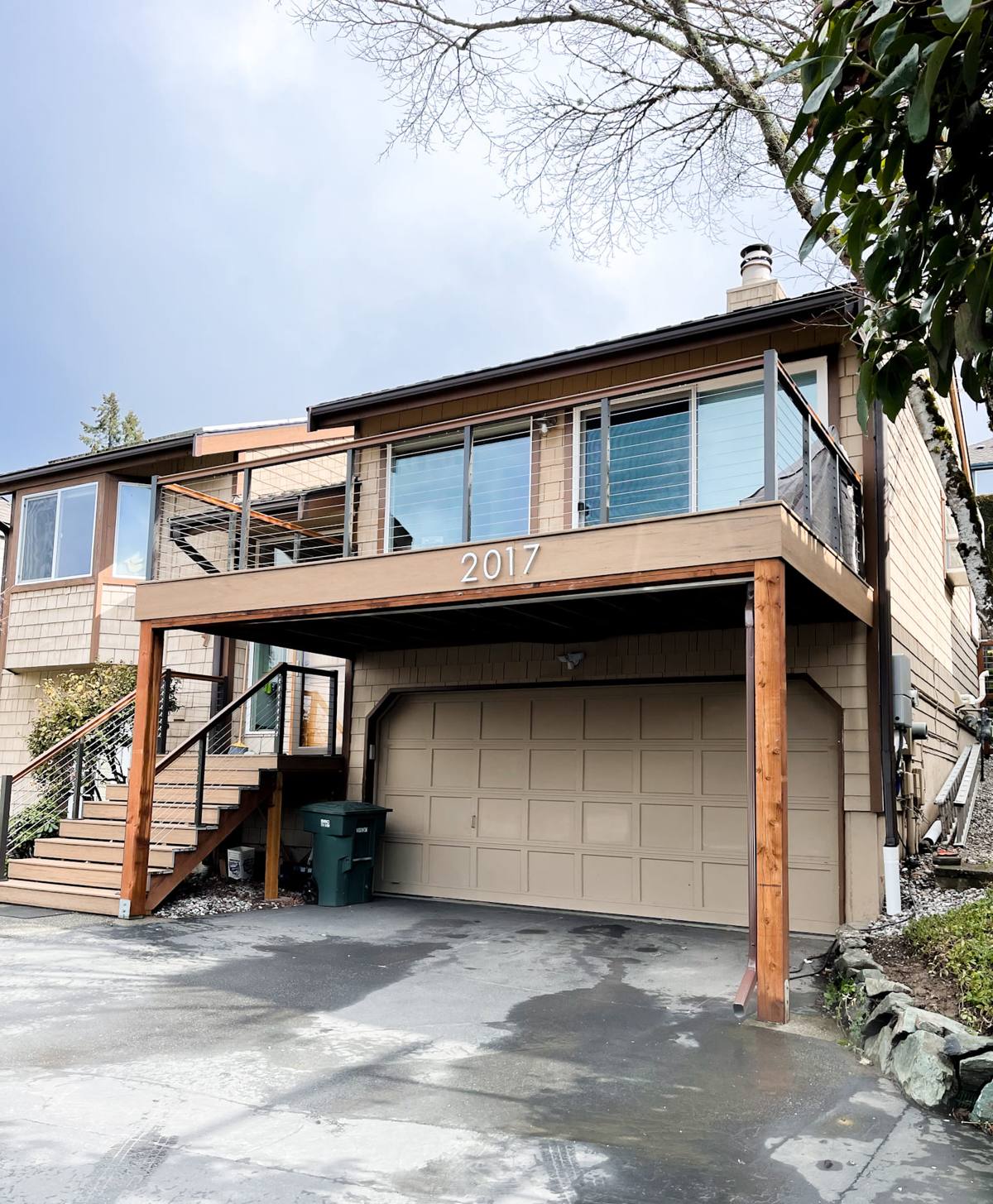
Repair, Resurface, or Full Replacement — Knowing the Difference
Not every tired deck in Geneva needs to come down to dirt. But a lot of them do, and it's worth being honest about the difference before spending money on the wrong fix.
- Repair makes sense when the framing and footings are sound and the problem is limited to a handful of boards, a railing section, or surface fasteners.
- Resurfacing (new decking and railing over existing framing) works only if the substructure passes a real inspection — joists, beams, posts, and footings all need to be solid, not just the parts you can see from above.
- Full replacement is the right call once moisture has reached the framing itself: soft or spongy joists, posts rotting at grade contact, a ledger board pulling away from the house, or footings that were undersized or improperly set to begin with.
Because moisture damage in this climate tends to start where you can't see it — under the decking, behind the ledger, at the post bases — we don't recommend resurfacing without pulling boards and physically checking the frame first. Covering rot with new decking doesn't stop it; it just hides it for another season or two.
What a Correct Deck Replacement Actually Involves
A deck built for the Sudden Valley area needs to handle sustained wet weather, not just survive an occasional storm. That changes several decisions from what you'd see in a drier region.
Ledger Board and Flashing
The ledger board — where the deck attaches to the house — is the single most common failure point on decks in wet climates. Proper flashing (not just caulk) needs to shed water away from the house sheathing and framing, with a drainage gap or flashing tape that keeps moisture from tracking behind the board. This detail is almost never visible once the deck is finished, which is exactly why it gets skipped on rushed jobs and exactly why we don't skip it.
Footings and Post Bases
Whatcom County's frost depth and drainage conditions vary by lot, and footings need to be sized and set to local code, not guessed at. Post bases should hold posts up off the concrete and decking surface so end grain never sits in standing water — a small detail that adds years to the life of the structure.
Framing Material and Spacing
Pressure-treated framing rated for ground contact where relevant, joist spacing tightened for the decking product chosen, and stainless or coated fasteners rated for the moisture and, where applicable, the salt exposure this area sees. Mismatched fasteners are a quiet but common cause of early staining and corrosion around Geneva and other lakeside parts of Sudden Valley.
Drainage and Airflow Underneath
A deck that can't dry out underneath stays wet longer after every rain, which accelerates rot and gives moss and mildew a head start. Grading beneath the deck, gaps at the perimeter, and avoiding solid skirting that traps moisture all matter more here than they would in a dry climate.
Choosing a Decking Material for This Climate
There's no single "best" decking material — the right choice depends on budget, how much maintenance you're willing to do, and how the deck will be used. Here's how the common options actually perform under Whatcom County's rain and moss pressure.
| Material | Moisture Behavior | Moss/Algae Resistance | Maintenance |
|---|---|---|---|
| Pressure-treated wood | Good if sealed regularly; end grain is vulnerable | Low — needs cleaning and treatment | Annual cleaning, re-sealing every 1-2 years |
| Cedar | Naturally moisture-resistant, still needs sealing | Moderate — still needs periodic cleaning | Sealing every 1-2 years, occasional cleaning |
| Composite decking | Excellent — won't rot or absorb water into the board itself | Moderate to good depending on product; surface can still host algae film | Periodic washing, no sealing needed |
| PVC/capped composite | Best — fully sealed surface, no organic material to feed rot | Good — smooth cap sheds moss growth more easily than wood grain | Occasional washing only |
We install all of these depending on what a homeowner wants, but we'll always tell you honestly where a given product's weak points are for this specific climate — end-grain sealing on wood, fastener compatibility on composites, and so on — rather than just pushing whatever has the best margin.
A Note on Framing Choices Under Composite Decking
Composite and PVC decking are often marketed as "no maintenance," which is true for the board surface but not for what's underneath. The framing beneath any decking material still needs to be pressure-treated, properly flashed, and well-drained — composite decking doesn't rot, but the joists under it absolutely can if the substructure work is cut short.
Our Process, Start to Finish
- On-site assessment. We walk the existing deck, check framing and footings where accessible, and talk through what you actually use the space for.
- Written estimate. Material options, a clear scope of work, and a straightforward price — no vague allowances that turn into surprise add-ons later.
- Permit handling. We pull the required permits and coordinate inspections so the finished deck is code-compliant, not just code-adjacent.
- Demolition and disposal. The old deck comes out cleanly, including a check of what's underneath before we build back up.
- Framing and structural work. Footings, posts, beams, joists, ledger flashing — the parts that determine how long the deck actually lasts.
- Decking, railing, and finish work. Installed to the manufacturer's fastening and spacing specs, which matters for warranty coverage as much as appearance.
- Final walkthrough. We go over care and maintenance specific to the material you chose before we consider the job done.
Permits and Whatcom County Considerations
Most deck replacements that involve new footings, framing, or a change in size require a permit, and inspections typically happen at the footing stage and again at final. Skipping this step is a common shortcut on lower-cost jobs, but it creates real problems down the line — unpermitted structural work can complicate a home sale and isn't covered the same way by insurance if something goes wrong. We handle the permit process as a standard part of a replacement rather than treating it as optional.
Living With a New Deck Through Moss Season
Even a well-built deck in the Sudden Valley area needs some seasonal attention. A few habits go a long way toward protecting the investment:
- Sweep leaves and debris off regularly in fall — trapped organic matter is what feeds moss growth.
- Rinse the deck surface periodically through the wet months rather than letting grime sit and set in.
- Keep gutters and downspouts near the deck clear so runoff isn't dumping extra water directly onto or under it.
- Reseal wood decking on the schedule recommended for the specific product — don't wait until it looks dry and gray.
- Check railing posts and stair connections once a year for movement, since these take the most repeated stress.
Why Hiring a Crew That Already Works in Geneva Matters
A deck built to a generic regional spec and a deck built for a specific lakeside microclimate aren't the same project, even if they look identical when finished. A crew that regularly works in and around Geneva and the rest of Sudden Valley already knows which fastener finishes hold up near the water, how local footing and frost conditions typically run, and which construction shortcuts show up as problems two winters later instead of two years later. That familiarity shows up in decisions that aren't visible on the surface — flashing details, fastener selection, drainage — but are exactly what determines whether a deck is still solid in fifteen years or needs another replacement in eight.
Get a Straightforward Estimate
If your deck in Geneva or elsewhere in Sudden Valley is showing soft spots, rust staining, or just isn't holding up the way it used to, it's worth having someone take an honest look before deciding between repair and full replacement. Fill out the form below for a free, no-pressure estimate — we'll tell you what we actually see, not just what's easiest to sell.