 Sudden Valley
 Why Roofs in Geneva Take a Different Kind of Beating
Geneva sits close enough to open water that homes here deal with a combination most inland Washington roofs never see: salt-tinged marine air, wind-driven rain that gets pushed sideways under poorly lapped shingles, and a moss season that can run eight or nine months out of the year. None of that is dramatic on its own. The problem is what happens when it's constant. Salt air accelerates the breakdown of metal flashing and fasteners. Driving rain finds every shortcut in a roof's water-shedding path — a nail popped too high, a valley that wasn't lined properly, a step flashing detail that was "close enough." And moss doesn't just look bad; it holds moisture against the shingle surface and works its way under tabs, lifting them and giving water a path underneath.
A roof built for a drier part of Whatcom County, or built to a bare-minimum spec anywhere, will show its weaknesses here faster than it would somewhere else. That's not a knock on any particular shingle — it's just what this climate does to a roofing system that wasn't detailed with it in mind.
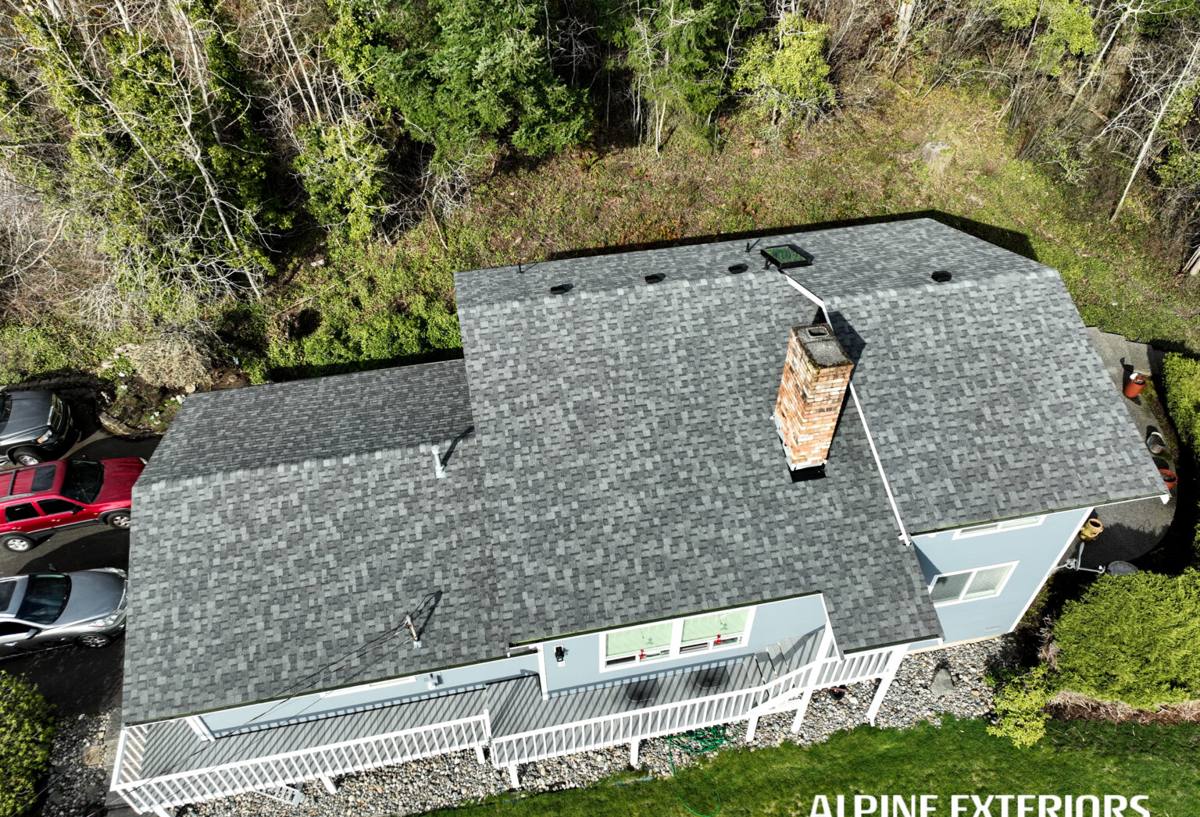
What a Correct Asphalt Shingle Roof Actually Involves
Asphalt shingles are a mature, well-understood product. Most roof failures we see aren't a shingle problem — they're an installation or detailing problem underneath the shingle. A correct job for a Geneva home includes:
- Full tear-off, not overlay. Roofing over an existing layer traps moisture, hides deck damage, and shortens the life of the new shingles. It's cheaper up front and more expensive over the life of the roof.
- A dry, sound deck. Any soft, delaminated, or water-stained sheathing gets replaced before anything else goes down. Nailing shingles over a compromised deck is how you get a roof that looks fine and leaks anyway.
- Synthetic underlayment rated for wind-driven rain, not just felt paper, especially on exposures that catch weather coming off the water.
- Ice-and-water shield at valleys, eaves, and around every penetration — chimneys, vents, skylights. This is the detail that stops the slow leaks that show up two winters later.
- New flashing, not reused flashing. Old step flashing and counter-flashing have already taken damage from salt air and repeated wet-dry cycles. Reusing it to save a line item is a false economy.
- Balanced intake and exhaust ventilation so the attic isn't trapping heat and moisture against the underside of the deck.
Skip any one of these and the shingles themselves — even a good shingle — don't get a fair chance to perform.
Choosing a Shingle for This Climate
There's no single "best" shingle for every house, but there are real differences that matter more in a wet, moss-prone area than they would somewhere drier. Here's how the common options stack up for a Geneva roof:
| Shingle Type | Wind & Rain Performance | Moss/Algae Resistance | Typical Lifespan Here |
|---|---|---|---|
| Standard 3-tab | Adequate when installed correctly, less margin for error | Depends on granule treatment; many aren't algae-resistant | Shorter end of the range in a wet climate |
| Architectural (laminated) | Thicker, better wind rating, more forgiving of minor installation variance | Widely available with algae-resistant granules | Mid-to-long range with proper ventilation |
| Impact-resistant / Class 4 | Strongest performance in wind and debris exposure | Usually paired with algae-resistant granules | Long range; premium upfront cost |
Our default recommendation for most Geneva homes is a laminated architectural shingle with algae-resistant granules. It's a meaningful step up from 3-tab in wind performance and moss resistance without moving into premium pricing territory. That said, the shingle choice matters less than most homeowners assume — installation quality is still the bigger factor in how long any of these last in this environment.
A Note on Algae-Resistant Granules
Algae-resistant shingles have copper or zinc-based granules mixed in specifically to slow the growth that causes those dark streaks and, more importantly, gives moss something to root into. They don't make a roof moss-proof — nothing does in a climate this wet — but they buy real time and reduce how aggressively moss establishes itself between cleanings.
Our Process, Start to Finish
Inspection and Honest Assessment
We start on the roof, not with a sales pitch. That means checking the deck condition where we can access it, looking at flashing and penetrations, checking attic ventilation and any signs of moisture inside, and being straight with you about whether you need a full replacement or whether repair and moss treatment will genuinely buy you more time.
Protecting the Property
Before tear-off starts, landscaping, siding, and gutters get protected. Tear-off is not a clean process — we plan for that instead of hoping it goes smoothly.
Tear-Off and Deck Inspection
Old shingles and underlayment come off completely, and we inspect the full deck before anything new goes down. Any damaged sheathing is called out and replaced — this is discussed with you before we proceed, not discovered after the fact on the invoice.
Installation
Underlayment, ice-and-water shield, new flashing, shingles, and ridge components go in following manufacturer specifications, which is also what keeps the material warranty intact. Nailing pattern and placement matter more than most homeowners realize — high or improperly placed nails are one of the most common causes of early shingle failure and warranty denial.
Cleanup and Walkthrough
Magnetic sweeps for nails, full debris removal, and a walkthrough where we show you the finished work and go over care and maintenance — including moss prevention — before we consider the job done.
Ventilation and Moss: The Two Details Most Re-Roofs Get Wrong
Ventilation
An attic needs balanced intake (usually soffit vents) and exhaust (ridge vent or equivalent) working together. Add exhaust without matching intake, or vice versa, and you can actually make moisture problems worse rather than better. In a marine climate with heavy rainfall and temperature swings, poor ventilation shows up as premature shingle aging from the underside — a failure mode that has nothing to do with the shingle brand and everything to do with what's happening in the attic above it.
Moss Prevention
Zinc or copper strips installed near the ridge use rainwater runoff to naturally inhibit moss growth on the slopes below them. They're inexpensive relative to the roof itself and worth including on most re-roofs in this area. Beyond that, periodic gentle cleaning (never pressure washing, which strips granules) and keeping overhanging branches trimmed back so shingles get some sun and airflow both make a real difference over the life of the roof.
What Affects the Cost of a Geneva Re-Roof
Every roof is priced on its own specifics, but these are the factors that move the number most:
| Factor | Why It Matters |
|---|---|
| Roof pitch and complexity | Steeper, more cut-up roofs take longer and require more safety setup |
| Number of existing layers | Multiple layers to remove adds labor and disposal cost |
| Deck condition | Any sheathing replacement is priced separately once it's exposed |
| Total square footage and number of valleys/penetrations | More material and more detail work at each transition |
| Access and staging | Tree cover, driveway access, and site layout affect setup time |
| Shingle tier selected | 3-tab, architectural, and Class 4 impact-resistant carry different material costs |
Broadly, homeowners in this region should expect asphalt shingle replacement to run from the lower five figures for a straightforward roof to well into the higher range for a large or complicated one. We'll give you a specific number after we've actually looked at your roof — not a phone estimate.
Signs Your Roof Needs a Closer Look
- Granules collecting in gutters or at the base of downspouts
- Shingles that look cupped, curled, or are missing tabs
- Visible moss or dark streaking across the slopes
- Daylight visible through the attic roof deck
- Water stains on interior ceilings, especially near chimneys, valleys, or skylights
- Soft or spongy feeling decking if you can safely check from the attic
- A roof older than 15–20 years that has never had a full tear-off replacement
Any one of these on its own isn't necessarily an emergency, but it's worth having looked at before the next heavy rain season.
Why It Matters That We Already Work in Geneva
A crew that already works this part of Whatcom County knows what the marine climate does to a roof over time, not just on paper but from having pulled off enough tear-offs to see it firsthand. That shows up in small decisions — where we add extra ice-and-water shield even when code doesn't strictly require it, how we detail flashing around penetrations, when we push back on a shingle choice that won't hold up to the moss pressure a particular lot will see because of shade and tree cover. It also means we're a known, findable crew if you ever need a warranty question answered or a follow-up visit — not a name that only shows up for the sale.
If your roof is showing its age or you're planning ahead rather than reacting to a leak, we're happy to take a look and give you a straight answer. Fill out the form below for a free, no-pressure estimate — we'll tell you what we actually see, not just what sells a job.