 Sudden Valley
 James Hardie Siding, Sized to What Sehome's Climate Actually Does to a House
Sehome is one of Bellingham's older central neighborhoods, rising toward Sehome Hill, with a housing stock that spans early-1900s homes, mid-century construction, and newer infill sitting close together on modest lots. Those houses don't share an era or a style, but they share a climate: Whatcom County's marine weather sends salt air off the Salish Sea across this part of Bellingham, storms arrive as driving rain more often than a straight-down shower, and shaded lots under mature trees stay damp long enough to run a moss season that lasts most of the year. We install James Hardie fiber cement siding, and only James Hardie fiber cement siding, on homes throughout Sehome. This page covers what that service actually involves: which parts of the Hardie product line fit this neighborhood's mix of housing, what correct installation requires given the salt air, rain, and moss this area sees, and how our process runs from the first walk-around to the last piece of trim.
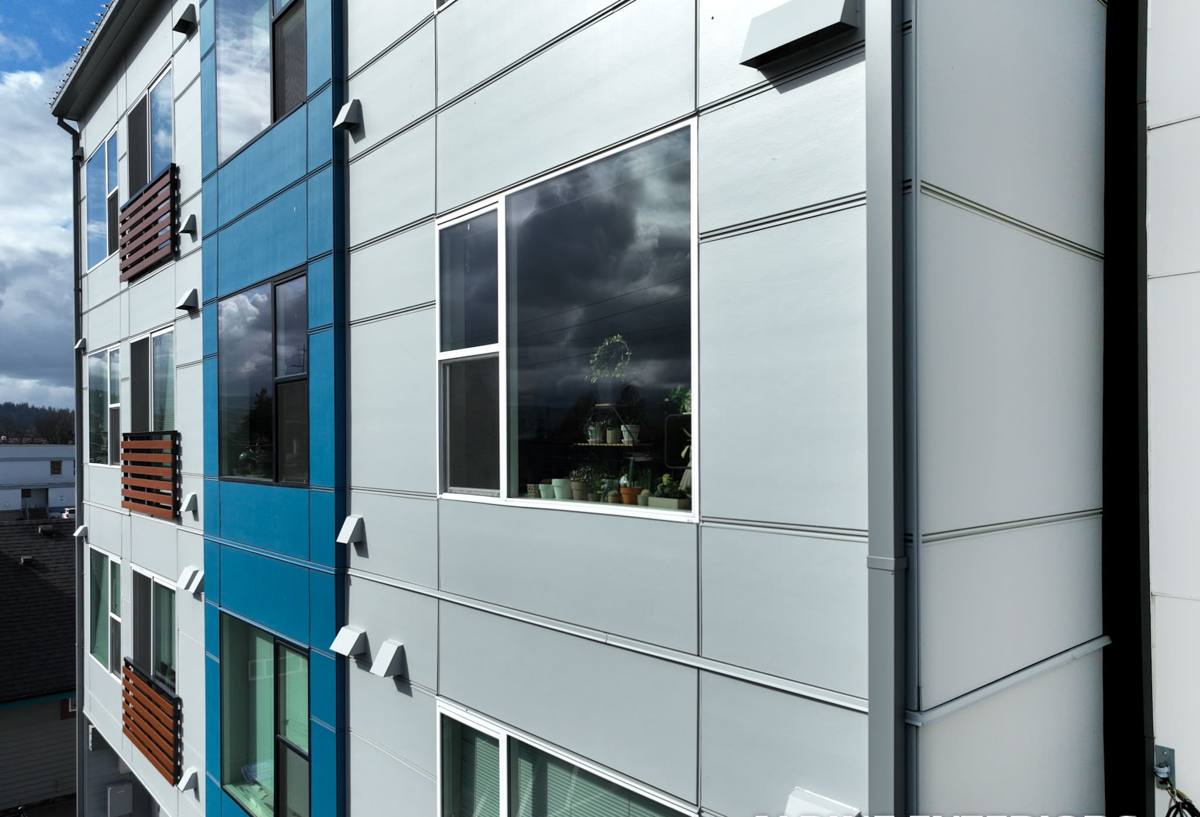
Why Salt Air, Driving Rain, and Moss Change the Siding Decision
Salt Air and Corrosion
Sehome sits inland of Bellingham's immediate waterfront, but salt-laden air off the Salish Sea still moves through this part of the city on a regular basis. It doesn't attack a fiber cement panel the way it attacks bare or lower-grade metal, but it does accelerate corrosion on fasteners, flashing, and exposed trim hardware. That's why fastener grade and flashing material matter on a Sehome job as much as the siding product itself — a great panel installed with the wrong hardware still fails early, just at the fastener instead of the board.
Driving Rain
Storms in this part of Whatcom County typically push rain sideways on the wind rather than dropping it straight down. That sends water into laps, joints, and penetrations instead of letting it simply sheet off a wall. Siding that isn't dimensionally stable, or that isn't installed with the correct overlap, clearances, and flashing, gives that wind-driven water a path in, and once water gets behind siding it rarely announces itself until the damage is already done.
A Long Moss and Mildew Season
Mature trees and shaded wall faces, common on Sehome's older lots, keep siding damp longer after every rain than it would stay on an open, sunny property. That extended dampness is exactly what moss and mildew need to establish. Materials that hold moisture at the surface, or absorb it into the substrate, become growth surfaces over time; materials that don't, don't.
None of that is unique to this one neighborhood, but it's the reason we standardized on one siding system instead of offering several. James Hardie fiber cement is non-combustible, dimensionally stable, and available in the HZ5 formulation Hardie engineers specifically for regions with heavy moisture exposure and freeze-thaw cycling — a fit for Whatcom County's climate. We don't install LP SmartSide, vinyl siding, Cemplank, Allura, primed spruce, or cedar. Each of those has a place in the market, and we're not going to tell you they can't perform anywhere. We've simply made the professional call that in a climate that puts this much sustained moisture and salt exposure on a wall, we'd rather install and stand fully behind one system than offer a cheaper option that quietly shifts maintenance risk onto the homeowner a few years down the road.
Matching the James Hardie Product Line to Sehome's Housing Stock
"James Hardie siding" isn't a single product — it's a system of lap siding, panels, shingles, and trim, and picking the right combination matters as much as picking the material. Sehome's mix of early-1900s homes, mid-century houses, and newer infill means we're rarely installing the same profile twice in a row on the same street.
| Hardie Product | What It Is | Where It Fits in Sehome |
|---|---|---|
| HardiePlank lap siding | Horizontal overlapping boards, in Select Cedarmill (wood-grain texture) or Smooth | Matches the clapboard look of Sehome's older homes; the most common choice on this project type |
| HardiePanel board and batten | Vertical sheet siding with battens over the seams | Gable accents, entry walls, or a full vertical treatment on mid-century and contemporary infill |
| HardieShingle | Staggered or straight-edge shingle-style panels | Accent sections on older homes that originally had wood shingle detailing |
| HardieTrim | Fiber cement trim boards for corners, windows, and fascia | Used on every job to finish edges cleanly and keep cut ends of siding protected |
Lap Siding for the Neighborhood's Older Homes
A lot of Sehome's early housing stock was originally sided in wood clapboard, and HardiePlank in a narrower exposure reads close to that original look from the street while performing nothing like old wood does in this climate. Select Cedarmill's wood-grain texture reads as traditional siding at a distance; Smooth reads cleaner and more contemporary. Neither one performs better than the other — the overlap between courses is what sheds water, not the surface texture — so the choice comes down to what fits the house.
Panel and Shingle Accents on Mid-Century and Infill Homes
On mid-century ranches and newer infill, board and batten on a gable end or entry wall, paired with lap siding on the main body of the house, is a combination we install often. Because both come from the same manufacturer in the same ColorPlus finishes, the result reads as one deliberate design rather than a later addition tacked onto the original siding.
ColorPlus Factory Finish vs. Field-Applied Paint
Every Hardie job in Sehome comes down to one finish decision, and it affects how the house looks now and how much attention it needs later.
ColorPlus is Hardie's factory-applied finish — multiple coats baked on under controlled conditions before the boards ever reach the site. In this climate, that matters: the coating goes on with no rain interruptions, it's fully cured before it faces its first wet season, and it carries a dedicated finish warranty against peeling, chipping, and cracking. Cut ends and fastener heads get touched up on site with color-matched paint, which is a normal part of a correct install, not a flaw. Primed Hardie board, painted after installation with a quality exterior acrylic, opens up any color rather than the curated ColorPlus palette, which matters if you're matching an existing trim color or a specific shade the ColorPlus lineup doesn't offer. The honest trade-off is that field-applied paint in a wet, shaded climate like Sehome's generally needs repainting sooner than the factory finish does, and the outcome depends heavily on prep and application quality.
What Correct Installation Requires in This Climate
Fiber cement performs the way it's engineered to only when it's installed to Hardie's published specifications, and in a climate with this much sustained moisture and salt exposure, skipped details show up faster than they would somewhere drier.
The Water-Resistive Barrier Behind the Siding
Siding is a rain screen, not the actual waterproofing layer. The weather-resistive barrier behind it does that job, so every project starts with a correctly lapped and sealed WRB, flashing integrated at every window and door opening, and kick-out flashing wherever a roofline meets a wall. On older Sehome homes especially, we often find that kick-out flashing was never installed correctly the first time around, and it's one of the most common sources of hidden wall damage we uncover during tear-off.
Fastening, Clearances, and Corrosion Resistance
Given the salt air moving through this part of Bellingham, fastener corrosion resistance isn't optional — we use fastener grades suited to that exposure rather than defaulting to whatever's cheapest. Manufacturer clearances get respected without exception: siding stays clear of grade, roofs, decks, and patios so the bottom edge never sits in splash-back or standing water, which matters more on Sehome's sloped lots where drainage patterns vary from wall to wall.
Coursing and Layout
Courses need to run level and consistent around the entire house, align across adjoining walls, and land sensibly at window heads rather than leaving an awkward sliver of siding above an opening. That takes a layout planned on paper before the first board is cut, not eyeballed as the crew works. Inconsistent coursing is one of the most common flaws we see on lower-cost siding jobs, and once it's nailed up, the only real fix is residing the wall.
Our Process
We start with an on-site walk of the house, paying attention to which walls get direct sun and which stay shaded most of the day, since that affects how long each elevation stays damp after a storm and how much drainage detailing it needs. From there we put together a written scope covering product selection, profile, finish, trim plan, and a realistic timeline before any contract is signed. Tear-off comes next, and it's where surprises tend to show up — soft sheathing, past moisture damage, or flashing that was never installed correctly the first time. We price that kind of discovery honestly rather than burying it, and we walk homeowners through what we found before proceeding. Installation follows Hardie's fastening and clearance specifications on every wall, and we finish with a walkthrough so the homeowner sees the completed work and understands what was done and why.
What Drives the Cost of a James Hardie Siding Project in Sehome
| Cost Factor | Why It Matters | Sehome-Specific Consideration |
|---|---|---|
| Home size and wall area | Siding square footage is the base driver of material and labor cost | Older two-story homes and homes on sloped lots add staging complexity |
| Tear-off vs. overlay | Removing old siding and repairing sheathing costs more than siding over sound substrate | Older housing stock more often needs tear-off due to prior moisture exposure |
| Product mix | Lap siding alone costs less than lap plus panel or shingle accents | Matching original clapboard detailing on older homes can add accent work |
| ColorPlus vs. field paint | ColorPlus raises material cost and removes near-term repainting; primed does the opposite | Shaded walls hold moisture longer, which favors the factory finish here |
| Trim scope | HardieTrim at corners, windows, and fascia adds material and labor | Older trim profiles sometimes need custom detailing to match the house |
Exact numbers depend on the specific house, lot, and existing wall condition, which is why we walk each property before giving a real estimate instead of quoting off a generic price list.
Why a Crew That Already Works Sehome Matters
A contractor who installs James Hardie siding regularly in this specific part of Bellingham has already seen how salt air, wind-driven rain, and a long moss season behave on real Sehome houses through a full year, not just how the product performs on a spec sheet. That shows up in practical decisions: which walls on a given lot need extra drainage detailing because they rarely see direct sun, how flashing needs to be lapped on a sloped or shaded roof-to-wall transition, and which fastener grade actually holds up in this air rather than which one is cheapest to stock. A crew that only occasionally installs fiber cement, or that splits its time across several siding brands, is more likely to apply generic details that don't quite match what Sehome's combination of terrain, shade, and coastal air actually demands.
Before You Hire: What to Ask a Sehome Siding Contractor
- Which siding product do they install, and is James Hardie fiber cement the only one they stand behind fully?
- Do they carry current Washington contractor licensing and active liability insurance?
- How do they handle hidden sheathing or framing damage found once old siding comes off?
- What fastener grade and flashing details do they use given the salt air in this area?
- Do they lay out coursing on paper before cutting, and will they walk you through that plan?
- Is the trim plan HardieTrim, or a mix of reused and replaced material, and why?
- Do they offer a written scope of work before any contract is signed?
If you're weighing a siding replacement on a Sehome home, we're glad to walk the exterior with you, talk through which Hardie products and profiles fit the house, and put a clear, honest estimate in your hands. Reach out using the form below for a free, no-pressure estimate.