 Sudden Valley
 Siding Installation in Barkley Is a Different Job Than It Looks Like
From the street, a siding installation looks like a finish carpentry job: cut boards, nail them up, caulk the seams, paint if needed. In Barkley, that assumption is exactly what gets homes into trouble a few years later. The siding on a house here isn't just cladding — it's the outermost layer of a moisture-management system that has to hold up against salt-laden air, wind-driven rain coming off the water, and a moss season that can run most of the year. Get the water management wrong under a beautiful new siding job, and the homeowner won't know it until the sheathing underneath is already soft.
This page is specifically about siding installation for homes in Barkley, not a general overview of siding in Whatcom County. The install details that matter here — flashing sequence, fastener spacing, clearance off grade, ventilation behind the cladding — are the same physics anywhere, but the margin for error is smaller in a climate that stays damp for months at a stretch. That's the lens we bring to every Barkley job.
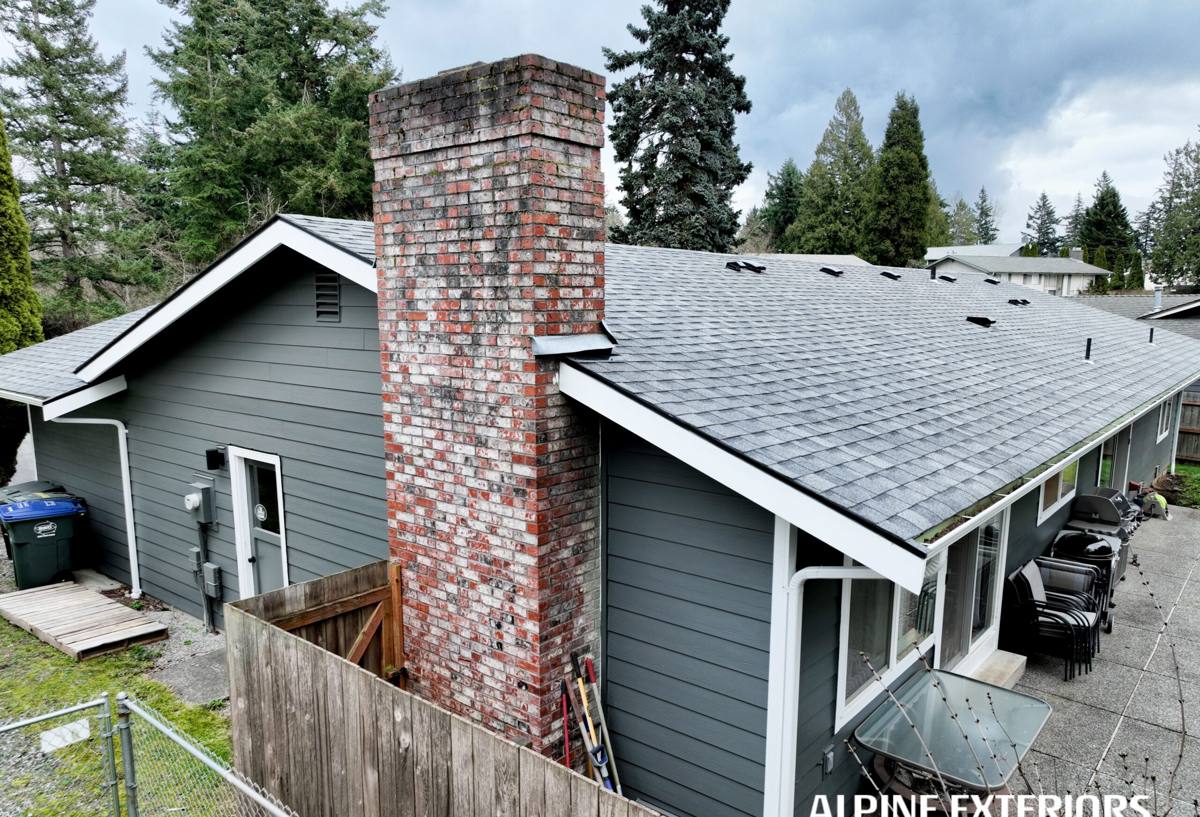
What Whatcom County's Climate Actually Does to Siding
Salt air and coastal exposure
Homes closer to the water pick up airborne salt that settles on every exterior surface. On siding, that means accelerated wear on fasteners, hardware, and any coating that isn't formulated to resist it. Salt exposure doesn't destroy siding overnight — it works slowly, finding the weak point in a fastener, a caulk joint, or a coating and exploiting it over years.
Driving rain, not just rain
Whatcom County doesn't just get a lot of rainfall — a meaningful share of it comes in sideways, pushed by wind off the water. Wind-driven rain finds gaps that vertical rain never reaches: under-lapped joints, unsealed penetrations, siding installed too tight to a window or door trim. A siding system built for a drier climate, or installed to a drier climate's tolerances, gets tested here in ways it wasn't designed for.
A long, damp moss season
Between the rain and the tree cover common through this part of Whatcom County, north-facing and shaded walls stay damp for extended stretches. That's exactly the environment moss and algae need. Siding material and finish quality both affect how much of that growth takes hold and how hard it is to clean off without damaging the surface underneath.
What a Correct Siding Installation Actually Involves
The visible siding is maybe 20% of the job. The rest is the sequence underneath it, and it's where most installation failures actually start:
Weather-resistive barrier and flashing
Every wall needs a continuous weather-resistive barrier behind the siding, lapped correctly from bottom to top so water sheds outward instead of behind the material. Flashing at windows, doors, and every penetration has to integrate with that barrier in the right order — flashing installed after the fact, or caulked in as an afterthought, is one of the most common causes of hidden water damage behind new-looking siding.
Rainscreen gap and drainage
In a climate this wet, siding that sits flat against the wall with no airspace behind it has nowhere for incidental moisture to go except into the wall assembly. A drainage gap lets bulk water drain out and lets the wall dry rather than trap moisture against the sheathing.
Fastening and clearances to manufacturer spec
Fastener type, spacing, and penetration depth all affect how the siding performs over decades, not just whether it looks straight on install day. Clearance off the ground, off roof lines, and off hard surfaces like walkways or patios keeps the bottom edge of the siding out of standing water and splash-back — a detail that's easy to shortcut and expensive to ignore.
Joint and penetration sealing
Every seam, corner, and penetration is a potential entry point. Correct installation means the right sealant, applied to the right joints — not every joint, since some are designed to be self-draining — and never used as a substitute for proper flashing.
Why We Install Only James Hardie Fiber Cement
We don't install vinyl siding, LP SmartSide, Cemplank, Allura, primed spruce, or cedar. That's a standard we hold across every job, including Barkley, and it comes down to how these materials actually perform in a wet, salt-exposed climate over the long haul — not marketing claims.
Vinyl expands and contracts with temperature and can warp or crack under UV and impact over time; wood-based and engineered-wood products are organic material that needs the coating and edge-sealing to stay perfect for decades to resist rot in a climate this damp. James Hardie fiber cement is non-combustible, doesn't support moss and mildew growth the way organic siding can, and comes with a factory-applied ColorPlus finish that's baked on rather than field-painted, which matters when the wall is going to see months of rain and salt air every year.
| Factor | James Hardie Fiber Cement | Vinyl / Engineered Wood |
|---|---|---|
| Moisture behavior | Engineered specifically for wet climates (HZ product lines); doesn't rot | Wood-based products can swell/rot if edges or coating fail; vinyl doesn't rot but traps moisture behind it if installed tight |
| Finish durability | Factory-baked ColorPlus finish resists fading and chalking | Field-applied paint or factory coatings wear faster under UV and salt exposure |
| Fire resistance | Non-combustible fiber cement | Combustible (vinyl melts/deforms; wood-based burns) |
| Moss/algae resistance | Dense cement composition resists organic growth better than wood-based products | Wood-based siding is more susceptible; vinyl can host growth in damp, shaded areas |
| Warranty | Strong transferable manufacturer warranty when installed to spec | Varies widely by product and manufacturer |
None of this means every other product is unusable everywhere — it means that for the climate Barkley homes actually sit in, we decided the trade-offs weren't ones we wanted to put our name behind.
Our Installation Process for Barkley Homes
- Walkthrough and assessment — we look at wall orientation, shade exposure, drainage around the foundation, and the condition of what's currently on the wall before we talk about the new siding.
- Tear-off and sheathing check — removing the old siding lets us actually see the sheathing underneath. If there's hidden rot or moisture damage, we address it before anything new goes up.
- Weather-resistive barrier and flashing — installed and lapped correctly at every window, door, and penetration, in the right sequence.
- Rainscreen/drainage gap — set behind the new siding so the wall can drain and dry.
- James Hardie installation to manufacturer spec — correct fastener type and spacing, correct clearances off grade and hard surfaces, correct joint treatment.
- Final detailing and walkthrough — trim, caulking at the joints designed for it, and a final look with the homeowner before we call it done.
Signs Your Current Siding Is Already Failing
Some warning signs are easy to spot from the ground; others take a closer look. Before assuming a repair will do, check for:
- Soft or spongy spots when you press on the siding, especially near the bottom edge
- Persistent dark streaking or heavy moss growth that comes back quickly after cleaning
- Paint or coating that's peeling, bubbling, or chalking heavily
- Visible gaps or separation at seams, corners, or trim joints
- Warping, bowing, or panels that no longer sit flat against the wall
- Interior signs like musty smells or discoloration on walls that share an exterior with damaged siding
Any one of these on its own might be minor. Several together, especially on a shaded or water-facing wall, usually means the issue is behind the siding, not just on the surface.
Cost Factors for a Barkley Siding Installation
We don't quote pricing without seeing the house, but the factors that actually move the number are consistent from job to job:
| Factor | Why It Matters |
|---|---|
| Condition of existing sheathing | Hidden rot found at tear-off adds repair scope before new siding can go up |
| Wall complexity | Corners, dormers, and multiple roof lines take more time and materials than a simple flat wall |
| Siding profile chosen | Lap siding, shingle-style panels, and board-and-batten differ in material and labor |
| Accessibility | Height, tight lot lines, or difficult equipment access affect labor time |
| Trim and detail work | Window and door trim replacement adds scope beyond the field siding itself |
Why a Crew That Already Works in Barkley Matters
Anyone can read a manufacturer's install manual. What actually shows up on a wall a few years later is a function of how carefully that manual gets followed on a specific house, in a specific microclimate. A crew that regularly works walls in this part of Whatcom County has already seen how shaded north walls hold moisture, how exposed corners take the worst of the driving rain, and where moss tends to establish first. That's not something you learn from a spec sheet — it's something you learn from doing the work here, repeatedly, and paying attention to what comes back as a warranty call versus what doesn't.
It also means fewer surprises during the job itself. Sheathing condition, drainage patterns, and access issues specific to homes in this area are things a local crew has already run into before, which keeps the tear-off phase from turning into guesswork.
If you're weighing a siding installation for a home in Barkley, we're glad to take a look and walk you through what your specific walls need — no pressure, no obligation. Reach out for a free estimate and we'll give you a straight answer on scope and condition before any work is scheduled.