 Sudden Valley
 Why Sunnyland Homes Take a Different Kind of Beating
Sunnyland sits close enough to the water and the tree line that its houses face a mix of weather most siding was never designed for. You get salt-tinged air rolling in off the Sound, long stretches of driving rain that comes in sideways more often than straight down, and a shoulder-season moss window that can run from October clear through April. None of these things alone is unusual for Whatcom County. Together, on the same wall, they wear out the wrong siding fast — and they make correct installation of the right siding non-negotiable.
This page is about one job done one way: James Hardie fiber cement siding, installed correctly, on a Sunnyland home. Not a general siding overview — the specific product, the specific climate problems it has to solve here, and what separates a job that lasts thirty-plus years from one that starts showing trouble in five.
Salt Air and Slow Corrosion
Homes closer to the water pick up airborne salt that settles on siding, trim, and especially fasteners. Over years, salt exposure accelerates corrosion on anything less than a marine-grade or coated fastener, and it degrades cheap caulk and sealants faster than inland homes ever see. It doesn't attack fiber cement the way it attacks bare wood or untreated metal, but it absolutely attacks a sloppy installation — the nail heads, the flashing, the trim screws.
Driving Rain, Not Just Rain
Whatcom County gets wind-driven rain that hits siding at an angle, which means water finds every gap, lap, and seam a straight-down rain would never reach. Siding here has to shed water sideways, not just downward, and every penetration — hose bibs, light fixtures, vents — is a place wind-driven rain will test first.
The Long Moss Season
Shaded walls, north-facing elevations, and anything near mature trees stay damp longer here than most of the country, and that damp holds through a moss and algae season that can run half the year. Wood and some lower-grade fiber cement products absorb that moisture into the substrate over time. A factory-finished product with a sealed, engineered surface resists it instead of soaking it in.
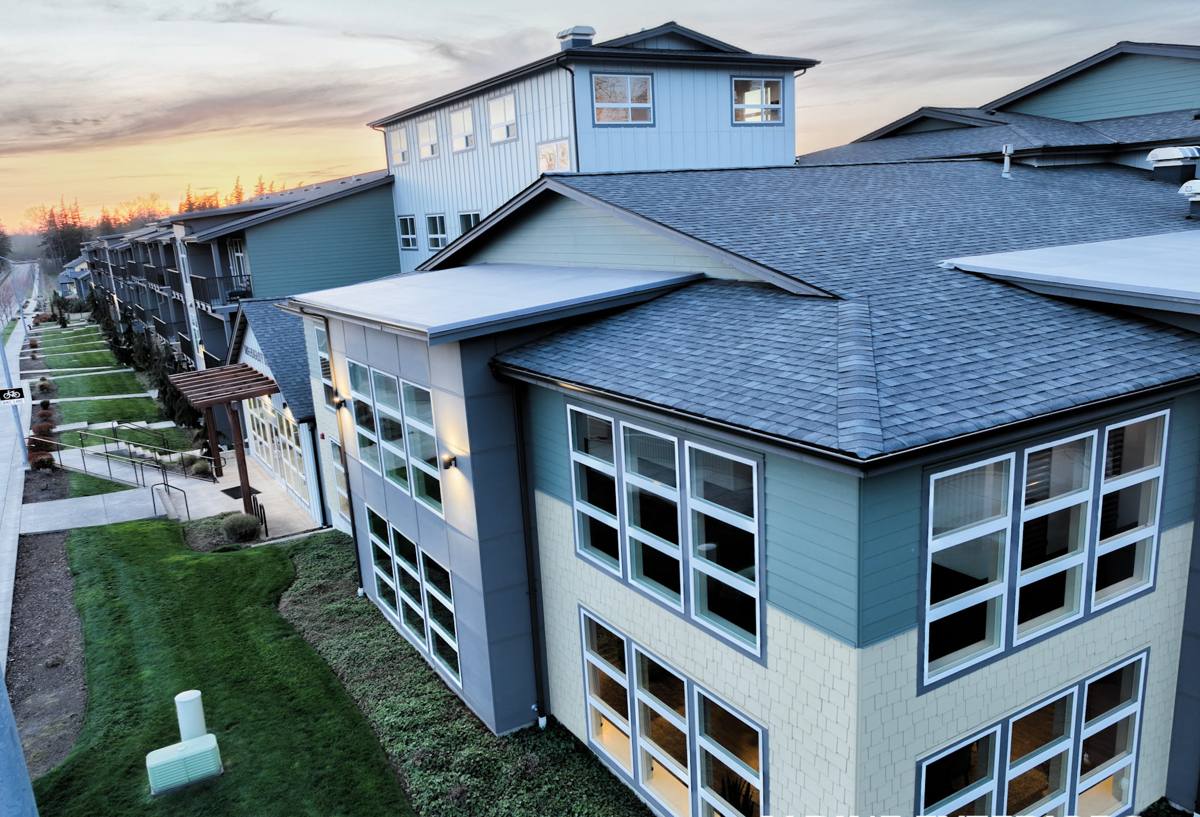
Why James Hardie Is the Product We Install Here — and Nothing Else
We install James Hardie fiber cement exclusively. Not as a sales position — as a standard we hold because of what this climate does to alternatives. Vinyl flexes and gaps at seams that wind-driven rain will exploit. Primed wood and cedar need a paint and caulk maintenance cycle that most homeowners fall behind on within a few years, and once that cycle slips, moisture gets into the substrate. LP SmartSide and other engineered wood products perform reasonably well when detailed perfectly, but they still rely on a factory or field-applied coating over a wood-based core, which means the coating is doing all the work of keeping moisture out.
Hardie's fiber cement core doesn't have that vulnerability. It's cement, sand, and cellulose fiber — it doesn't rot, it isn't a food source for moss or algae, and it holds paint and factory finish far longer than wood-based substrates in a wet climate. Hardie also builds specific product lines engineered for different climate zones, and Pacific Northwest installations should be speced to the HZ5 climate profile, which is built around exactly the freeze-thaw and moisture cycling this region sees.
ColorPlus Finish vs. Job-Site Paint
Hardie's ColorPlus factory finish is baked on under controlled conditions, which gives it more consistent adhesion and UV resistance than field-applied paint over fiber cement. In a climate with this much rain and this many gray-sky months, a finish that isn't relying on a painter's timing and weather window matters. It also means touch-up work matches instead of turning into a repaint of the whole elevation.
What a Correct Hardie Installation Actually Involves
Fiber cement siding fails in this climate almost exclusively because of installation mistakes, not the product itself. The material is only as good as the water management behind it.
Water Management Comes First
- A drainable weather-resistive barrier installed over the sheathing, lapped correctly shingle-style from bottom to top
- Flashing at every horizontal penetration — windows, doors, hose bibs, light fixtures, deck ledgers
- A rainscreen gap or drainage plane behind the siding so any water that gets past the cladding can drain and dry instead of sitting against the sheathing
- Kick-out flashing anywhere a roofline meets a wall, directing runoff away from the wall rather than behind the siding
- Caulking only where Hardie's install specs call for it — over-caulking traps moisture as often as it keeps it out
Fastening and Clearances
Hardie has published fastener schedules, nailing patterns, and clearance requirements — minimum gaps from grade, roof lines, decks, and abutting hardscape — for good reason. Board contact with soil, stucco, or pavement lets moisture wick straight into the bottom of the plank. In a county where fall and winter deliver months of sustained ground moisture, we treat that clearance rule as fixed, not a suggestion.
Our Process on a Sunnyland Job
- On-site assessment — we look at wall orientation, shade exposure, existing moisture damage, and how the current siding is holding up before we ever talk product
- Tear-off and sheathing check — old siding comes off and we inspect the sheathing underneath for rot or soft spots before anything new goes up
- Weather barrier and drainage plane installation — the part nobody sees but the part that decides how the job ages
- Flashing at every penetration — done before siding, not patched afterward
- Hardie installation to manufacturer spec — correct fastener type, spacing, and clearances for the HZ5 profile
- Final walk-through — trim, caulk lines, and touch-up paint checked against ColorPlus color match
What Drives Cost on a Sunnyland Siding Job
| Factor | Why It Matters Here |
|---|---|
| Home size and number of stories | More wall area and higher elevations mean more material, more staging, and more flashing detail work |
| Condition of existing sheathing | Moisture-damaged sheathing found during tear-off has to be replaced before new siding goes on |
| Amount of trim and architectural detail | Dormers, bump-outs, and multiple rooflines multiply the flashing and cutting work |
| Siding profile chosen | Lap siding, panel siding, and shingle-style Hardie products differ in material and labor cost |
| Access and site conditions | Sloped lots, mature landscaping, and tight setbacks near the water can add staging time |
| Weather window for the job | Scheduling around the wettest months protects open wall assemblies during the install |
HardiePlank vs. HardiePanel: Picking the Right Profile
Most Sunnyland homes we work on use either HardiePlank lap siding, which gives the traditional horizontal board look with a shadow line at each lap, or HardiePanel vertical siding, often paired with battens for a board-and-batten look on gables or accent walls. Lap siding sheds water naturally at each overlap, which is a real advantage in a driving-rain climate. Panel siding needs more attention to seam sealing and Z-flashing at horizontal joints, since it doesn't have that built-in overlap. Either can be detailed correctly — the point is choosing the profile that matches the home's design and making sure the water management behind it matches the profile.
What Ongoing Maintenance Looks Like
Correctly installed Hardie siding is genuinely low-maintenance compared to wood or vinyl, but "low-maintenance" isn't "no-maintenance" in this climate.
- Rinse siding annually, especially on shaded or north-facing walls where moss and algae have the best chance to establish
- Check caulk joints around windows, doors, and trim every year or two — caulk is the first thing to fail, well before the siding itself
- Keep gutters clear so overflow isn't running down the face of the siding during heavy rain events
- Trim back vegetation that's shading a wall or holding moisture against it
- Repaint touch-ups with matched ColorPlus product rather than generic exterior paint when color match matters
Why a Crew Already Working This Area Matters
Whatcom County's coastal and lake-effect microclimates aren't uniform — a wall that's shaded and damp most of the year in Sunnyland can behave very differently from an open, sun-exposed elevation a few miles inland. A crew that already works Sudden Valley and the surrounding Whatcom County communities has seen how local wall assemblies actually perform over time, not just how a spec sheet says they should. That shows up in small decisions: where to add extra flashing attention, which elevations need a closer look at the drainage plane, and how to sequence a job around the realistic rain windows this area gets rather than a generic install calendar.
It also means faster response if something needs a look after the job is done — no waiting on a crew that has to drive in from outside the area for a five-minute caulk check.
What to Ask Before You Hire Anyone for This Job
- Are they James Hardie certified, and can they explain why they'd spec HZ5-profile products for this climate zone?
- Will they show you the flashing and drainage plane details before siding goes up, not just the finished look?
- Do they inspect and replace damaged sheathing as part of the job, or just cover over whatever's there?
- Can they explain the manufacturer's fastener and clearance requirements without checking a manual mid-conversation?
- Do they carry both the manufacturer's product warranty and their own workmanship warranty, and what does each actually cover?
If your Sunnyland home's siding is past its best years, or you're just trying to plan ahead before the next wet season sets in, we're happy to take a look and walk you through what correct James Hardie installation would involve on your specific home — no pressure, no obligation. Use the form below to request a free estimate.