 Sudden Valley
 Windows Built for the Yew Street Climate, Not Just the Yew Street Look
Homes along Yew Street in Sudden Valley deal with a specific combination of weather that most window brochures never mention: months of driving rain angled by the wind, salt-tinged marine air moving in off the water, and a moss season that can stretch from late fall well into spring. None of that shows up as damage overnight. It shows up two or three years later as a soft spot under a sill, a window that won't latch tight anymore, or glass that fogs between the panes. Window replacement in this neighborhood isn't just about picking new glass — it's about choosing a window and an installation method that can actually stand up to what Whatcom County throws at it.
This page is about that one job, done right, for the homes on and around Yew Street. We're not going to walk through every possible siding or roofing scenario — just what a correct window replacement looks like here, what goes wrong when it's done wrong, and why local experience with this exact stretch of Sudden Valley matters more than it does in a drier climate.
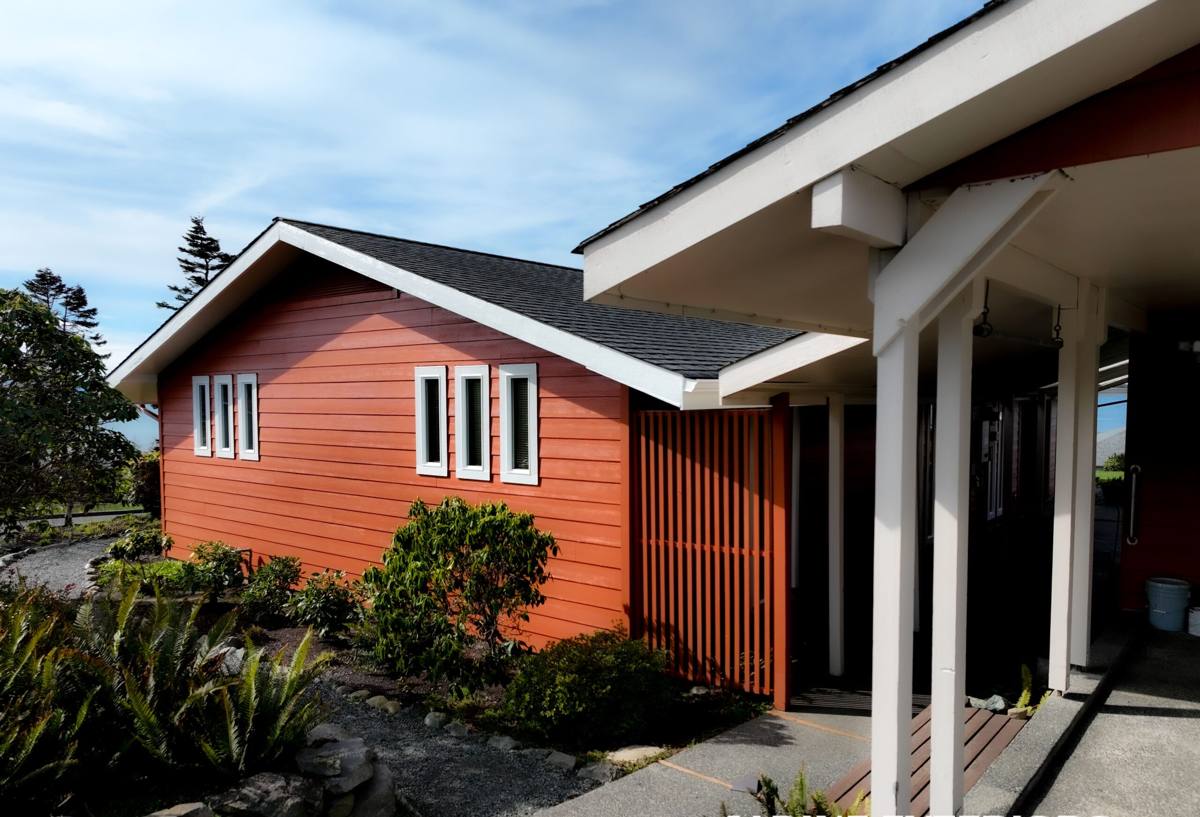
What Driving Rain and a Long Moss Season Actually Do to Windows
Whatcom County doesn't get the kind of violent storms that show up on the news, but it makes up for that with volume and duration. Rain here comes sideways more often than straight down, and it comes often. Over a full winter, that means water is pushed against window frames and trim for weeks at a time rather than in short bursts you can plan around.
Where the damage starts
Water intrusion around windows almost never starts with a dramatic leak. It starts small, in a handful of predictable places:
- Gaps in old caulking or sealant that has shrunk, cracked, or pulled away from the frame
- Failed or missing flashing above the window, where wind-driven rain gets pushed upward and behind the trim
- Wood trim and sills that stay damp long enough for rot to set in, especially on north- and west-facing walls
- Moss and algae holding moisture against sills and casings instead of letting them dry between rain events
The long, mild, damp stretch of a Sudden Valley winter is exactly the environment moss and mildew prefer. Once moss gets a foothold on a sill or the trim around a window, it acts like a sponge — it keeps that wood wet far longer than open rain would on its own, and that's when rot really accelerates.
Signs a Yew Street Home Needs Window Replacement
Most homeowners call us after noticing one or two of these. If you're seeing several at once, it's worth having a look before the next wet season:
- Fogging or a hazy film between the panes — the seal has failed and the insulating gas is gone
- Soft, spongy, or discolored wood on the sill, jamb, or exterior trim
- Windows that are hard to open, close, or lock, or that no longer sit square in the frame
- A draft you can feel near the frame even with the window fully latched
- Visible moss, black staining, or persistent green growth on the sill or casing
- A noticeable jump in heating costs with no other explanation
- Condensation forming on the inside of the glass regularly, even when it's not unusually cold
Any one of these can be a minor fix. Several together usually mean the window and the assembly around it have been absorbing moisture for a while, and replacement is the more honest answer than another round of caulk.
What a Correct Window Replacement Job Actually Involves
This is where a lot of window jobs go wrong — not in the window itself, but in what happens around it. A high-end window installed over a rotten sill or without proper flashing will fail the same way a cheap one would, just more expensively.
Full-frame vs. insert replacement
There are two basic approaches, and the right one depends on the condition of what's already there:
- Insert (pocket) replacement — the new window goes into the existing frame. Faster and less invasive, but only appropriate when the existing frame, sill, and flashing are still sound and dry.
- Full-frame replacement — the old window and frame come out entirely, down to the rough opening. This is slower and more involved, but it's the only way to actually inspect and fix what's behind the trim, which matters a lot on a house that's absorbed a few decades of Whatcom County rain.
We check for rot and moisture before recommending either one. On older Sudden Valley homes we more often end up recommending full-frame replacement than insert, simply because it's common to find soft sheathing or old flashing that's due for an upgrade once the trim comes off.
The details that actually keep water out
The window itself is maybe half the job. The other half is the assembly around it:
- Proper flashing integrated with the house's weather-resistive barrier — not just caulk over the top
- A sloped sill pan so any water that does get past the exterior sheds outward instead of pooling
- Correct, continuous sealant at all four sides, not just the visible joints
- Shimming the window square and plumb in the opening so it operates properly and seals evenly for its whole life, not just the first winter
Skip any of these steps and you can end up with a brand-new window that still lets water in behind the trim — which is often worse, because it's hidden.
Choosing the Right Window Material for This Climate
There's no single "best" window material for every house, but in a wet, moss-prone marine climate some trade-offs matter more than others. Here's how the common options stack up for a Sudden Valley home:
| Material | Moisture Resistance | Maintenance | Typical Lifespan | Relative Cost |
|---|---|---|---|---|
| Vinyl | Good — won't rot, minimal upkeep | Low | 20–30 years | $ |
| Fiberglass | Very good — stable in wet/dry cycling, resists warping | Low | 30–40+ years | $$$ |
| Wood-clad | Depends heavily on cladding integrity and installation | Higher — cladding and seals need periodic inspection | 20–30 years if well maintained | $$–$$$ |
| Aluminum | Weak thermally, prone to condensation in this climate | Low | 20–30 years | $ |
For most Yew Street homes, we steer people toward vinyl or fiberglass. Both handle repeated wet-dry cycling without the maintenance burden of wood cladding, and neither gives moss or rot a foothold the way exposed wood trim can. Wood-clad windows can still be the right call on some homes for appearance or historical matching — we just make sure the homeowner understands the added upkeep going in, rather than finding out the hard way in year eight.
Our Process, Start to Finish
- Free on-site estimate. We look at the actual condition of your existing windows, sills, and trim — not just measure for new glass.
- Honest recommendation. We'll tell you if insert replacement is enough or if full-frame is the smarter long-term move, and why.
- Written quote. Clear pricing, materials, and timeline before any work starts — no surprise add-ons mid-project.
- Removal and inspection. Old windows come out; we check the framing and sheathing behind them before anything new goes in.
- Correct installation. Flashing, sill pans, sealant, and shimming done to spec — not just the window itself.
- Cleanup and walkthrough. We haul away the old windows and debris and walk you through the finished work before we call it done.
Why a Crew That Already Works Yew Street Matters
Window replacement isn't exotic work, but local conditions change what "correct" looks like. A crew that regularly works homes in Sudden Valley already knows which construction eras around here tend to have undersized or missing flashing, which orientations take the worst of the driving rain, and how aggressively moss needs to be dealt with before it's allowed anywhere near new trim. That's not something you get from a manual — it comes from having pulled a lot of siding and trim off Whatcom County houses and seeing what the weather actually did to them.
It also means fewer surprises during the estimate. We're not guessing at what's likely behind your trim — we've seen the pattern often enough on this street and nearby to know what to check for before we ever pull a nail.
Permits and Timeline
Straightforward like-for-like window replacement is often permit-exempt, but that depends on the scope of the work and whether structural framing is being altered. We handle the permit question as part of the estimate, so you're not left figuring out Whatcom County requirements on your own. Most single-window jobs take well under a day once work begins; full-house replacements are typically a few days depending on the number of openings and whether full-frame work is needed anywhere.
Get a Straight Answer, Not a Sales Pitch
If your windows on Yew Street are fogging, drafting, sticking, or growing moss on the sills, it's worth getting an honest look before another wet season makes the problem bigger. We'll give you a free, no-pressure estimate, tell you plainly what we find, and lay out your real options — you can use the form below to get started.