 Sudden Valley
 Composite Decking Built for the Alger Climate
Alger sits close enough to the water that homes here deal with a specific combination of weather most inland decks never see: salt-laden air, long stretches of driving rain, and a moss season that can run from October well into spring. A deck built or installed without that combination in mind will show it within a few years — soft spots, green film on the boards, corroded fasteners, and a substructure that's staying wet longer than it should. Composite decking, installed correctly, is one of the better answers to that combination, but "installed correctly" is doing a lot of work in that sentence. The material itself only performs as well as the framing, flashing, and fastening underneath it.
We work throughout the Sudden Valley and greater Whatcom County area, and Alger is part of our regular service territory, not a stretch job we take once and never see again. That matters more with decks than with most exterior work, because a deck problem is almost always a water and ventilation problem hiding under boards that look fine from the top.
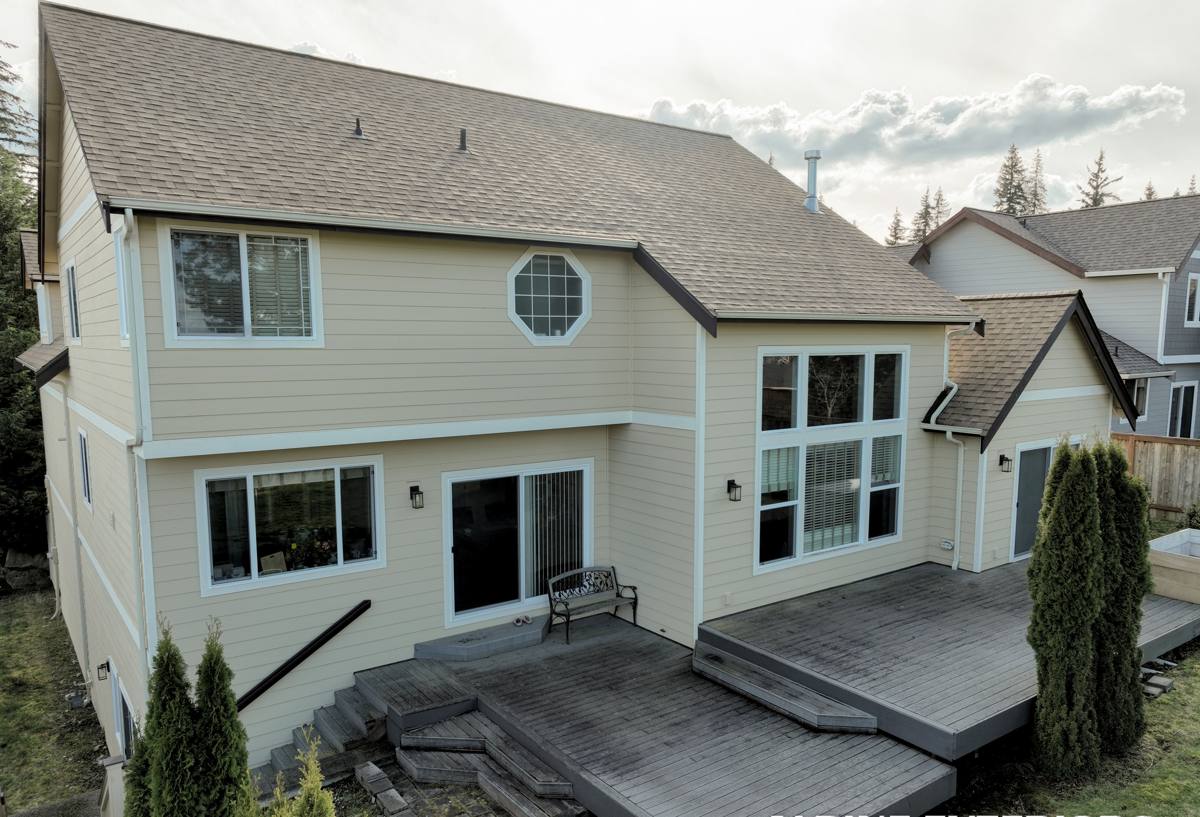
What Driving Rain and Salt Air Actually Do to a Deck
These two conditions attack a deck in different ways, and a good installation has to answer both.
Driving Rain and Water Management
Wind-driven rain doesn't fall straight down — it gets pushed sideways under railings, into ledger board connections, and between deck boards at a steeper angle than most installers plan for. The failure points we see most often aren't the decking surface itself; they're the ledger board where the deck attaches to the house, the joists directly underneath gaps between boards, and any post base that sits in standing water after a storm. If those areas aren't flashed and drained properly, composite boards on top can look perfect for years while the framing underneath rots or the ledger connection lets water into the house's rim joist.
Salt Air and Fasteners
Proximity to salt water accelerates corrosion on anything metal — screws, joist hangers, hidden fastener clips, flashing tape edges. Standard interior-grade or even generic exterior fasteners can start showing rust streaks on composite boards within a season or two in this kind of air. That streaking isn't just cosmetic; it means the fastener itself is degrading, and a corroded fastener holding deck boards down is a safety issue, not just an appearance one.
The Moss Problem, Specifically
Moss needs shade, moisture, and time — Alger's decks, especially ones under tree cover or on the north side of a house, offer all three for a good chunk of the year. On wood decking, moss roots into the grain and holds moisture against the board, which speeds up rot. On composite decking, moss doesn't root the same way, but it still grows on the surface film of grime and pollen that builds up between boards and in low-traffic corners, and it makes the surface slick and slippery long before it looks obviously "mossy." A capped composite board resists staining and moss growth far better than an uncapped one, and board spacing and slope matter just as much as the material — a deck that doesn't shed water properly will grow moss no matter what it's built from.
What a Correct Composite Deck Install Actually Involves
The boards are the visible 20% of the job. The other 80% is substructure work that determines whether the deck lasts 10 years or 30. On every install we do in this area, that includes:
- Pressure-treated or naturally rot-resistant framing, sized and spaced to the composite manufacturer's span requirements — composite needs tighter joist spacing than wood in most spans
- Joist tape over every joist top to seal fastener penetrations and keep water from wicking into the framing
- Proper ledger board flashing where the deck meets the house, with a drainage gap so water doesn't collect against the siding or rim joist
- Stainless steel or coated exterior-rated fasteners and hidden fastener clip systems rated for coastal or marine-grade exposure
- Correct deck slope away from the house (roughly 1/8 inch per foot) so water sheds instead of pooling
- Adequate ventilation underneath the deck so the framing can dry out between rain events instead of staying damp
- Post bases set above grade or on proper footings, not sitting in soil or low spots that hold water
Skip any one of these and the composite boards on top can still look good while the deck underneath is failing. This is the part of the job that doesn't show up in photos but is the actual difference between a deck that holds up in this climate and one that doesn't.
Composite vs. Other Decking Materials
Homeowners in Alger usually narrow it down to composite, pressure-treated wood, or PVC. Here's how they actually compare for this climate, honestly:
| Material | Maintenance | Moisture Behavior | Moss/Mildew Resistance | Typical Lifespan |
|---|---|---|---|---|
| Composite (capped) | Occasional washing, no staining/sealing | Doesn't rot, but framing underneath still can | Good, especially with a capped surface | 25–30+ years |
| Pressure-treated wood | Annual/biannual staining or sealing required | Absorbs water, prone to warping and splitting | Poor — moss and mildew take hold quickly | 10–15 years |
| PVC | Very low, similar to composite | Fully water-resistant board itself | Good | 25–30+ years |
We install composite most often because it strikes a good balance of upfront cost, appearance, and long-term maintenance for this climate. PVC is fully synthetic and handles moisture the best of the three, but it costs more and some homeowners find the look less natural. Wood costs less upfront but the maintenance burden in a wet, salty, moss-prone climate is real — it's not a one-time stain-and-forget material here.
Why We Don't Push Uncapped Composite
Older-generation uncapped composite (just compressed wood fiber and plastic, no protective outer layer) is still on the market and costs less. Our standard is to install capped composite because the cap layer is what actually resists moisture absorption, staining, and mold growth at the surface. Uncapped boards can absorb moisture at the surface over time, which shows up as darkening, swelling at cut edges, and a rougher texture that holds onto moss and algae. It's a legitimate cost-saving option for some budgets, but we're upfront that it comes with a real maintenance and appearance trade-off in a climate like this one.
Cost Factors for a Composite Deck in Alger
Every deck is different, so we don't quote sight unseen, but these are the variables that actually move the price:
| Factor | Why It Matters |
|---|---|
| Deck size and shape | More cuts, angles, and picture-framing add labor time |
| Framing condition | Rebuilding rotted substructure costs more than decking over sound framing |
| Height and railing type | Elevated decks need code-compliant railings and stair stringers |
| Board tier | Entry-level capped composite vs. premium lines with deeper wood-grain finishes |
| Fastener system | Hidden fastener clips cost more in labor than face-screwing but leave a cleaner surface |
| Site access | Decks over slopes or tight side yards near the water take longer to frame and haul materials to |
As a rough range, a straightforward composite deck replacement runs into the mid-thousands, with larger or more complex decks — multiple levels, built-in seating, extensive railing — running higher. We'll give you an actual number after seeing the site and the existing framing, not a phone estimate.
Our Process
We approach a composite deck job in Alger the same way every time, because skipping steps is where deck problems start:
- On-site evaluation — we check the existing framing, ledger connection, and drainage before quoting anything, since framing condition is the biggest cost variable
- Framing repair or rebuild — any soft, rotted, or undersized framing gets addressed before a single composite board goes down
- Flashing and joist tape — the moisture-management layer that doesn't show once the job is done but determines how long it lasts
- Composite board installation — laid with correct spacing, slope, and fastener system for the board manufacturer's specifications
- Railing and stair work — built to current code for height and baluster spacing
- Final walkthrough — we check board fastening, railing stability, and drainage under real conditions before we call it done
Maintaining a Composite Deck in This Climate
Composite decking is low-maintenance, not no-maintenance, and in a salt-air, high-moss environment that distinction matters. A rinse with a garden hose and a stiff (not metal) brush a couple times a year keeps pollen film and early moss growth from taking hold. Debris that collects between boards or in corners — needles, leaves, seed pods — should be cleared out regularly, since that's where moisture sits longest and moss gets its first foothold. We also recommend a visual check of railing posts and stair connections once a year; loose hardware is usually the first sign of a fastener starting to corrode, and it's a quick fix if caught early.
Why Hire a Crew That Already Works This Area
A deck installer who mostly works drier inland areas can still build a technically sound deck, but they may not default to marine-grade fasteners, extra joist tape, or the drainage slope that this specific combination of salt air and driving rain calls for — because they haven't had to fix the callbacks that come from skipping it. Working Alger and the surrounding Whatcom County area regularly means we've seen what actually fails here versus what holds up, and we build to that reality by default rather than as an upgrade option. If you're getting quotes, it's worth asking directly whether the crew is planning for coastal-grade fasteners and ledger flashing, or building the same way they would for a deck fifty miles inland.
If you're weighing a new composite deck or replacing one that's showing its age, we're happy to take a look and walk you through what your specific site needs. Fill out the form below for a free, no-pressure estimate — we'll look at your framing, your drainage, and your exposure before we ever talk numbers.