 Sudden Valley
 Why Sehome Roofs Wear Out the Way They Do
A roof in Sehome doesn't fail for the same reasons a roof fails in a dry inland climate. Here, the problem is rarely one dramatic storm — it's the slow, repeated combination of salt-laden air, driving rain that comes in sideways instead of straight down, and a moss season that can run most of the year. Each of these on its own is manageable. Together, over ten or fifteen years, they find every weak seam, every under-flashed penetration, and every spot where the wrong material was used in the wrong place.
If you're researching a roof replacement, it helps to understand what you're actually replacing the old roof to withstand, not just what shingle color to pick.
Salt Air and Metal Components
Homes closer to open water deal with airborne salt that accelerates corrosion on exposed metal — nails, flashing, vent caps, and gutter hardware. Standard electro-galvanized fasteners can start showing surface rust well before the shingles themselves are due for replacement. A roof built for this area should use fasteners and flashing rated for coastal or marine exposure, not whatever is cheapest at the supply house.
Driving Rain and Wind-Driven Water
Whatcom County storms frequently push rain horizontally, which means water gets tested at every lap, seam, and penetration — not just where it lands. A roof that would be perfectly fine under straight-down rain can leak at a skylight curb, a chimney cricket, or a low-slope valley when the wind is driving water uphill under the shingle edge. Replacement is the point where those weak details get corrected, not just recovered.
Moss and Trapped Moisture
Shade, humidity, and mild temperatures make this a long moss season. Moss itself doesn't just sit on top of shingles — its root structure lifts shingle edges and holds moisture against the roof deck, which is what actually causes rot, not the moss's appearance. By the time moss is visible from the ground, it's often already been working on the roof for a season or two.
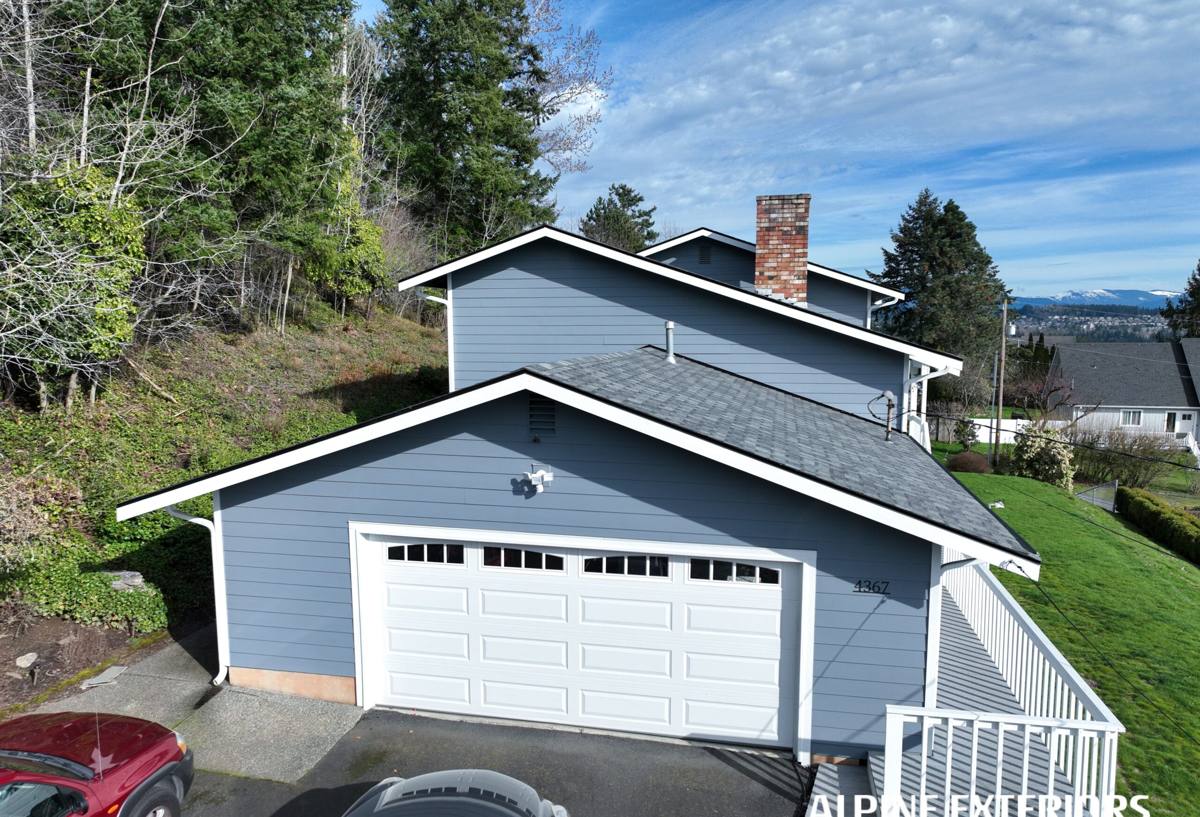
Signs a Sehome Home Needs Roof Replacement, Not Another Repair
Not every roof problem calls for full replacement, and a straight contractor will tell you when a repair is the honest answer. But there's a point where patching becomes throwing money at a roof that's already lost its structural integrity. Watch for:
- Granule loss heavy enough that shingles look patchy or blotchy rather than uniform
- Shingles that are curling, cupping, or cracking at the tabs
- Moss growth that returns within months of cleaning, especially on north-facing slopes
- Soft spots or spongy areas underfoot when walked (a sign the deck itself is compromised)
- Daylight visible through the roof deck from the attic, or water stains on attic sheathing
- Multiple past repairs in different areas of the same roof in a short span
- A roof that's at or past the manufacturer's expected service life for this climate
If your roof shows two or more of these, it's worth getting a full inspection rather than another spot repair.
What a Correct Roof Replacement Actually Involves
A roof replacement is more than stripping old shingles and nailing down new ones. The parts that matter most for long-term performance in this climate are usually the parts a homeowner never sees once the job is done.
Full Tear-Off and Deck Inspection
We don't install new roofing over old layers. A full tear-off is the only way to actually see the deck — and in a climate with this much moisture exposure, deck condition is not something to guess at. Any soft, delaminated, or rotted sheathing gets replaced before anything new goes down. Skipping this step is how a brand-new roof ends up with a soft spot within a few years.
Underlayment and Ice-and-Water Protection
Given how often this area sees wind-driven rain, underlayment choice matters more here than in drier climates. Self-adhering ice-and-water membrane at eaves, valleys, and around every penetration gives a second line of defense if wind pushes water past the shingle surface — which it will, eventually, on any roof.
Flashing at Every Transition
Chimneys, skylights, sidewalls, and valleys are where the overwhelming majority of roof leaks originate — not in the open field of shingles. Correct step flashing, counterflashing, and valley metal, properly lapped and sealed, is where a careful crew earns its reputation. This is also where past corner-cutting shows up first.
Ventilation That Matches the Climate
Balanced intake and exhaust ventilation keeps the attic space closer to outdoor temperature and humidity, which reduces condensation on the underside of the deck — a real issue in a damp, mild climate where attics can stay humid much of the year. Poor ventilation also shortens shingle life from the underside, which is easy to miss during a visual inspection.
Comparing Roofing Materials for This Climate
There's no single "best" roofing material — there's the right material for your roof's pitch, your home's exposure, and how much long-term maintenance you're willing to take on. Here's how the common options actually perform against salt air, driving rain, and moss:
| Material | Moss Resistance | Wind/Rain Performance | Maintenance | Typical Lifespan |
|---|---|---|---|---|
| Architectural Asphalt Shingle | Moderate (better with algae-resistant granules) | Good when properly fastened and flashed | Periodic moss/debris removal | 25–30 years |
| Standing Seam Metal | High — sheds moss more easily than textured surfaces | Excellent in wind-driven rain | Low; occasional fastener/seam checks | 40–50+ years |
| Cedar Shake | Low without diligent upkeep; holds moisture | Fair; sensitive to installation quality | High — regular treatment and cleaning | 20–30 years with upkeep |
| Synthetic/Composite Shake | High | Good | Low to moderate | 30–50 years |
We'll tell you honestly if cedar is a poor match for a shaded, moisture-prone lot rather than sell you what you initially ask for. That's a maintenance-burden and moisture-behavior conversation, not a knock on the material itself — cedar can work fine on a sun-exposed, well-ventilated roof; it's a harder sell on a shaded one.
Our Roof Replacement Process
- Inspection and assessment — we get on the roof and in the attic, not just a ground-level look, to check deck condition, ventilation, and flashing details.
- Written estimate — clear scope of work, material options, and pricing, with no vague allowances buried in the fine print.
- Material selection — we walk through the tradeoffs above based on your roof's actual exposure and pitch, not a one-size answer.
- Tear-off and deck repair — old roofing removed, deck inspected, any compromised sheathing replaced.
- Underlayment, flashing, and ventilation installed — the parts that determine how the roof performs in year eight, not just year one.
- Final installation and cleanup — new roofing installed to manufacturer spec, site cleaned including a magnetic nail sweep.
- Walkthrough — we go over what was done and what maintenance, if any, keeps the warranty intact.
What Drives Roof Replacement Cost
Every roof is priced on its own specifics, but the cost swings between similar-sized homes usually come down to a handful of factors:
| Factor | Why It Matters |
|---|---|
| Roof pitch and complexity | Steep or cut-up roofs (multiple valleys, dormers) take longer and need more flashing work |
| Deck condition | Rotted or delaminated sheathing found during tear-off adds material and labor |
| Material choice | Metal and premium composites cost more upfront than standard asphalt, but shift the maintenance and replacement-cycle math |
| Layers being removed | Tear-off of multiple existing layers takes longer than a single-layer strip |
| Access and staging | Steep lots, limited driveway access, or tree cover near the roofline affect setup time |
| Ventilation and flashing upgrades | Bringing an older roof's ventilation or flashing up to current standards adds scope, but reduces future problems |
Broadly speaking, a straightforward asphalt shingle replacement on an average single-family home runs into the mid five figures in this region, with metal and premium materials running higher. Anyone quoting a firm number without walking the roof and attic first is guessing, not estimating.
Why It Matters to Hire a Crew That Already Works in Sehome
A roofing crew that regularly works Sehome and the surrounding Whatcom County area isn't guessing at what this climate does to a roof over time — they've already seen it. That means knowing which details tend to fail first on homes with this kind of moss and rain exposure, which flashing approaches hold up, and which corners other crews sometimes cut that show up as callbacks two or three winters later.
Local familiarity also means straightforward answers on permitting and inspection requirements for your specific jurisdiction, and a crew that's easy to reach if a question comes up after the job is done — not a company that did one job in the area and moved on.
Keeping a New Roof Performing After Installation
A correctly installed roof still benefits from basic upkeep in this climate. A short annual routine goes a long way:
- Clear gutters and downspouts before the fall rains, so water isn't backing up under the roof edge
- Have moss growth treated or removed at the first sign of it, rather than waiting for a heavy mat to form
- Trim back overhanging branches that keep sections of the roof shaded and damp
- Schedule a visual inspection every year or two, especially after any major windstorm
- Check attic ventilation isn't blocked by insulation or debris
None of this is expensive or time-consuming, but skipping it is the single most common reason a well-installed roof underperforms its expected lifespan in this climate.
If your roof is showing its age or you just want an honest read on where it stands, we're happy to take a look. Fill out the form below for a free, no-pressure estimate — we'll tell you what we actually see, not just what sells a job.