 Sudden Valley
 What Sunnyland's Climate Does to Siding Over Time
Homes in and around Sunnyland and Sudden Valley take on a specific combination of weather stress that doesn't show up the same way in drier parts of Whatcom County. It's not one dramatic event that wears out a home's exterior here — it's the slow accumulation of salt-carrying air, wind-driven rain, and a moss season that can run most of the year. Siding that isn't built or installed for that combination tends to fail quietly, from the inside out, long before it looks bad from the street.
Salt-Laden Air and Slow Corrosion
Air moving in off the water carries fine salt particles that settle on exterior surfaces and accelerate corrosion of fasteners, flashing, and any exposed metal trim. On siding materials that depend on paint film or a factory coating to keep moisture out, that salt film also holds humidity against the surface longer between dry spells, which speeds up finish breakdown at seams, corners, and butt joints.
Driving Rain and Wind-Driven Water
Rain here rarely falls straight down. Wind pushes it sideways and up under laps, around window and door trim, and into any gap that wasn't sealed or flashed correctly the first time. A siding system that relies on caulk alone to stay dry — rather than proper lap geometry, flashing, and a drainage plane behind it — will eventually let water in, even if the surface material itself never absorbs a drop.
A Moss Season That Doesn't Really End
Shaded north and west walls, tree cover, and consistent moisture keep moss, algae, and mildew active for most of the year in this part of Whatcom County. Moss holds water against a surface, blocks air movement, and on organic siding materials it gives fungal growth a foothold. Even on materials that resist moisture well, moss buildup at laps and trim can trap enough water to cause problems underneath if it's never cleaned off.
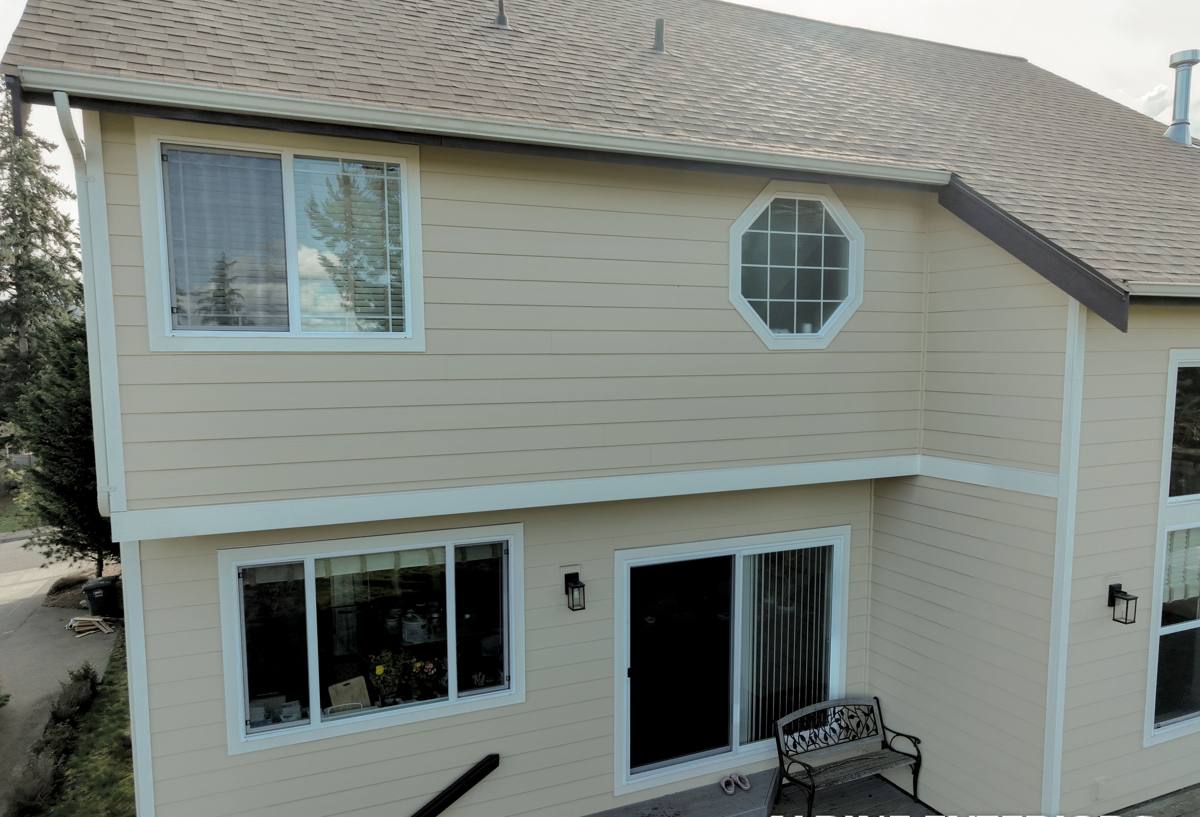
Repair or Replace? Signs It's Time for a Full Siding Replacement
Not every problem calls for tearing off the whole wall. But in a climate like this, small issues on the wrong material tend to spread faster than homeowners expect, and by the time damage is visible on the surface, it's often already gone deeper. Here's what usually tips a job from "patch it" to "replace it":
- Soft, spongy, or crumbling siding when pressed, especially near the bottom of walls or below windows
- Paint that keeps failing in the same spots within a year or two of repainting
- Persistent moss or dark staining that returns quickly after cleaning
- Visible warping, cupping, or separation at panel seams and butt joints
- Interior signs — musty smell, discolored drywall, or soft trim — near exterior walls
- Siding older than its expected service life with multiple problem areas rather than one isolated spot
- Damage that shows up in the same locations every wet season, meaning water is getting in and not drying out between storms
One or two of these in isolation might mean a repair. Several at once, or recurring damage in the same area year after year, almost always means the underlying wall assembly needs to come apart and be rebuilt correctly — which is a replacement, not a patch.
What a Correct Siding Replacement Job Involves
Siding replacement done right is mostly about what happens before the new siding ever goes up. The visible material gets the attention, but the parts nobody sees are what determine whether the job lasts.
Tear-Off and What's Underneath Matters More Than the Siding Itself
Removing the old siding is also the only real chance to inspect sheathing, framing, and insulation for hidden rot or moisture damage. In a wet climate, it's common to find soft sheathing or damaged framing at window sills, corners, and the bottom courses near grade — areas where wind-driven rain has been getting in for years. Any of that needs to be cut out and replaced before new siding goes on; installing over damaged sheathing just repeats the same failure underneath a fresh face.
Weather-Resistive Barrier and Flashing
A correctly detailed weather-resistive barrier (housewrap or building paper) with properly lapped seams, and flashing at every window, door, deck ledger, and roof-to-wall intersection, is what actually keeps water out — the siding itself is the first line of defense, not the only one. In driving-rain conditions, sloppy flashing at these transition points is the single most common cause of hidden water damage.
Fastening and Clearances
Fastener type, spacing, and depth matter, especially with fiber cement, which has specific nailing patterns for wind and moisture performance. Ground clearance and gaps at the bottom of the wall also matter more here than in drier regions — siding installed too close to grade, decking, or landscaping traps moisture and moss against the bottom courses, which is exactly where we see the earliest failures on homes that weren't installed with enough clearance.
Why We Only Install James Hardie Fiber Cement
We get asked fairly often why we don't offer vinyl, LP SmartSide, cedar, or primed spruce as options. All of those are legitimate products, and each has a real place in the market — we're not going to pretend otherwise. But we made a decision as a company to install one system, correctly, rather than offer several and let climate risk fall on the homeowner.
Vinyl siding is affordable and low-maintenance in the sense that it doesn't need painting, but it's a thin, flexible material that expands and contracts significantly with temperature and can crack or warp under impact, particularly in colder shoulder seasons. It also relies heavily on correct installation for water management since it isn't a sealed, monolithic surface — gaps and laps are part of its design, which puts more pressure on flashing details in a wind-driven rain climate.
LP SmartSide and cedar are wood-based products (engineered strand or solid wood). Wood-based siding can look excellent and performs well when maintained on a strict schedule, but it's inherently more vulnerable to moisture absorption, swelling, and rot than fiber cement, and that vulnerability is magnified by a long moss and mildew season. Cedar and primed spruce in particular require diligent, ongoing refinishing to keep water out at the surface; skip a maintenance cycle or two in this climate and problems can start.
James Hardie fiber cement is dense, dimensionally stable, and doesn't support fungal growth or absorb water the way wood-based products do. It holds paint and factory finish far longer because the substrate itself isn't moving and swelling underneath the coating. That combination — a stable substrate plus a factory-cured finish — is what stands up best to salt air, driving rain, and year-round moss pressure without a demanding maintenance schedule. That's the whole reason we standardized on it rather than offering multiple options.
The Hardie Products We Use on Homes Like Yours
James Hardie's HZ5 product line is engineered specifically for wetter, colder climate zones like the Pacific Northwest, with formulation adjustments aimed at freeze-thaw and moisture cycling. We pair it with the factory-applied ColorPlus finish, which is baked on under controlled conditions rather than field-applied, giving a more consistent, longer-lasting color and a stronger bond than job-site painting can achieve.
| Factor | James Hardie Fiber Cement | Vinyl | Wood-Based (Cedar / LP SmartSide) |
|---|---|---|---|
| Moisture absorption | Very low; dimensionally stable | Doesn't absorb, but relies on laps/gaps for drainage | Absorbs and swells if finish fails |
| Combustibility | Non-combustible | Combustible | Combustible |
| Finish longevity | Factory ColorPlus finish, long service life | Color molded in, but can fade/chalk | Field-applied paint, needs recoating on a schedule |
| Moss/mildew resistance | Doesn't feed fungal growth | Doesn't feed growth, but traps moisture at laps | Organic substrate is more vulnerable |
| Maintenance burden | Periodic washing | Periodic washing | Regular inspection and recoating |
Our Process, Start to Finish
Every replacement job follows the same sequence, whether it's a full house or a single wall that took the brunt of the weather:
- On-site inspection and walkthrough to assess current siding, trim, and any visible signs of water intrusion
- Written estimate covering scope, material, and any anticipated sheathing or framing repair contingencies
- Tear-off of existing siding and inspection of sheathing and framing underneath
- Repair or replacement of any damaged sheathing, framing, or insulation found during tear-off
- Installation of weather-resistive barrier with correctly lapped seams
- Flashing installed at every window, door, and wall-to-roof or wall-to-deck transition
- James Hardie siding installed to manufacturer fastening and clearance specifications
- Trim, caulking, and final detail work at corners, seams, and penetrations
- Final walkthrough with the homeowner before the job is closed out
What Affects the Cost of a Siding Replacement in Sunnyland
Costs vary house to house, and we're not going to quote numbers that don't reflect your specific home — but the factors that move the price up or down are consistent:
| Cost Factor | Why It Matters |
|---|---|
| Home size and wall area | More square footage of siding, trim, and flashing means more material and labor |
| Number of stories | Multi-story homes need more staging/scaffolding and take longer per square foot |
| Condition of sheathing underneath | Hidden rot found during tear-off adds repair scope that can't be fully known until the old siding is off |
| Amount of trim and architectural detail | Corners, dormers, and decorative trim take more time than large flat wall sections |
| Existing moss/water damage extent | Homes with years of untreated moss or water intrusion often need more structural repair before new siding goes on |
| Access and site conditions | Steep lots, tight setbacks, or limited equipment access add labor time |
Why Hiring a Crew That Already Works This Area Matters
Siding installation isn't one-size-fits-all across climates. A crew that mostly works drier inland regions may not default to the flashing details, clearances, and moisture management that this part of Whatcom County actually needs — not because they're careless, but because it isn't what their normal jobs demand. A crew that regularly works Sunnyland and Sudden Valley homes already knows which walls and details tend to take the worst of the salt air and driving rain, and builds accordingly instead of treating every house the same.
Local familiarity also helps on the practical side. Some neighborhoods and communities in this area have their own design or association guidelines that can affect exterior color or material choices, and a crew that's worked here before knows to check for that early rather than after material is already ordered. It also means faster turnaround on permitting questions and a better sense of realistic scheduling around this region's wetter months.
Caring for Your New Siding After Installation
James Hardie siding is low-maintenance, not zero-maintenance. A little routine care keeps it performing the way it's designed to for the long run:
- Rinse the exterior periodically to remove salt film, pollen, and organic buildup before it accumulates
- Keep gutters clear so overflow doesn't run down the wall face repeatedly in one spot
- Trim back vegetation and tree branches that keep walls shaded and damp, which encourages moss
- Check and re-caulk trim joints and penetrations (vents, hose bibs, light fixtures) every couple of years
- Address any moss growth on the siding promptly with a gentle wash rather than letting it establish
- Watch for and address any landscaping or grading changes that reduce clearance at the bottom of the wall
If your home in Sunnyland or Sudden Valley is showing signs of siding wear, or you're just planning ahead, we're happy to take a look and give you a straight assessment. Fill out the form below for a free, no-pressure estimate.